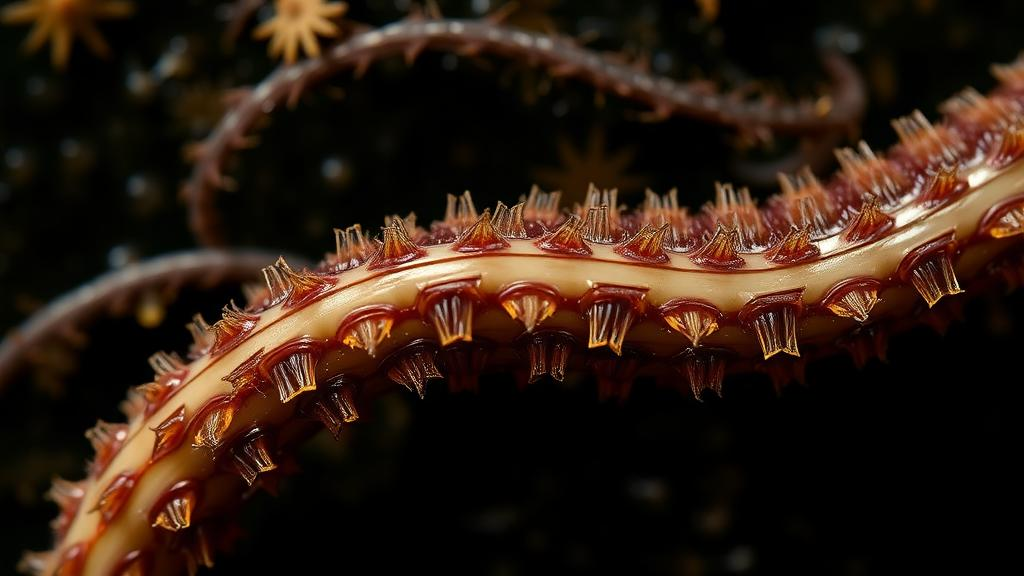
The medicinal leech Hirudinaria manillensis has long been prized in both traditional medicine and modern reconstructive surgery, yet the tiny animals raised in aquaculture facilities are vulnerable to a poorly understood disease whose microbial roots have remained murky. A new study published in Microbial Ecology by Kaiqing Liu, Dezhi Yang, Yuanhai Chen and colleagues at Kunming University and partner institutions set out to map what actually changes inside the leech gut when illness strikes. Their central finding is surprising: diseased leeches do not simply lose microbial diversity. Instead, the architecture of their gut communities shifts in subtler and arguably more consequential ways, with certain bacterial residents disappearing, interaction networks destabilizing, and a composite health index falling measurably.
The team used 16S rRNA amplicon sequencing, the workhorse technique of microbiome research, to profile the bacteria inhabiting the guts of healthy leeches and leeches showing characteristic disease symptoms. Rather than relying on traditional operational taxonomic units, the researchers worked with amplicon sequence variants, or ASVs, which offer finer resolution by distinguishing sequences that differ by even a single nucleotide. Across the dataset they detected 528 distinct ASVs. Of these, 232 were found only in healthy individuals and 173 only in diseased ones, a pattern that immediately suggested that sickness reshapes which microbes are present, even if it does not dramatically alter how many kinds are there.
That distinction became clear when the researchers ran the standard diversity statistics. Alpha diversity, which measures within-sample richness and evenness, showed no significant differences between healthy and diseased animals. Beta diversity analysis, which asks whether whole communities differ between groups, likewise revealed no overall separation, with an analysis of similarities returning an R value of just -0.0019 and a p value of 0.442. In plain terms, the gut communities of sick and healthy leeches overlap too much for a clean statistical split. There was, however, one telling clue: healthy individuals clustered more tightly together, hinting that disease loosens the constraints that normally keep a gut community within a predictable range.
To capture health-associated and disease-associated bacterial signatures in a single number, the team constructed a Gut Microbiome Health Index, or GMHI, modeled on similar indices developed for human microbiome studies. The index weighs the relative abundance of bacteria previously linked to healthy states against those linked to disease. When applied to the leech data, GMHI scores were significantly higher in healthy animals, and, crucially, the index outperformed the commonly used Shannon diversity metric in its ability to discriminate between the two groups. This is a technically meaningful result. It implies that the identity and roles of specific taxa carry more diagnostic signal than generic diversity measures, reinforcing a growing consensus in microbiome science that diversity alone is a blunt instrument.
The most conceptually innovative part of the study is its prevalence-based classification of gut taxa. Instead of treating all bacteria equally, the researchers sorted them by how consistently they appear across individuals. Persistent taxa, those found reliably in most animals, made up 57.9 percent of the healthy gut community but only 46.4 percent of the diseased one. That gap of more than eleven percentage points suggests that diseased leeches lose a portion of their stable microbial core, the dependable residents that likely perform essential functions such as aiding digestion, producing vitamins, or excluding pathogens. A community built on a shrunken core is, ecologically speaking, a community living closer to the edge.
Intermittent taxa, by contrast, are microbes that come and go between individuals, and the study flagged two genera in particular. Thomasclavelia and Desulfovibrio both showed nominal trends toward higher abundance in healthy leeches, with uncorrected p values of 0.034 and 0.020 respectively. The authors are careful to note, however, that these differences did not survive false discovery rate correction, the statistical safeguard that accounts for the many comparisons made in sequencing studies. Other dominant taxa showed no significant differences at all. This restraint matters. In an era when microbiome findings are often oversold, the team explicitly frames its work as descriptive, resisting the temptation to crown specific bacterial culprits before the evidence supports it.
Where the disease signal did emerge strongly was in the realm of microbial ecology rather than microbial identity. Co-occurrence network analysis, which maps the statistical relationships between pairs of taxa across samples, revealed destabilized interspecies interactions in diseased leeches. In healthy guts, microbial species tend to form structured webs of positive and negative associations that confer robustness, allowing the community to absorb perturbations without collapsing. In diseased animals, that web appears frayed, with weakened or scrambled connections indicating disrupted community robustness. Network destabilization of this kind is increasingly viewed as a hallmark of dysbiosis, the umbrella term for unhealthy shifts in microbial communities, and it can precede or accompany functional breakdown even when species counts look superficially normal.
Taken together, the study argues that disease in Hirudinaria manillensis is associated with functional and ecological shifts rather than simple diversity loss. The leech gut does not empty out when the animal sickens; it reorganizes, shedding persistent core members, tilting its balance of health- and disease-associated signatures as captured by GMHI, and losing the coherent interaction structure that stabilizes a mature community. For aquaculture, where diseased leeches represent direct economic losses, this reframing has practical implications. Monitoring programs that track only species richness could miss the earliest warning signs, whereas prevalence-based metrics and network-level indicators might detect destabilization before visible symptoms appear.
The authors are equally candid about the limits of their work. Because the study is cross-sectional, comparing healthy and diseased animals at a single point in time, it cannot establish whether the observed microbial shifts cause disease or merely accompany it. The team underscores the need for functional validation, for example metagenomic or culturing approaches that test what the shifting taxa actually do, and for longitudinal monitoring that follows individual leeches as health status changes. Such work would be required to establish causative links and to determine whether restoring persistent core taxa or stabilizing interaction networks could protect farmed leeches.
Even so, the study delivers a foundational dataset for an organism whose microbiome had been essentially uncharted in the context of disease, and it offers a methodological template that extends well beyond leeches. The combination of prevalence-based classification, a composite health index, and co-occurrence network analysis provides a richer diagnostic toolkit than diversity statistics alone, one that could be adapted to other aquaculture species and even to biomedical models. As microbiome research matures, the lesson from the medicinal leech is becoming a recurring theme across the field: what matters most is not how many microbes a host carries, but which ones persist, how they interact, and how gracefully the whole system bends under stress.
Subject of Research: Gut microbiota composition and dysbiosis in diseased medicinal leeches (Hirudinaria manillensis)
Article Title: Prevalence-Based Classification of Gut Microbiota in the Medicinal Leech Hirudinaria manillensis Reveals Differential Roles of Persistent and Intermittent Taxa in Disease Development
Article References: Prevalence-Based Classification of Gut Microbiota in the Medicinal Leech Hirudinaria manillensis Reveals Differential Roles of Persistent and Intermittent Taxa in Disease Development. (n.d.). https://doi.org/10.1007/s00248-026-02895-z
Image Credits: AI Generated
DOI: 10.1007/s00248-026-02895-z
Keywords: medicinal leech, Hirudinaria manillensis, gut microbiota, 16S rRNA sequencing, dysbiosis, persistent taxa, intermittent taxa, microbial ecology, co-occurrence network, Gut Microbiome Health Index, aquaculture, microbiome
News Source: Morgan Morrow. (October 14, 2026). Sick Leeches Keep Their Microbial Diversity but Lose Their Microbial Stability. Scienmag.