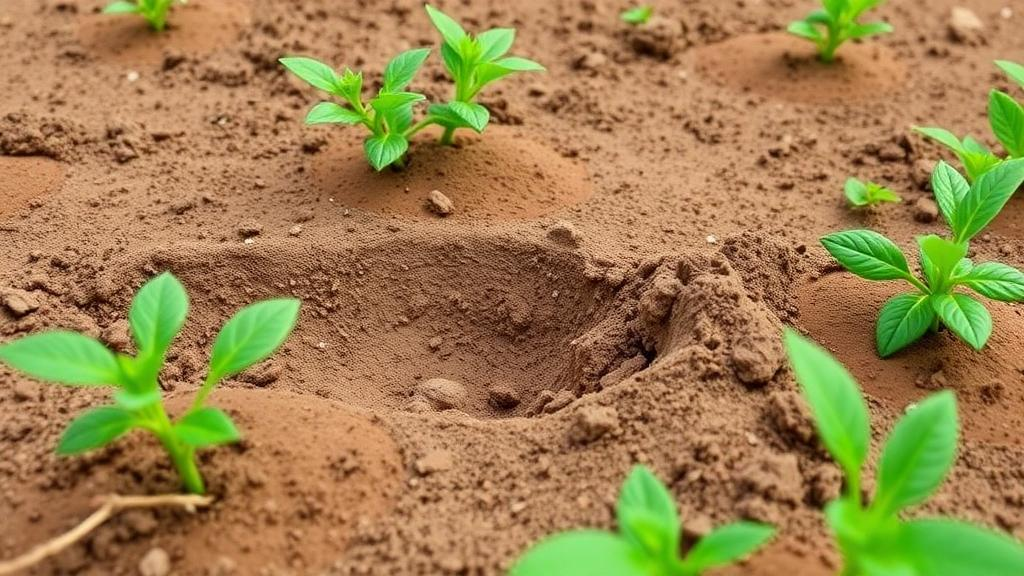
Farmers have long battled a hidden enemy beneath their fields: compacted subsoil that blocks roots from reaching the water and nutrients stored deep underground. Now, a team of German researchers has shown that a strikingly simple intervention—punching narrow vertical holes into the soil—can give crops a way through. In a two-year field experiment published in the journal Plant and Soil, Elron Wiedermann, Miriam Athmann, and Axel Don demonstrated that artificial macropores, created by pushing 10-millimeter steel rods 80 centimeters into the ground, significantly increased grain yields and transformed the way cereal roots explore the subsoil. The findings suggest a new strategy for restoring soil function on farmland degraded by decades of heavy machinery.
The scale of the problem is considerable. In Germany, roughly 51 percent of agricultural soils contain compacted layers within the top meter, with traffic-induced compaction concentrated between 30 and 50 centimeters deep. Compacted soil raises penetration resistance and limits oxygen diffusion, both of which impede root elongation. While topsoil compaction can be addressed by routine tillage, subsoil compaction persists for decades, quietly capping the productivity of fields across the temperate zone. Because subsoils can supply between 10 and 70 percent of the nutrients and up to 65 percent of the water a crop needs, cutting roots off from these reserves is a serious constraint on yield stability, particularly during drought.
Existing remedies fall short. Mechanical deep loosening temporarily reduces bulk density but often fails to produce lasting effects and leaves soil vulnerable to recompaction. Biological approaches, such as growing perennial crops like lucerne to generate natural biopores, take at least three years and sacrifice cash-crop revenue. Earthworms, nature’s own burrowers, are themselves constrained by high soil bulk density. The research team set out to test whether artificial macropores could sidestep these limitations, acting as ready-made channels that roots could use immediately.
The experiment was conducted at two sites in northern Germany with contrasting soils: a loamy sand near Schwerin and a silt loam near Adenstedt, both classified as stagnic Luvisols. In February 2024, the researchers established randomized, fourfold-replicated field trials in winter wheat at the tillering stage. Using steel rods and wooden templates, they manually created vertical pores of 10 millimeters in diameter to a depth of 80 centimeters at densities of 50, 100, and 200 pores per square meter. In total, more than 12,000 artificial pores were installed by hand. The trials were sampled in 2024 and again in 2025, with winter wheat grown at the silt loam site in both years and winter barley at the loamy sand site in the second year.
The yield results were clear. At the loamy sand site, 100 artificial pores per square meter increased grain yield by 9 to 15 percent, equivalent to 0.72 to 1.14 megagrams per hectare, compared with control plots containing only naturally occurring biopores. At the silt loam site, the same treatment raised yields by about 3 percent. Notably, the gains were larger on the more compacted loamy sand and in the drier year of 2025, when growing-season precipitation at the loamy sand site was 59 percent lower than in 2024. At the silt loam, yield rose on average by roughly 3 kilograms per hectare for each additional artificial pore per square meter, though the incremental benefit declined above densities of about 151 pores per square meter.
The mechanism behind these gains lies underground. Using the trench profile method combined with convolutional neural network-based image analysis—the researchers trained a RootPainter segmentation model on 200 images to quantify root length—the team found that artificial pores increased root length density in the subsoil by an average of 91 plus or minus 18 percent across both sites and years. In the 50-to-80-centimeter layer, root length density rose by 120 plus or minus 28 percent, and even below the pores, in the 80-to-100-centimeter layer, it increased by 101 plus or minus 34 percent. Root dry weight in the subsoil rose by about 10 percent under the 100-pore treatment, with significant increases of 16 percent at 50 to 80 centimeters and 13 percent at 80 to 100 centimeters.
Crucially, the roots were not simply trapped inside the artificial channels. Detailed image analysis of vertical strips centered on individual pores showed that roots grew along the pores and extended one to two centimeters into the surrounding bulk soil, with markedly intensified exploration below 50 centimeters and just beneath the lower end of the pores at 80 to 100 centimeters. This contrasts with earlier Australian observations where wheat roots in biopores were effectively imprisoned by impenetrable surrounding soil. The researchers attribute the difference to lower maximum bulk density at their sites, 1.68 grams per cubic centimeter on the loamy sand, and to the fact that roots bypassed the most compacted layer between 30 and 50 centimeters before re-entering the bulk soil below.
One of the study’s most surprising findings concerns root preference. The team had hypothesized that natural biopores, enriched with nutrients from earthworm casts and decayed roots, would be more attractive to roots than the sterile artificial pores. The opposite proved true: 86 plus or minus 1 percent of artificial pores were colonized by at least one root, compared with 72 plus or minus 1 percent of biopores. Artificial pores also contained 140 percent more pores hosting three roots and 280 percent more hosting four or more roots than biopores. The authors suggest that reduced penetration resistance and higher oxygen concentrations inside the perfectly vertical, structurally intact artificial channels matter more to roots than nutrient-enriched pore walls. Vertical pores also withstand traffic-induced pressure better than the inclined burrows of earthworms, preserving pore continuity and aeration.
The earthworm story adds an intriguing dimension. Four months after pore creation, 1.4 percent of artificial pores at the silt loam site were already colonized by the anecic earthworm Lumbricus terrestris, rising to 3.5 percent one year later. Earthworms still preferred natural biopores, being 3.4 times more likely to occupy them, but the rapid adoption of artificial channels hints at a positive feedback loop: earthworms may maintain and enrich the artificial pores over time, coating their walls with casts and connecting them to natural biopore networks. No decline in artificial pore density was detected over the one-and-a-half-year study period, and the authors expect the pores to persist for decades in loamy subsoils, though they caution that sandy or very clayey soils may not support such stability.
The implications extend beyond yield. Enhanced root biomass means more carbon input into subsoils, where organic carbon is typically scarce and newly added carbon persists longer, raising the prospect of what the authors call a win-win-win outcome for crop productivity, drought resilience, and soil carbon stocks. Because the measured bulk densities at both sites remained below critical thresholds for harmful compaction under European soil monitoring standards, the approach may benefit not only severely degraded headlands but ordinary loamy cropland as well. The researchers emphasize that open questions remain, including the economics of pore installation, optimal pore depth, and long-term effects across multiple seasons. But as climate change brings longer and more frequent droughts, the idea that a steel rod pushed into the ground can open a lifeline for crop roots offers a remarkably low-tech path toward more resilient agriculture.
Subject of Research: Field testing of artificial macropores as a subsoil melioration strategy to improve root access to compacted subsoils and increase crop productivity
Article Title: Artificial macropores increase crop productivity through improved root access to subsoils
Article References: Wiedermann, E., Athmann, M., & Don, A. (2026). Artificial macropores increase crop productivity through improved root access to subsoils. Plant and Soil. https://doi.org/10.1007/s11104-026-09016-2
Image Credits: AI Generated
DOI: 10.1007/s11104-026-09016-2
Keywords: artificial macropores, soil compaction, subsoil, root growth, root length density, crop yield, biopores, earthworms, drought resilience, soil melioration, winter wheat, deep learning image analysis
News Source: Alan Morgan. (October 14, 2026). Man-Made Soil Pores Boost Crop Yields by Helping Roots Break Through Compacted Ground. Scienmag.