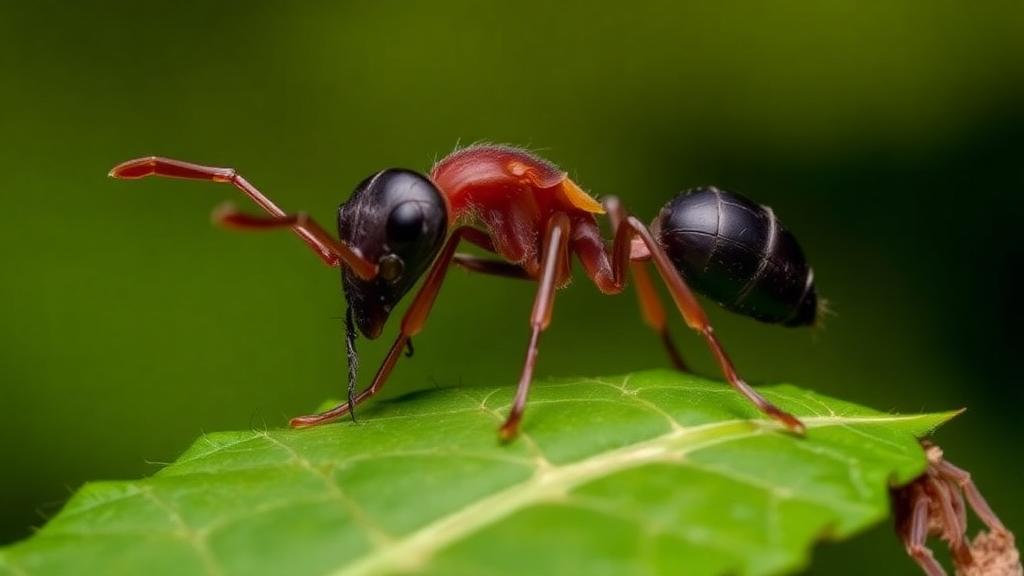
A tiny ant marching across the Australian bush navigates using a mental snapshot of the world around its nest. For decades, scientists have treated these visual memories as stable reference points, learned during a few careful learning walks and then carried unchanged through the animal’s life. A new study, published in the journal Animal Cognition, upends that picture. Researchers Leo Clement, Cody A. Freas and Antoine Wystrach report that navigating bull ants continuously revalue their visual memories while on the move, even when nothing in the environment changes, no reward appears or disappears, and the animal’s internal sense of distance and direction stays exactly the same. The findings suggest that insect memory is not a fixed archive but a dynamic, constantly edited system.
The central question the team set out to answer is deceptively simple. Insects can learn to associate particular locations with food, danger or home, and models of insect learning have typically treated this as a matter of discrete, reinforced events: a stimulus arrives, a reward follows, and a connection is strengthened. But navigation is different. An ant’s journey is a continuous behavioral process, punctuated only occasionally by meaningful events, while most of what the animal learns along the way is acquired latently, without any explicit reinforcement. Whether insects can keep updating their visual memories throughout this continuous process, rather than only at moments of reward or punishment, has been a stubborn open problem in insect cognition.
To attack the problem, the researchers used a trackball system, a laboratory apparatus in which a tethered ant walks on top of an air-cushioned ball whose rotations are recorded. The crucial feature of this setup is that it prevents visual progress. The ant can see a visual scene, typically the panoramic view surrounding its nest, and it can attempt to walk toward it, but its legs carry it nowhere. From the ant’s perspective, it is straining toward a goal that it can see but never reach. That unnatural impasse turns out to be an extraordinarily revealing probe of how the animal values what it sees.
What the team observed was a steady decline. When ants were placed on the trackball facing a view of their nest, they were initially attracted to it, orienting toward the familiar panorama. But over time, and without any change in motivation or any external reinforcement, that attraction weakened. The nest view simply stopped pulling the ants as strongly as it had before. The researchers interpret this gradual loss of attraction as a form of extinction: the slow fading of a response to a stimulus that, from the animal’s point of view, no longer delivers on what it once promised. Importantly, this decline unfolded as a continuous, time-dependent process rather than being triggered by any discrete event such as the omission of an expected reward.
The details of this decline are what make the study technically striking. First, the memory updates were view-specific: the change applied to the particular visual scene the ants had been exposed to, not to their navigational memories in general. Second, the effect was independent of the ants’ path integrator state, the internal odometer-and-compass system that lets desert and bull ants keep a running tally of their displacement from home. Whether the ants’ path integrator read a short trip or a long one made no difference to how their visual memories were revalued, showing that two of the insect’s major navigation systems, panoramic memory and path integration, operate with considerable independence. Third, and perhaps most importantly, the memory changes persisted for at least 24 hours, indicating that they engage long-term memory processes rather than being fleeting shifts in attention or arousal.
Then came the twist that gives the study its name. When the ants were given a brief exposure to a novel visual scene, one they had not seen before, their attraction to the nest view partially returned. The original memories had not been erased by the extinction-like process; they had been suppressed, and a short burst of novelty was enough to lift that suppression. The team describes this extinction-like process as labile, with the underlying memory preserved beneath it. In classic laboratory paradigms of extinction, from Pavlov’s dogs onward, the loss of a learned response typically depends on the omission of an expected reward, a prediction error that tells the animal its expectations have failed. Here, no such discrete trigger exists. The decline appears to run continuously, driven by time itself, while recovery is what depends on a discrete event: the detection of visual novelty.
The authors propose that these dynamics may be grounded in the architecture of the insect mushroom bodies, the paired brain structures long known to be central to learning, memory and sensory integration in insects. In their proposed model, parallel memory processes within the mushroom bodies interact to produce the observed pattern. One process tracks how long an animal has been exposed to a given view, generating a temporal estimate that gradually drives the extinction-like decline of that view’s attractiveness. A second process performs novelty detection, comparing incoming visual scenes against stored memories, and when a genuinely new scene is detected, it gates the recovery of the suppressed memories. The elegance of this arrangement is that it requires no special machinery beyond circuitry insects are already known to possess: mechanisms for comparing current sensory input with stored templates, and mechanisms for timing exposure.
The ecological logic of such a system is compelling. An ant’s visual world does not hold still. Vegetation grows, shadows shift, light changes with the time of day, and the panorama around the nest looks different from one season to the next. A navigator whose memories were truly static would steadily drift out of register with reality. A system that continuously down-weights views the animal has been staring at without progress, and that snaps memories back into relevance when something genuinely new appears, provides a plausible mechanism for keeping stored snapshots calibrated with the world. In effect, the ants seem to be doing the equivalent of quietly checking whether their map still matches the territory, and revising it on the fly.
The study also carries broader implications for how scientists think about learning in small brains. Current models of insect memory often confine modulations to discrete, reinforced events, precisely because those events are easy to define and easy to model. But the bull ant results suggest that a large share of memory updating happens outside that framework, woven into the ordinary continuous flow of behavior. Latent learning, the acquisition of information without reinforcement, has long been acknowledged in insects, and this work pushes the idea further: not only is information acquired latently, it is also revised latently, with memories gaining and losing value as a function of time and novelty rather than reward. That reframing moves extinction, traditionally a laboratory construct built on reward omission, into the natural behavioral stream of an animal simply trying to get home.
There are practical and conceptual consequences as well. For researchers who use visual memories in ants and other insects as model systems for spatial cognition, the message is that experimental exposures themselves change the animal: every minute an ant spends viewing a scene alters how much that scene will later attract it. For neuroscientists, the proposed split between a time-driven decline process and a novelty-gated recovery process offers a concrete, testable hypothesis about how parallel circuits in the mushroom bodies might implement something functionally resembling extinction and reinstatement without prediction-error signals of the classical kind. And for anyone captivated by the question of what a brain the size of a pinhead can do, the study adds a remarkable entry to the list: these ants appear to run a continuous background revision of their own memories, dimming the familiar when it stops paying off and rekindling it when the world presents something new. The suppressed original memories survive, waiting to be restored, which means an ant’s navigation system may be less like a photograph and more like a living document, annotated and re-annotated with every step of the journey.
Subject of Research: Dynamic updating and extinction of visual route memories in navigating bull ants
Article Title: Dynamic extinction and novelty-triggered recovery of visual route memories in ants
Article References: Dynamic extinction and novelty-triggered recovery of visual route memories in ants. (n.d.). https://doi.org/10.1007/s10071-026-02089-7
Image Credits: AI Generated
DOI: 10.1007/s10071-026-02089-7
Keywords: bull ants, visual navigation, memory extinction, novelty detection, mushroom bodies, long-term memory, latent learning, path integration, insect cognition, trackball, animal cognition, spatial memory
News Source: Gavin Prescott. (October 14, 2026). Ants Constantly Rewrite Their Visual Memories While Navigating, Study Finds. Scienmag.