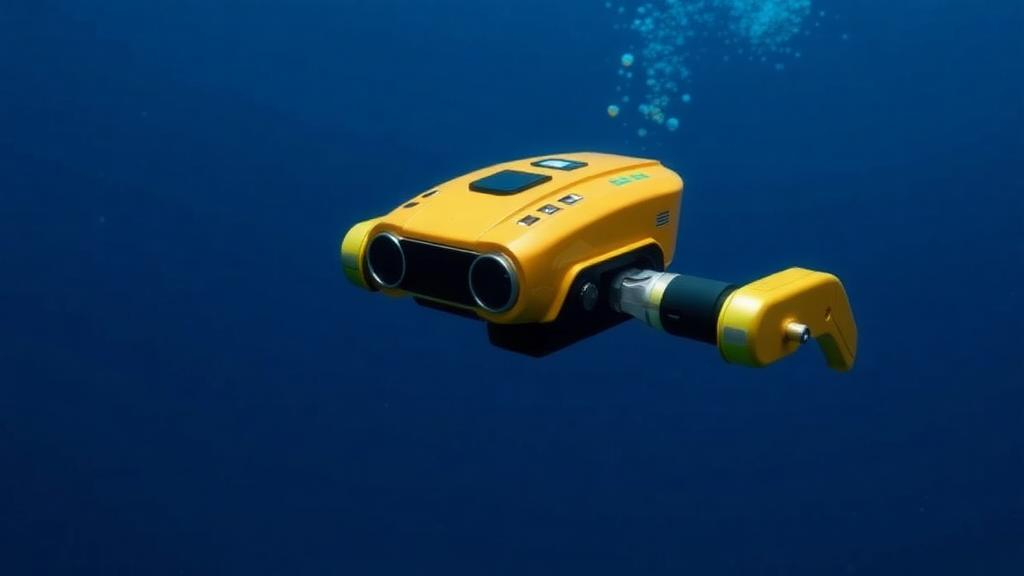
Underwater robots are having a moment. From mapping fragile deep-sea ecosystems to inspecting offshore wind turbines and hunting for missing aircraft on the ocean floor, unmanned underwater vehicles, or UUVs, are being asked to operate with more autonomy and precision than ever before. Yet the ocean is one of the most unforgiving environments in engineering: currents shift unpredictably, waves and vortices push and pull on the hull, and the hydrodynamic equations that describe how a vehicle moves are never known exactly. Now, a study published in Scientific Reports by Qinrong Li and Shiwei Wang of the Transport Planning and Research Institute under China’s Ministry of Transport presents a new control framework designed to keep these vehicles on course in three dimensions despite all of that uncertainty, while simultaneously cutting down on the computational churn that wears out their hardware.
The core challenge the researchers tackle is one that has dogged marine robotics for decades: the tracking control of underactuated underwater vehicles. A UUV is called underactuated because it has more degrees of freedom to control than it has independent actuators. A typical vehicle might be able to surge forward, yaw, and pitch using its propellers and fins, but it cannot directly command sideways sway or vertical heave. Those motions must emerge indirectly, orchestrated by clever control laws that exploit the vehicle’s dynamics. When the goal is to follow a precise three-dimensional path, say, a survey line over a coral reef or an inspection trajectory along a pipeline, the controller must coordinate all six degrees of motion through limited actuation, all while the model of the vehicle itself is imperfect and the environment keeps changing.
Li and Wang’s first innovation addresses the imperfection in the model. Real UUVs are plagued by what engineers call model uncertainties: unknown hydrodynamic coefficients, unmodeled lift and drag effects, shifting mass properties as payload changes, and nonlinear coupling between motions that textbooks often simplify away. To reconstruct these uncertain dynamics on the fly, the authors built what they call an adaptive PD-like composite neural network. Neural networks have long been used as universal approximators in control systems, capable of learning unknown functions from data in real time. But conventional adaptive neural networks can converge slowly, meaning the vehicle spends its first minutes in the water fumbling with a bad model. The composite structure introduced in this study blends the strengths of proportional-derivative control, a classic and reliable feedback technique, with neural approximation, and the authors report that it accelerates the learning process while improving the accuracy with which the uncertain dynamics are reconstructed. In practical terms, the vehicle figures out what the ocean is doing to it faster and with less residual error.
The second pillar of the framework is a disturbance observer equipped with what the researchers describe as a gain iteration protocol. External disturbances, such as currents, wave-induced forces, and turbulence from nearby structures, are a constant menace to underwater tracking. The standard engineering response is a disturbance observer, a software module that estimates the unwanted force acting on the vehicle so the controller can cancel it out. The problem is that most observers rely on fixed gains, constants chosen in advance by the designer. A gain set too low yields sluggish, inaccurate estimates; a gain set too high amplifies measurement noise and can destabilize the loop. Because the true disturbance intensity varies with sea state and depth, no fixed value is right for all conditions. The observers designed by Li and Wang instead adjust their gains dynamically through an iterative protocol, tuning themselves as they go. According to the paper, this adaptive iteration achieves more accurate disturbance estimation and strengthens the overall robustness of the UUV system, allowing the vehicle to shrug off environmental forces that would push a conventional design off track.
The third pillar is perhaps the most quietly consequential: a dynamic periodic event-triggered control protocol. In conventional digital control, the computer re-computes the actuator command at every fixed sampling instant, thousands of times per minute, whether or not anything has changed. That relentless updating has costs. It consumes processor cycles and communication bandwidth, and in underwater vehicles it translates into frequent actuator adjustments that accelerate mechanical wear on propellers, thruster gimbals, and seals. Event-triggered control flips the logic: the controller updates the command only when a specified error condition indicates an update is genuinely needed. The twist in Li and Wang’s design is that it is both dynamic, meaning the triggering threshold itself evolves over time with an internal auxiliary variable, and periodic, meaning the trigger is checked at regular sampling intervals. This combination, the authors note, inherently precludes Zeno behavior, a pathological condition in which an event-triggered system updates infinitely often in a finite interval of time, something no physical actuator could survive. Guaranteeing a positive minimum time between updates is a mathematical seal of practicality.
Putting the pieces together, the researchers formulated a novel adaptive PD-like composite neural control law that integrates the iterative disturbance observer and the dynamic periodic event-triggered protocol into a single closed-loop system. The neural network handles the unknown dynamics, the observer cancels the measured disturbances, and the event-triggered mechanism decides when the control signal actually needs refreshing, sparing the actuators unnecessary work. To prove that this elaborate machinery does not fall apart in practice, the authors turned to Lyapunov theory, the standard mathematical tool for establishing stability in nonlinear systems. By constructing an energy-like function that decreases along the system’s trajectories, they demonstrated that all signals within the closed-loop control system remain bounded, the technical guarantee that the vehicle’s states, the neural network weights, the observer estimates, and the control inputs cannot blow up to infinity. Boundedness is the gold-standard certificate that a nonlinear controller is safe to deploy.
Simulation results reported in the paper substantiate the effectiveness and feasibility of the proposed strategy, showing that the vehicle can track desired three-dimensional trajectories under model uncertainty, external disturbance, and actuator degradation caused by mechanical wear. That last factor, wear, deserves emphasis. Actuator mechanical degradation is an underappreciated failure mode in long-endurance missions: as thrusters age, their response degrades in ways that are difficult to model and predict. By combining an event-triggered protocol that reduces actuator activity with adaptive components that accommodate changing dynamics, the framework is explicitly built to extend the operational life of the hardware, not just the accuracy of the trajectory.
Why does this matter beyond the control-theory community? Because every gain in efficiency and reliability compounds across the rapidly growing fleet of underwater robots. Battery capacity is the binding constraint on UUV endurance, and every redundant actuator adjustment drains it. Communication underwater is precious, often bottlenecked through low-bandwidth acoustic links, and event-triggered updating reduces the volume of control signaling. Maintenance intervals for subsea vehicles are costly, often requiring recovery to a surface vessel, so reducing wear directly reduces operational expense. A controller that learns the vehicle’s uncertain dynamics quickly, estimates disturbances accurately as they evolve, and updates commands only when necessary touches all three of those levers at once. The authors received no external funding for the research, and the work is published open access under a Creative Commons license, making the full technical details freely available to the engineering community.
The framework also reflects a broader convergence in robotics: the marriage of learning-based components with rigorous stability guarantees. Pure machine-learning controllers can be powerful but opaque, while classical robust controllers are provably safe but often conservative. Composite designs like this one, in which a neural network approximates unknown dynamics inside a Lyapunov-certified architecture, aim to capture the best of both worlds. The adaptive PD-like composite network, the iteratively tuned observer, and the dynamic periodic event trigger each represent a piece of that synthesis, and their integration for underactuated vehicles in three-dimensional tracking is what distinguishes this contribution.
There remain, of course, the usual caveats that separate simulation from the sea. The results in the paper are substantiated through simulation, and real deployments will bring sensor noise, actuator saturation, communication dropouts, and conditions harsher than any test bed. Nonetheless, the mathematical guarantees of bounded signals and the built-in immunity to Zeno behavior give the approach a solid foundation for the transition to field trials. As ocean industries expand, from offshore renewable energy to deep-sea mining surveys and marine conservation monitoring, the demand for vehicles that can follow demanding 3D paths accurately, efficiently, and for years at a time will only grow. Control frameworks like the one from Li and Wang are the kind of unglamorous but essential engineering that will determine whether the autonomous ocean of the near future operates smoothly, or spends its time drifting off course.
Subject of Research: Dynamic periodic event-triggered adaptive PD-like composite neural control with iterative disturbance observer for 3D tracking of UUVs
Article Title: Dynamic periodic event-triggered adaptive PD-like composite neural control with iterative disturbance observer for 3D tracking of UUVs
Article References: Li, Q., & Wang, S. (2026). Dynamic periodic event-triggered adaptive PD-like composite neural control with iterative disturbance observer for 3D tracking of UUVs. Scientific Reports. https://doi.org/10.1038/s41598-026-72808-0
Image Credits: AI Generated
DOI: 10.1038/s41598-026-72808-0
Keywords: Dynamic, periodic, event-triggered, adaptive, PD-like, composite, neural, control, iterative, disturbance, observer, tracking
News Source: Denise Maddox. (October 14, 2026). Smarter Neural Control Promises Sharper, Energy-Efficient 3D Tracking for Underwater Robots. Scienmag.