Every digital image that has ever been photographed, scanned, or generated is, at heart, a grid of numbers. Each pixel stores three values for red, green, and blue, and conventional image processing treats these numbers as little more than coordinates in an abstract color space. A new study published in Multimedia Tools and Applications argues that this flat, purely numerical view leaves something important on the table: geometry. Researchers Sanad Aburass, Osama Dorgham, and Maha Abu Rumman propose reimagining each pixel as a three-dimensional solid, a construct they call a Cubixel, in which the red, green, and blue channel values are transformed into the physical edge lengths of a cuboid. What emerges from this seemingly simple shift is a volumetric language for describing images, one in which color relationships acquire shape, size, and spatial consequence.
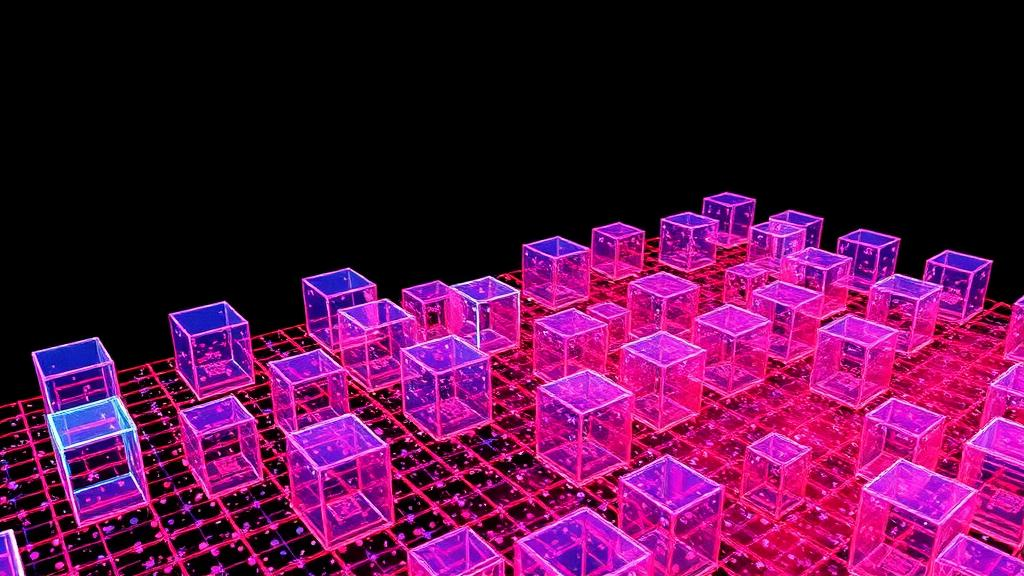
The core idea is easiest to grasp through an analogy the authors themselves embrace. Once every pixel becomes a cuboid whose dimensions are set by its color intensities, an entire image can be read as a dense urban landscape, a so-called Cubixel City, in which bright pixels tower like skyscrapers and dark pixels flatten into low structures. Crucially, the gaps between neighboring cuboids are not wasted space. The researchers define the volume of these empty regions, which they term the Volume of Void or VoV, as a direct measure of spatial discontinuity. Where two adjacent Cubixels differ sharply in color, their volumes diverge and the void between them swells; where the image is smooth, the structures nest together and the void nearly vanishes. In this way, a quantity that most representations simply ignore becomes a rich, physically motivated signal.
To exploit that signal, the team built two complementary frameworks. The first, the Cubixel City Exploration Framework, or CCEF, is designed for feature extraction and classification. Rather than scanning the image with uniform filters, CCEF deploys a deterministic exploration strategy that actively traverses regions of high discontinuity, following corridors where voids accumulate. This behavior echoes ideas from agent-based modeling, where an autonomous explorer balances systematic coverage against targeted investigation, and it draws conceptual kinship with saliency and attention models that direct computational effort toward the most informative parts of a scene. As the explorer moves through the Cubixel City, it constructs hybrid feature maps that fuse local void intensity, a fine-grained measure of geometric disruption, with a global record of the traversal pathway itself.
Those hybrid maps are then fed to a conventional convolutional neural network for classification. The pairing is deliberate: the CNN supplies the statistical learning machinery, while the Cubixel representation supplies a geometry-aware prior that tells the network where the image’s structural tensions lie. The authors are careful to frame the work as conceptual and foundational rather than benchmark-driven. Their empirical evaluation uses MNIST, the classic dataset of handwritten digits, and CIFAR-10, a more demanding collection of small natural images, as proof-of-concept tests. On MNIST, where the shapes are simple, high-contrast, and nearly binary, the CCEF pipeline generalizes strongly, suggesting that void-based features capture the essential strokes and contours of digit forms with remarkable economy.
CIFAR-10 tells a more cautionary tale. Natural photographs contain textured backgrounds, gradual gradients, and complex object boundaries, and the evaluation revealed signs of overfitting when the framework was applied to this harder domain. The authors report this transparently, and they connect the observation to their earlier work on quantifying overfitting through a dedicated Overfitting Index. Rather than treating the result as a failure, they present it as diagnostic information: the geometric features that discriminate digits so cleanly may, on richer imagery, latch onto idiosyncratic void patterns that do not transfer across the training and test splits. Understanding when a geometry-first representation helps and when it hurts is, in their view, exactly the kind of question this foundational stage of research is meant to surface.
The second framework extends the same geometric intuition from analysis to synthesis. Cubixel-GAN is a generative adversarial network, the now-standard architecture in which a generator produces images and a discriminator tries to distinguish them from real examples, augmented with a VoV-based regularization term woven directly into the generator’s loss function. The regularizer penalizes spatial inconsistency between adjacent pixels, expressed through the void volumes in their Cubixel interpretation. In effect, the generator is nudged to produce images whose neighboring colors cohere geometrically, discouraging the noisy, patchy artifacts that plague adversarial training. The inspiration recalls classical total variation regularization, long used in image denoising, but recast in the vocabulary of volumetric color solids rather than raw intensity differences.
During training, the researchers observed progressive stabilization of both generator and discriminator losses, alongside generated samples that grew steadily more coherent over successive epochs. This trajectory, documented on the same MNIST and CIFAR-10 benchmarks, indicates that the VoV term behaves as intended: it does not derail the delicate adversarial equilibrium but instead appears to smooth the generator’s path toward plausible imagery. The authors emphasize that these are early, qualitative signals rather than state-of-the-art scores. Generative adversarial networks are notoriously sensitive to regularization choices, with a large literature devoted to stabilizing techniques such as Wasserstein distances, spectral normalization, and perceptual losses. Cubixel-GAN adds a geometric entry to that toolbox, and its full competitive standing remains a question for future benchmarked implementations.
What makes the work intellectually provocative is the way it reconnects image processing with ideas that predate digital cameras entirely. The treatment of color as a measurable, geometric quantity has deep roots, from the color gamut transformations that shaped early computer graphics to perceptually calibrated color-difference formulas used in industry. Edge detection, likewise, has always been about finding discontinuities, from Canny’s classical operator to gradients computed across multi-channel images and modern holistically-nested deep detectors. The Cubixel approach can be read as a unifying gesture: it makes discontinuity a volume, an actual three-dimensional quantity, rather than a derivative or a difference score. That reframing may sound like bookkeeping, but representational choices in machine learning frequently prove consequential, as the history of convolutional, attention-based, and transformer architectures attests.
The study also sits within a broader effort by the same research community to bring geometry and deep learning into closer conversation, including prior work introducing the Cubixel paradigm itself and comprehensive reviews of vision transformers in medical imaging. The potential application space sketched by this line of research is broad. Volumetric color representations could inform medical image analysis, where boundaries between tissue types are literally structures, or satellite and geospatial imaging, where geometric coherence across regions carries real semantic weight. In generative settings, geometry-aware regularization might one day help constrain deepfake synthesis or improve the fidelity of images generated for data augmentation in domains where labeled data is scarce.
For now, the appropriate response is informed enthusiasm tempered by the authors’ own candor. The experiments are deliberately modest in scale, the benchmarks are standard rather than cutting-edge, and the paper positions itself as laying groundwork rather than claiming victories. Yet the underlying question it raises is genuinely fundamental: should images be treated as arrays of numbers, or as objects with shape? By building both an analytical framework and a generative one on the answer that images are, in a meaningful sense, sculptures of color, the researchers have opened a line of inquiry that others can now optimize, benchmark, and stress-test. If geometry-aware representations mature as the authors hope, the humble pixel may never look quite so flat again.
Subject of Research: Volumetric Cubixel representation of RGB pixels for geometry-aware image feature extraction and generative synthesis
Article Title: Cubixel geometry meets deep learning: feature discovery and image synthesis with volume of void
Article References: Cubixel geometry meets deep learning: feature discovery and image synthesis with volume of void. (n.d.). https://doi.org/10.1007/s11042-026-21977-1
Image Credits: AI Generated
DOI: 10.1007/s11042-026-21977-1
Keywords: Cubixel, Volume of Void, image processing, generative adversarial networks, convolutional neural networks, feature extraction, computer vision, volumetric color representation, MNIST, CIFAR-10, deep learning, regularization
News Source: Blake Davidson. (October 14, 2026). Pixels Become Cuboids: Turning RGB Values Into 3D Blocks Helps AI See and Draw. Scienmag.