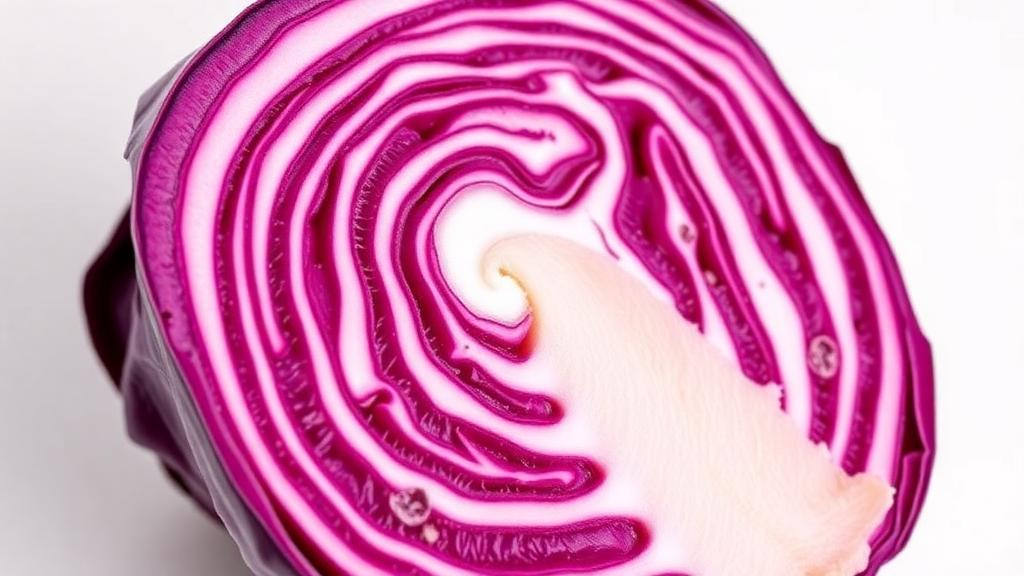
A small label made from red cabbage and apple pectin could soon tell shoppers and retailers whether the chicken in a sealed pack is still fresh, without opening the container, scanning a chip, or running a single laboratory test. Researchers at Bu-Ali Sina University in Hamedan, Iran, have developed a lightweight, highly porous aerogel indicator that changes color as meat spoils, and their results, published in Food Chemistry: X, show that the simplest formulation tracked microbial and chemical spoilage more faithfully than denser versions of the same material. The work sits at the intersection of two growing trends: the push to replace synthetic dyes in food packaging with edible, plant-derived pigments, and the search for solid support matrices that make those pigments respond faster and more dramatically to the gases that spoilage releases.
The logic behind the indicator rests on the peculiar chemistry of anthocyanins, the water-soluble pigments that give red cabbage its deep color. Anthocyanins are molecular chameleons: their structure, and therefore their color, shifts with the acidity of their surroundings. In acidic conditions the pigment exists mainly as a flavylium cation, producing a rose-red hue. As pH rises toward neutral, the molecule equilibrates among several forms, including the quinoidal base and carbinol pseudo base. Above pH 7, deprotonation generates quinoidal structures with extended conjugation that shift absorbed light toward longer wavelengths, and under strongly alkaline conditions the pyran ring cleaves and rearranges into yellow chalcones. The team confirmed this behavior spectroscopically, measuring the total anthocyanin content of their dried cabbage powder at 18.90 milligrams of cyanidin-3-glucoside equivalents per gram of dry matter, and observing the absorption maximum of their extract drift from roughly 500 nanometers under acidic conditions to 600 nanometers as pH climbed from 3 to 12.
Red cabbage is an attractive pigment source because it is cheap, edible, and richer in anthocyanins than many alternative plants, which matters when the indicator will sit inside a food package where dye migration is a safety concern. Synthetic pH dyes can volatilize or leach into food matrices, so natural colorants have become the preferred option for intelligent packaging. But a pigment alone is not enough; it needs a physical platform that exposes it to the air inside the package while holding it in place. The Iranian team chose pectin, the plant polysaccharide best known for setting jam, as that platform. Pectin is built from alpha-1,4-linked D-galacturonic acid units, and its degree of esterification governs how it gels and holds water, allowing it to form the layered macroporous structures needed for aerogel fabrication.
Aerogels are among the lightest solid materials known, produced by replacing the liquid in a gel with gas while preserving the three-dimensional polymer network. To make theirs, the researchers dissolved apple pectin at concentrations of 10, 15, and 20 percent weight per volume, mixed in a diluted red cabbage extract, cast the solutions into molds, froze them in liquid nitrogen, and freeze-dried them at minus 80 degrees Celsius for 48 hours. The resulting indicators were extraordinarily porous: bulk densities ranged from 0.074 to 0.139 grams per cubic centimeter, with porosity between 90 and 95 percent. That internal free volume is the point. A highly porous network adsorbs and retains volatile spoilage gases efficiently, accumulating them near the embedded anthocyanins and amplifying the color response.
The formulation details turned out to matter enormously. Increasing the pectin concentration produced a denser, more cross-linked network: porosity fell, moisture absorption dropped from 16.1 percent to 7.9 percent, and the aerogels became harder, more cohesive, and less springy in texture analysis. Adding the red cabbage extract reinforced this trend, because hydrogen bonding between anthocyanin molecules and pectin chains packed the polymer network more tightly. Fourier-transform infrared spectroscopy revealed the signature of these interactions: the hydroxyl stretching band broadened and shifted to lower wavenumbers in loaded aerogels, while a band near 1623 per centimeter, assigned to the aromatic carbon-carbon skeletons of anthocyanin rings, grew in intensity, confirming that the pigment was genuinely integrated into the matrix rather than merely sitting on its surface. X-ray diffraction showed increased crystallinity in the loaded samples, consistent with closer molecular packing.
When the team exposed the loaded aerogels to ammonia vapor, a stand-in for the volatile bases that escaping from spoiling meat, the materials shifted from red to purple in a time-dependent manner. After 30 minutes of exposure, the 10 percent pectin formulation registered the largest total color difference, a delta E of 27.79, compared with 24.20 for the 15 percent version and 19.95 for the 20 percent version. The explanation is straightforward physics: the denser networks at higher pectin concentrations restricted ammonia diffusion and slowed the anthocyanins’ structural transformation. The 10 percent aerogel, with its lower polymer density, higher porosity, and greater anthocyanin accessibility relative to its pectin content, let the gas reach the pigment fastest and most completely.
The real test came with actual chicken. The researchers sealed 40-gram skinless chicken samples in oriented polypropylene containers, attached the aerogel labels to the inner upper surface without direct meat contact, and stored everything at 4 degrees Celsius for 12 days, measuring pH, total volatile basic nitrogen, lipid oxidation, bacterial counts, and sensory qualities along the way. The meat started fresh, with 3.76 log colony-forming units per gram of total viable count, a pH of 5.25, and TVB-N of 9.6 milligrams of nitrogen per 100 grams. By day 8, those values had reached 7.01 log CFU per gram, 6.577, and 25.61 milligrams per 100 grams respectively, crossing the accepted spoilage thresholds for raw chicken fillets, while odor scores from trained panelists collapsed to the minimum of the hedonic scale.
The labels told the same story in color. The 10 percent pectin indicator transitioned from purple on day 0 to purplish-blue by day 6, marking semi-fresh meat, and turned green during days 8 through 12, signaling advanced spoilage. The 15 and 20 percent formulations lagged, turning purplish-blue on day 8 and green only during days 10 through 12. Critically, the team went beyond visual impressions and ran statistical analyses to determine whether the measured color change could serve as an objective spoilage metric. After controlling for storage time, only the 10 percent pectin aerogel showed significant partial correlations between its delta E values and the key spoilage indicators, total viable count and TVB-N, as well as sensory attributes including color, texture, and overall acceptability. Receiver operating characteristic analysis then established delta E cut-off values of 25.8, 16.9, and 11.1 for the 10, 15, and 20 percent formulations against the microbiological and chemical spoilage thresholds.
Those numbers carry practical weight. A delta E above 5 is generally considered the threshold at which a color change becomes visible to the naked eye, so a cut-off of 25.8 for the best formulation means the label’s color shift is not subtle; it is unmistakable. Because the indicator works passively, responding to the ammonia and other alkaline nitrogenous compounds that protein-degrading bacteria release into the package headspace, it requires no electronics, no reader device, and no cold-chain data infrastructure. A consumer, an inspector, or a warehouse camera could in principle read it. The researchers note that the anthocyanin-to-pectin ratio directly controls both the magnitude of the color response and the delta E threshold at which spoilage is flagged, which suggests the technology can be tuned for different foods and spoilage chemistries.
The study also contributes a useful design principle for the broader field of halochromic food sensors: the support matrix is not a passive carrier but an active determinant of sensitivity. Three-dimensional porous networks enhance sensing performance, but only up to the point where the matrix remains open enough for gases to diffuse. Too much polymer, and the indicator goes blind; too little, and the structure may lack the mechanical integrity to survive handling. The pectin aerogels’ combination of low density, high porosity, and anthocyanin-stabilized mechanical strength appears to hit a workable balance, and the fact that every component, from the cabbage pigment to the fruit-derived polysaccharide, is food-safe removes the migration concerns that have limited synthetic dye indicators. Whether such labels can be manufactured at scale, and whether their response holds up under the temperature fluctuations of real supply chains, remain questions for future work, but the demonstration that a simple, edible aerogel can quantitatively track chicken spoilage in real time marks a concrete step toward packaging that speaks for the food it protects.
Subject of Research: Pectin aerogel colorimetric indicators with red cabbage anthocyanins for real-time monitoring of chicken meat freshness
Article Title: Evaluation of intelligent aerogel indicators composed of red cabbage extract and pectin for monitoring chicken meat freshness
Article References: Shirkhani, H., Emamifar, A., & Davati, N. (2026). Evaluation of intelligent aerogel indicators composed of red cabbage extract and pectin for monitoring chicken meat freshness. Food Chemistry: X, Article 104615. https://doi.org/10.1016/j.fochx.2026.104615
Image Credits: AI Generated
DOI: 10.1016/j.fochx.2026.104615
Keywords: intelligent packaging, aerogel, anthocyanins, red cabbage extract, pectin, chicken meat freshness, colorimetric indicator, food spoilage, TVB-N, total viable count, freeze-drying, halochromic sensor
News Source: Bethany Barker. (October 13, 2026). Red Cabbage Aerogel Labels Turn Color to Reveal When Chicken Goes Bad. Scienmag.