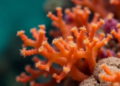
Credit: Figure provided by lead author Tyler Pavlowich
A Dartmouth study of spearfishing on a Caribbean coral reef illustrates how understanding the process of fishing can help in developing management strategies to address overfishing and coral reef protection worldwide. Understanding which fish are targeted, when, why and where in a coral reef habitat, are important details that extend beyond catch limits or even bans that so often define fishing regulations. The findings are published in PLOS ONE.
This study examines spearfishing in a rural village in northwest Dominican Republic, where this type of artisanal fishing serves as the main source of livelihood for residents in this community and throughout the Caribbean. In coral reefs and seagrass beds, finfish such as parrotfish, grouper and grunt, and invertebrates such as lobster, conch and crab, are among the species that are highly sought after, for their market value in addition to fulfilling subsistence needs.
Parrotfish are a staple in Dominicans' diet but they also play a vital role in the health of coral reefs, as these herbivores eat macroalgae or large algae that compete with coral, and help prevent algae from overgrowing, which could smother coral and take over reefs.
Spearfishing may be one of the most selective fishing methods, as fishers have up until the last possible second to determine which fish to target. Using cameras mounted onto spearguns, researchers investigated the differences between fishers who free dove (in waters less than 10 meters deep), and those who dove with compressed air (in waters between 10 and 35 meters deep), to see how the different equipment affects which fish are targeted. By analyzing video footage, the different types of fish observed and caught were catalogued, and classified by market value, along with other data documenting fishers' decision-making.
Compressor divers encountered more higher quality fish, caught each fish more efficiently, and caught 69 percent of the fish that they targeted or 28 percent more than freedivers. It is likely that compressor divers encountered more fish given that they had access to deeper reefs.
Parrotfish were targeted the most. Even though they did not fall into the highest market value category, parrotfish accounted for nearly half of the encounters in which no other types of fish were present, or 40 percent of such opportunities for compressor divers and 50 percent for freedivers.
"Spearfishing underlies the economic and social organization of this community, but also degrades fishery resources when left unmanaged," says lead author Tyler Pavlowich, a Ph.D. candidate in the ecology, evolution, ecosystems and society graduate program at Dartmouth.
In considering management strategies to protect parrotfish populations from overfishing on coral reefs, the data illustrate how an outright ban on parrotfish could severely eliminate opportunities for fishers. Prohibiting compressor diving, another option being considered, would also inherently limit fishers' opportunities and restrict how many fish they can catch. This study helps inform the difficult decisions of how to restrict fishing to safeguard ecosystems without imparting undue hardship for fishers.
To help ensure the health of marine ecosystems, last month, the Dominican Republic government issued a two year ban on the capture and commercialization of parrotfish, as well as prohibitions on catching long spine urchin (another important herbivore on reefs) and all sharks and rays. Whether the ban can be effectively enforced remains to be seen, as a lack of resources often makes enforcement)measures challenging.
The study is part of Pavlowich's dissertation, which also explores possible fishery management strategies that take into account the life-history of stoplight parrotfish, an ecologically- and economically-important parrotfish species, as well as other options for fishing restrictions in the area. It is an ongoing collaboration with members of the Buen Hombre community and with AgroFrontera, a non-governmental organization in the Dominican Republic, which is working to address sustainable agriculture and sustainable fisheries in the country.
Lead author Tyler Pavlowich is available for comment at: [email protected]. Anne Kapuscinski, professor of environmental studies and the Sherman Fairchild Distinguished Professor in Sustainability Science, served as the study's co-author.
###
Broadcast studios: Dartmouth has TV and radio studios available for interviews. For more information, visit: http://communications.dartmouth.edu/media/broadcast-studios.
Media Contact
Amy D. Olson
[email protected]
603-646-3274
@dartmouth
http://www.dartmouth.edu