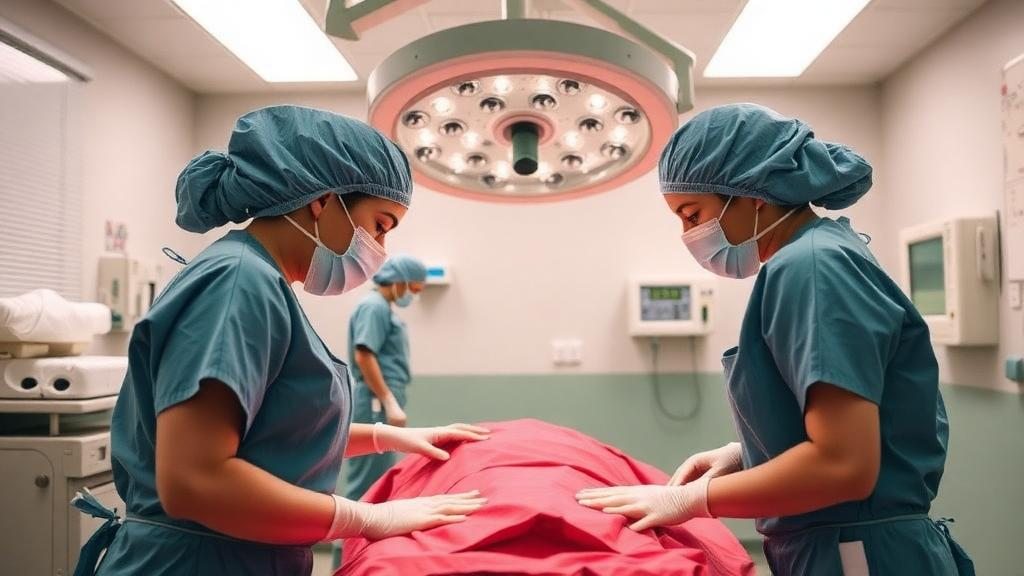
The operating room is one of the most unforgiving environments in modern healthcare. It is a place where a single misplaced instrument can alter a patient’s outcome, where the hierarchy is visible in every command, and where the walls physically seal a small team off from the rest of the hospital. For newly graduated nurses, stepping into this world is a professional trial by fire, and a new qualitative study from China now offers one of the most detailed portraits yet of how these novices actually survive the transition. The research, published in BMC Nursing by a team at Shengjing Hospital of China Medical University in Shenyang, argues that career adaptability among operating room nurses is not a fixed personality trait but a dynamic process shaped by the peculiar physics of the surgical suite itself.
The study was grounded in an integrated theoretical framework that combines transition shock theory with career construction theory. Transition shock describes the disorientation that occurs when nursing students cross the boundary into independent practice, a period in which academic knowledge collides with the raw demands of clinical reality. Career construction theory, developed within vocational psychology, frames individuals as active authors of their own working lives, building identity and meaning through the stories they tell about their roles. By fusing these two perspectives, the researchers were able to examine adaptation as a dual process: novices must simultaneously endure the stress of transition and actively construct a professional identity that fits the operating room’s distinctive culture.
Methodologically, the team chose a descriptive phenomenological design, an approach specifically engineered to capture lived experience in its own terms. Between May and November 2024, the researchers conducted semi-structured, face-to-face interviews with 15 newly graduated nurses working in the operating rooms of a tertiary hospital in Northeast China. Participants were recruited through purposive sampling, a technique in which researchers deliberately select individuals who have direct experience of the phenomenon under investigation, and recruitment continued until data saturation was reached, meaning that additional interviews no longer produced new themes. The interview transcripts were then analyzed using Colaizzi’s seven-step method, a rigorous qualitative procedure that moves from reading the raw accounts to extracting significant statements, formulating meanings, clustering themes, and finally validating the resulting structure with participants themselves.
What emerged from the analysis was a six-factor map of the forces acting on these young professionals. The first factor, individual characteristics, encompasses the psychological resources each nurse brings through the door: resilience, self-efficacy, and the capacity for emotional regulation. The second, professional competence development, reflects the steep technical learning curve of perioperative practice, from instrument handling and sterile technique to anticipating the needs of surgeons mid-procedure. The third factor, professional identity and role perception, captures how novices understand what it means to be an operating room nurse rather than a general ward nurse, a distinction that carries real consequences for motivation and belonging.
The remaining three factors are largely environmental, and this is where the study makes its most distinctive contribution. Workplace-specific stressors and risks include the high stakes of surgical care, the demand for absolute precision, and the exposure to occupational hazards ranging from sharps injuries to radiation. Workplace interpersonal relationships describe the dense web of surgeons, anesthesiologists, senior nurses, and technicians on whom novices depend, and whose approval often determines whether a newcomer feels welcomed or invisible. Finally, the organizational environment, including staffing, scheduling, and institutional culture, forms the backdrop against which all other factors play out. The authors describe the operating room through three evocative properties: its material density, the sheer concentration of instruments, equipment, and technology; its authority visibility, the way surgical hierarchies are on open display; and its spatial confinement, the physical isolation of a sealed suite cut off from the wider hospital.
These properties matter because they change the adaptation trajectory itself. A new nurse on a general medical ward can retreat to a corridor, consult a colleague on another unit, or gradually build confidence across a diffuse set of tasks. In the operating room, the novice is embedded in a tightly choreographed team from the first day, where errors are immediately visible and where the emotional temperature is set by the surgeon at the table. The study suggests that this combination of density, hierarchy, and confinement amplifies transition shock, making the operating room a qualitatively different adaptation challenge rather than simply a harder version of ward nursing.
Yet the research is not merely a catalogue of difficulties. Alongside the six influencing factors, the analysis identified four key categories of improvement measures that nurses deploy to build adaptability. The first is self-adjustment, the internal work of reframing setbacks, managing anxiety, and setting incremental goals. The second is proactive communication and skill enhancement, in which novices deliberately seek feedback, ask questions despite the risk of appearing inexperienced, and invest extra hours in mastering technical routines. The third and fourth categories involve building support networks, both informal peer relationships and mentoring bonds, and perceiving organizational support through structured training programs that signal the institution’s investment in their growth.
The interplay between these individual strategies and organizational structures is the study’s central practical lesson. Adaptation, the authors conclude, relies not only on personal psychological resources and proactive identity construction but also on a multi-layered, healthy work ecosystem. Systematic training gives novices a scaffold for competence; supportive interpersonal relationships buffer the emotional shocks of early practice; and an inclusive organizational culture legitimizes the act of asking for help. Where any of these layers is missing, the burden falls disproportionately on the individual nurse, and the risk of burnout, dissatisfaction, and eventual attrition rises sharply.
The findings arrive at a moment when nursing workforce stability has become a global concern. Health systems worldwide are contending with shortages and high turnover among early-career nurses, and the first years of practice are consistently identified as the period of greatest vulnerability. Most existing research on transition shock has focused on general ward settings, leaving specialty environments like the operating room understudied despite their demanding nature. By systematically identifying the specific challenges and coping mechanisms of newly recruited operating room nurses, the Shengjing Hospital team provides an empirical foundation for designing targeted interventions, from structured orientation curricula to mentorship schemes tailored to the surgical suite’s unique social dynamics.
For nursing administrators, the message is direct: cultivating supportive environments is not a soft perk but a strategic necessity for retaining the next generation of perioperative staff. For the nurses themselves, the study offers a validating insight, that the struggle of the first year in the operating room is a shared, describable, and manageable experience rather than a private failure. The transition from student to independent practitioner will always be demanding, but with the right ecosystem of training, relationships, and culture, the operating room can become a place where new nurses do not merely endure their adaptation but actively construct the professional identities that will carry them through long careers.
Subject of Research: Career adaptability and transition experiences of newly graduated nurses in operating room settings
Article Title: Career adaptability of newly graduated nurses in operating room: a qualitative study
Article References: Wen, L., Liu, Z., Lu, C., Shang, Y., Ma, C., Fu, J., Shi, R., & Wu, H. (2026). Career adaptability of newly graduated nurses in operating room: a qualitative study. BMC Nursing. https://doi.org/10.1186/s12912-026-05499-7
Image Credits: AI Generated
DOI: 10.1186/s12912-026-05499-7
Keywords: career adaptability, newly graduated nurses, operating room, qualitative study, transition shock, professional identity, nursing workforce, phenomenology, healthy work environment, nursing education, perioperative nursing, organizational support
News Source: Ophelia Keating. (October 12, 2026). Inside the Operating Room: How New Nurses Learn to Adapt Under Pressure. Scienmag.