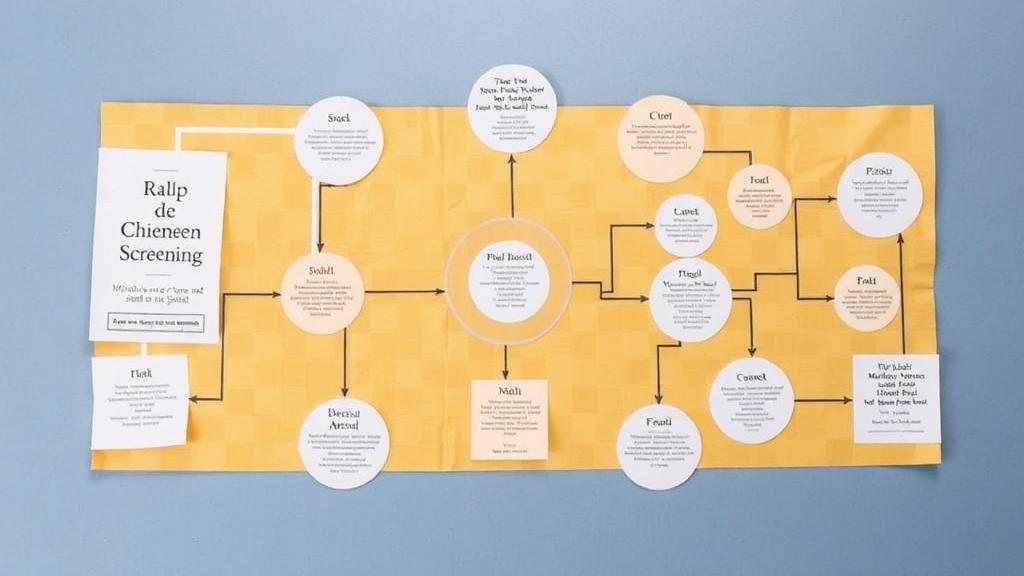
Cancer screening saves lives, yet people with intellectual disabilities consistently participate far less often than the general population, even when they are invited to the same national programs. A new study published in BMC Medicine by Amina Banda of Radboud University Medical Center and colleagues offers an unusually detailed explanation of why. Rather than cataloguing barriers one by one, the researchers used a technique called group model building, a core method of system dynamics, to capture how dozens of factors interact to shape whether a person with an intellectual disability actually completes a screening test. The result is a causal loop diagram containing 48 interconnected variables, built directly from the experiences of healthcare professionals and support workers in the Netherlands who guide people with intellectual disabilities through everyday health decisions.
System dynamics is a modeling tradition that treats stubborn problems as products of feedback structures rather than single causes. In group model building, stakeholders gather in facilitated workshops and construct a map of the system together, naming the variables they believe matter and drawing arrows that show which factors influence which. The approach has a distinctive strength: it surfaces assumptions that participants may never have articulated, and it forces the group to confront how a factor that helps in one place can quietly undermine progress elsewhere. For a problem like cancer screening in people with intellectual disabilities, where general practitioners, screening organizations, family caregivers, and professional support workers all act at different moments, that relational view is essential.
The workshops brought together healthcare professionals and support workers involved in caring for people with intellectual disabilities in the Netherlands. Participants mapped the key variables influencing access to and participation in cancer screening, including the national programs for breast, cervical, and bowel cancer screening that rely on tools such as the faecal immunochemical test. The discussions during the sessions were then used to interpret and contextualize the emerging diagram. Crucially, the researchers did not stop at the workshop stage: an independent group of similar participants, healthcare professionals and support workers with comparable experience, validated the finished causal loop diagram during a structured assessment, giving the model a check on credibility that many qualitative maps lack.
The resulting model is organized around five thematic clusters that together trace the decision-making trajectory of a screening invitation. The first cluster concerns awareness of the screening invitation itself, because an invitation letter that arrives at a shared address, or that is opened by a caregiver rather than the person it names, may never become a topic of conversation. The second cluster addresses understanding of information, since standard screening materials are written at a level that assumes health literacy and abstract reasoning that many people with intellectual disabilities do not possess. The third cluster captures well-informed decision making, the point at which someone must weigh the benefits and discomforts of a test and arrive at a choice that is genuinely their own.
The fourth cluster covers access to participation, the practical machinery of making an appointment, arranging transport, preparing for a procedure, and physically getting through it. The fifth cluster is perhaps the most novel: system-level visibility and oversight, meaning whether anyone in the system can actually see who has been invited, who has decided, and who has fallen through the cracks. When no single actor holds oversight of the whole trajectory, a person who misses one step can disappear from view entirely, and no alarm sounds anywhere in the system.
A central finding of the study is the critical role of decision-making moments throughout the screening process. The model shows that these moments are not a single event but a chain of junctures, each one capable of ending participation. A person may understand an invitation but not the procedure; a caregiver may grasp the procedure but hesitate to influence a decision they believe belongs to the individual; a professional may support the decision but find that the screening organization cannot accommodate the extra time or adjusted communication the appointment requires. Each handoff between stakeholders is a point where momentum can be lost, and the diagram makes those losses visible as feedback loops rather than isolated failures.
This systems view has a direct implication for policy. Interventions that target only one variable, such as producing easier-to-read invitation letters, address a real need but leave the surrounding structure intact. If accessible information is not paired with support at the moment of decision, and with procedures that flex at the point of delivery, the loops that suppress participation will continue to operate through other variables. The authors argue that continuous support for decision making across the different stages of the screening process, and among all the stakeholders involved, is essential to improve access. That is a call for a multidisciplinary approach in which general practitioners, screening program staff, and disability support workers coordinate deliberately rather than incidentally.
The methodological contribution is as interesting as the substantive one. Group model building is still rare in disability health research, where the literature has largely accumulated lists of barriers through surveys and interviews. By converting those perspectives into a causal structure, the Dutch team produced something a list cannot: a testable hypothesis about how the system behaves. The 48 variables and their connections can now be examined, challenged, and refined, and the diagram can serve as a shared reference point for stakeholders who otherwise hold fragmented pieces of the same problem. The validation step, in which an independent group assessed the diagram, strengthens the claim that the model reflects a consensus understanding rather than the view of a single workshop.
The study also clarifies where responsibility currently falls. Support workers and family caregivers often absorb the invisible labor of screening, translating letters, explaining procedures, and accompanying people to appointments, yet they sit outside the formal screening system and receive little guidance or recognition for this role. Meanwhile, screening organizations typically see only whether an invitation was answered, not why it was not. Making the whole trajectory visible, the fifth cluster of the model, is therefore not an abstract ambition but a practical prerequisite: without oversight, no actor can tell whether an intervention worked, and without feedback, the system cannot learn.
For a problem that has persisted across decades of screening policy, the message of this research is quietly radical. People with intellectual disabilities are not failing to participate because they lack motivation or because any single gatekeeper blocks them. They are embedded in a system whose parts, each acting reasonably in isolation, collectively produce exclusion. The causal loop diagram built by Banda and colleagues gives clinicians, program designers, and caregivers a common map of that system for the first time, and it points to a concrete design principle: build support for decision making into every stage of the screening journey, and give the system eyes to see where people are lost. The study was funded by the Maarten van der Weijden Foundation, the Netherlands Organisation for Health Research and Development, and the Dutch Ministry of Health, Welfare and Sport, none of which influenced the design or interpretation of the work.
Subject of Research: System dynamics analysis of cancer screening access for people with intellectual disabilities
Article Title: Healthcare workers and caregivers’ perspectives on access to cancer screening for people with intellectual disabilities as revealed by system dynamics and group model building
Article References: Banda, A., Cuypers, M., Rouwette, E. A., Nägele, M., Timen, A., Leusink, G., & Naaldenberg, J. (2026). Healthcare workers and caregivers’ perspectives on access to cancer screening for people with intellectual disabilities as revealed by system dynamics and group model building. BMC Medicine. https://doi.org/10.1186/s12916-026-05294-w
Image Credits: AI Generated
DOI: 10.1186/s12916-026-05294-w
Keywords: cancer screening, intellectual disability, system dynamics, group model building, causal loop diagram, decision making, health equity, caregivers, healthcare professionals, Netherlands, screening participation, BMC Medicine
News Source: Nathaniel Bowman. (October 12, 2026). Mapping the Hidden System That Keeps People With Intellectual Disabilities Out of Cancer Screening. Scienmag.