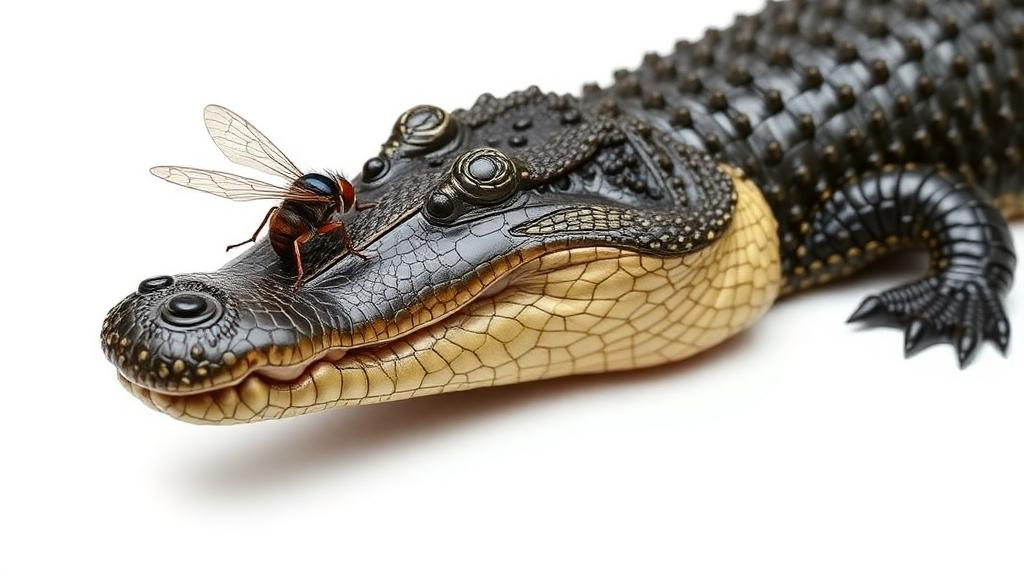
Even the most heavily armored animals alive today have their weak points, and a new study has mapped them with unusual precision. Researchers Gabriel A. Brito Vera and Bruce Anthony Tumbaco Vega set out to understand where parasitic horse flies actually land on the bodies of one of the Amazon’s most formidable predators, the black caiman (Melanosuchus niger). Their results, published in The Science of Nature, show that these biting flies do not attack at random. Instead, they concentrate their assaults on the soft, undefended terrain of the caiman’s face, particularly around the nostrils and the eyes, bypassing the thick osteoderm-reinforced hide that covers most of the animal’s body.
The study tackles a long-standing gap in parasite ecology. Ectoparasites, from ticks on mammals to lice on seabirds, are known to exploit particular anatomical regions of their hosts, yet quantifying exactly where attacks occur on complex, three-dimensional body surfaces has been surprisingly difficult. Traditional approaches rely on two-dimensional sketches, verbal descriptions, or counts per body region, all of which flatten and simplify what is fundamentally a spatial problem. For reptiles wrapped in bony armor, the question of why parasites bite where they bite has remained especially opaque, because the armor itself seems like it should deter attacks almost everywhere.
To get around this problem, the authors combined two data sources that rarely meet in the same analysis. The first was citizen science: photographs contributed by naturalists and photographers, many uploaded to platforms such as iNaturalist, showing horse flies perched on or biting black caimans. From this photographic record the researchers cataloged 275 distinct tabanid biting events, noting the precise anatomical location of each attack. Citizen-science imagery has become an increasingly powerful resource for studying elusive species, and the black caiman, an apex predator of Amazonian waterways, is a textbook example of an animal that is difficult to observe systematically in the wild.
The second ingredient was a high-resolution three-dimensional anatomical model. Rather than treating the caiman’s body as a set of labeled regions, the researchers mapped every recorded bite onto a detailed 3D surface of the animal, then applied three-dimensional kernel density estimation, a statistical technique known as 3D KDE, to identify regions where attacks clustered more densely than chance would predict. Kernel density estimation is widely used in geography and ecology to find hotspots in point data, but extending it onto a curved anatomical surface required the researchers to work with the geometry of the model itself. They used open-source tools, including the Blender 3D modeling package and the R statistical environment with kernel-smoothing libraries, to compute density estimates across the caiman’s actual body form.
The result was a heat map of parasitism draped over a crocodilian body, and it told a clear and unexpected story. If horse flies simply attacked whatever skin they could reach, the intensity of bites should scale with how much surface area each body region exposes to the air. It does not. Bite intensity was unrelated to surface exposure. Instead, the attacks concentrated in two well-defined hotspots: the nasal region at the tip of the snout and the orbital region around the eyes. Both are areas where the skin is thin, soft, and richly supplied with blood vessels, and where the protective osteoderms, the bony plates embedded in crocodilian skin, are absent.
That anatomy matters is well supported by what is known of crocodilian skin. The dorsal armor of crocodilians is built from osteoderms, dermal bones that create a tough, keratinized, layered shield whose mechanical properties have been studied in alligators as a model of natural armor. The head, by contrast, is not only unarmored but physiologically special. Research on crocodilian cranial vasculature has shown that the head serves as a site of thermal exchange, with dense networks of blood vessels near the surface of the snout and around the eyes. For a blood-feeding insect, a region where blood flows close to the skin and the hide is soft enough to pierce is an obvious target. The new mapping suggests that horse flies have, in effect, found the seams in the caiman’s armor.
The mouthparts of horse flies reinforce this interpretation. Tabanids possess slashing and sponge-like mouthparts adapted for cutting skin and lapping up blood, and their bites are painful, which is why they are notorious pests of livestock and wildlife alike. Earlier fieldwork in the central Amazon had already documented tabanid species feeding on caimans and even on anacondas, showing that crocodilians are established hosts for these flies. What the new study adds is the spatial dimension: not just that horse flies bite caimans, but exactly where on the body they prefer to do so, and how strongly that preference departs from randomness. The clustering in nasal and orbital regions points to anatomy-driven microhabitat selection by the parasites rather than simple opportunism.
Why does this matter beyond the caiman? Parasite microhabitat selection is a recurring theme in ecology, with documented examples ranging from ectoparasitic arthropods partitioning body regions on Alaskan seabirds to parasites occupying distinct microhabitats on the gills of Lake Victoria cichlids and on the shells of freshwater turtles. Understanding where parasites attack helps explain transmission dynamics, wound patterns, and the evolutionary pressures that shape host defenses. For an armored ectotherm like the black caiman, concentrated attacks on the face could impose real costs: repeated biting around the eyes and nostrils may interfere with sensory functions that are critical for hunting, and broken skin in these vascularized areas could provide entry points for pathogens. Tabanids are also recognized vectors of disease agents, giving the interaction a potential epidemiological edge.
Methodologically, the study’s most durable contribution may be its framework. By pairing open-access citizen-science photographs with an openly shared 3D anatomical model, in this case a scan of a black caiman made freely available by the Natural History Museum Vienna, and by releasing all data and R code on Zenodo, the authors have built a pipeline that other researchers can replicate for entirely different host-parasite systems. The approach is explicitly designed for elusive or logistically constrained study animals, situations where direct observation is difficult but photographic evidence accumulates naturally through the enthusiasm of wildlife photographers and naturalists worldwide. As vertebrate collections and museums continue to digitize specimens in 3D, the raw material for similar spatial analyses of parasitism is rapidly expanding.
The image of a nine-foot armored predator being nibbled around the nose and eyes by flies is vivid enough to spread quickly online, but the science underneath is the real story. It demonstrates that even in an animal whose integument has been refined by roughly 200 million years of evolution, defenses are imperfect and parasites evolve to find the gaps. It also shows how citizen science, 3D modeling, and spatial statistics can be stitched together into a rigorous, transparent, and reproducible method for studying interactions that were previously too fine-grained, too dangerous, or too remote to quantify. No armor is perfect, as the study’s title observes, and now ecologists have a tool to measure precisely where it fails.
Subject of Research: Spatial distribution of parasitic horse fly bites on the black caiman analyzed with 3D modeling and citizen science
Article Title: No armor is perfect: detecting hotspots of parasitic horse fly attacks on black caiman through 3D modeling and citizen science
Article References: No armor is perfect: detecting hotspots of parasitic horse fly attacks on black caiman through 3D modeling and citizen science. (n.d.). https://doi.org/10.1007/s00114-026-02174-4
Image Credits: AI Generated
DOI: 10.1007/s00114-026-02174-4
Keywords: black caiman, Melanosuchus niger, horse flies, Tabanidae, ectoparasitism, 3D modeling, kernel density estimation, citizen science, crocodylian armor, host-parasite interactions, Amazonia, parasite microhabitat selection
News Source: William Thompson. (October 12, 2026). Horse Flies Aim for the Face: 3D Maps Reveal Where Parasites Bite Armored Caimans. Scienmag.