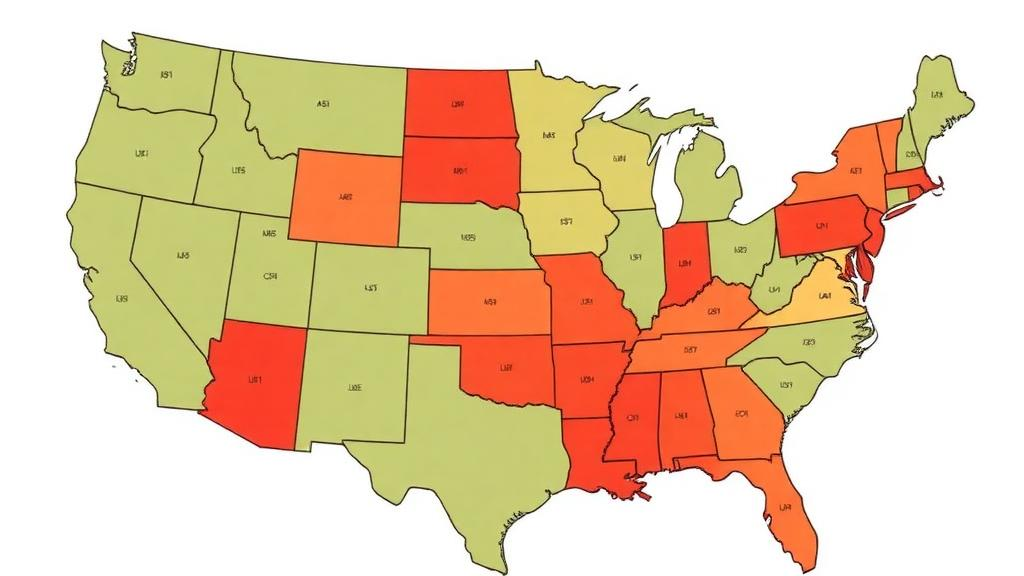
Even as deaths from cardiovascular disease in the United States have fallen steadily over two decades, the benefits of that progress have not been shared equally, and the geography of the burden is far more fragmented than national statistics suggest. A new county-by-cause-by-population analysis published in JACC, the flagship journal of the American College of Cardiology, shows that mortality from heart and vascular conditions varies far more across counties than across states, and that disparities rooted in race, ethnicity and place have persisted despite sustained overall declines. The study offers one of the most granular portraits to date of who dies from which form of cardiovascular disease, and where, across the American landscape.
Cardiovascular disease remains the leading cause of death worldwide, and in the United States it is a major contributor to both overall mortality and health disparities, with death rates differing widely across racial and ethnic groups. Decades of public health campaigns focused on prevention, early detection and treatment have helped push death rates downward, but researchers have noted with growing concern that the pace of that decline has slowed over the last fifteen years. The new analysis was designed to understand what that slowdown looks like when examined at the finest practical resolution of American public health administration: the county.
The research team, led by George A. Mensah, MD, FACC, Director of the Center for Translation Research and Implementation Science at the National Heart, Lung, and Blood Institute, estimated age-standardized mortality rates, or ASMRs, for five racial and ethnic groups across 3,110 counties and 21 causes of cardiovascular disease death. The estimates covered the period from 2000 to 2019 and were built from death certificate data drawn from the U.S. National Vital Statistics System. To achieve this level of detail, the investigators leveraged methods previously developed for estimating cause-specific mortality by county and race or ethnicity for a comprehensive set of causes of death from the Global Burden of Diseases cause list, adapting small-area estimation techniques to the particular structure of cardiovascular mortality.
Age-standardization is the technical backbone of the analysis. Because populations differ in age structure from one county to another, raw death counts can be deeply misleading; a county with many older residents will naturally report more deaths than a demographically young one even if underlying risk is identical. By applying standardized age weights, ASMRs allow fair comparison across places and populations, isolating genuine differences in cardiovascular risk and outcomes from the distorting effects of demographics. Applying that method across 3,110 counties, five population groups and 21 distinct causes of death produced a dataset of unusual resolution for a field that has long relied on state-level or national summaries.
The headline numbers confirm both progress and its limits. In 2019, the age-standardized mortality rate for total cardiovascular disease stood at 237.8 deaths per 100,000 individuals. Over the two-decade study window, mortality declined for total cardiovascular disease and for 12 of the 17 detailed causes of death examined. Yet the improvement was not uniform across conditions: mortality rates increased for three detailed causes, and the pace of the overall decline slowed noticeably after 2011, a deceleration that appeared across several detailed causes of death and signals a plateau in what had been one of the great public health success stories of the past half-century.
The 17 detailed causes tracked in the study span the full breadth of cardiovascular and circulatory disease: rheumatic heart disease, ischemic heart disease, ischemic stroke, intracerebral hemorrhage, subarachnoid hemorrhage, hypertensive heart disease, nonrheumatic calcific aortic valve disease, non-rheumatic degenerative mitral valve disease, myocarditis, alcoholic cardiomyopathy, other cardiomyopathy, pulmonary arterial hypertension, atrial fibrillation and flutter, aortic aneurysm, lower extremity peripheral arterial disease, endocarditis, and a residual category of remaining cardiovascular and circulatory diseases. Alongside these, the analysis included three subtotals: stroke, non-rheumatic valvular heart disease, and cardiomyopathy and myocarditis. This cause-level breakdown matters because the conditions respond to different interventions, and because the adverse trends were concentrated in specific diagnoses rather than spread evenly across the spectrum.
Those adverse trends deserve particular attention. Hypertensive heart disease and atrial fibrillation and flutter increased over the study period overall, and ischemic stroke, despite longer-term declines, showed an increase after 2011. Each of these conditions is closely linked to risk factor control: high blood pressure management for hypertensive heart disease and stroke prevention, and the growing prevalence of obesity, diabetes and physical inactivity as drivers of atrial fibrillation. The post-2011 reversal in ischemic stroke mortality in particular suggests that gains made in blood pressure control and acute stroke care may be eroding in parts of the country, a pattern that national averages alone would obscure.
The racial and ethnic patterns in the data are stark. The Black population suffered the highest mortality rate for total cardiovascular disease and for 12 of the 17 detailed causes of death, while the Asian population suffered the lowest rate for total cardiovascular disease and for 13 of the 17 detailed causes. Between those poles, the other groups studied occupied varying positions that shifted depending on the specific cause of death, underscoring that cardiovascular risk is not a single gradient but a mosaic shaped by differences in exposures, access to care, socioeconomic conditions and the local burden of specific diseases.
Perhaps the most consequential methodological finding is geographic. Mortality varied much more by county than by state, both within and among racial and ethnic populations, and the spatial patterns of mortality also differed significantly depending on the cardiovascular disease cause. In practical terms, this means that state-level statistics can mask enormous internal variation, and that two counties in the same state, with similar demographic composition, can sit at opposite ends of the mortality distribution for the same condition. For policymakers accustomed to allocating resources along state lines, the analysis is a warning that the true geography of cardiovascular risk operates at a much finer scale.
Mensah argued that this granularity is not an academic luxury but a practical necessity. Detailed knowledge of county-level variation, he said, is important for all racial and ethnic populations because it can inform the appropriate local-level clinical and public health practices, policies and strategies needed to have a sustained effect on reducing or eliminating racial, ethnic and place-based cardiovascular disease disparities. For clinical practice, he added, the findings point to the value of integrating local epidemiology into risk assessment, outreach and care delivery, noting that health systems and clinicians need to align prevention strategies with the dominant local causes and the populations experiencing the greatest burden. In other words, the most effective prevention program in a county dominated by hypertensive heart disease may look very different from one confronting a rising tide of atrial fibrillation.
The study’s framing as a pre-pandemic map was emphasized in an accompanying editorial comment by ACC President Roxana Mehran, MD, FACC, who said the findings are a reminder that heart disease statistics on a national scale can hide the realities patients are facing on a local level. She highlighted how the American College of Cardiology is leading a coordinated approach to reducing disparities and improving cardiovascular health for all through partnerships, education, advocacy and workforce initiatives. The data end in 2019, deliberately preceding the COVID-19 pandemic, which disrupted care delivery, worsened risk factor profiles and caused excess cardiovascular deaths; the pre-pandemic baseline therefore serves as a reference point against which the pandemic’s cardiovascular toll, and any recovery from it, can be measured.
Mehran’s editorial framed the challenge ahead in pointed terms. Dr. Mensah and colleagues, she wrote, provided an essential pre-pandemic map of cardiovascular disparities across time, place, race and ethnicity, and the next challenge is to turn that map into a roadmap for action. Her formulation captured the central tension of the study: describing inequities with precision is now achievable with modern small-area estimation methods, but closing them requires translating that precision into targeted investment, clinical outreach and policy at the community level. Our commitment to cardiovascular health equity, she argued, should be measured not by how precisely we describe inequities, but by how effectively we close them.
For a field that has celebrated decades of falling cardiovascular mortality, the study is a sobering accounting of unfinished business. The decline in deaths from 2000 to 2019 was real, extending across most of the detailed causes examined, yet the slowdown after 2011, the increases in hypertensive heart disease, atrial fibrillation and flutter, and the post-2011 rise in ischemic stroke mortality all point to headwinds that national averages conceal. Combined with the finding that county-level variation dwarfs state-level variation, both within and across racial and ethnic groups, the analysis makes a clear case that the next phase of cardiovascular progress in the United States will depend less on broad national campaigns and more on the unglamorous work of identifying which communities, and which patients within them, have been left behind by two decades of improvement, and directing resources to the specific places and conditions where the burden remains heaviest.
Subject of Research: County-level racial, ethnic and geographic disparities in U.S. cardiovascular disease mortality
Article Title: Heart disease gaps persist despite overall declines
Article References: Heart disease gaps persist despite overall declines. (n.d.). Original publication
Image Credits: AI Generated
DOI: Not provided
Keywords: cardiovascular disease, mortality disparities, county-level analysis, age-standardized mortality rate, hypertensive heart disease, atrial fibrillation, ischemic stroke, health equity, JACC, National Heart Lung and Blood Institute, Global Burden of Disease, public health
News Source: Frances Kline. (October 12, 2026). County-Level Mapping Reveals Stubborn Heart Disease Disparities Across America. Scienmag.