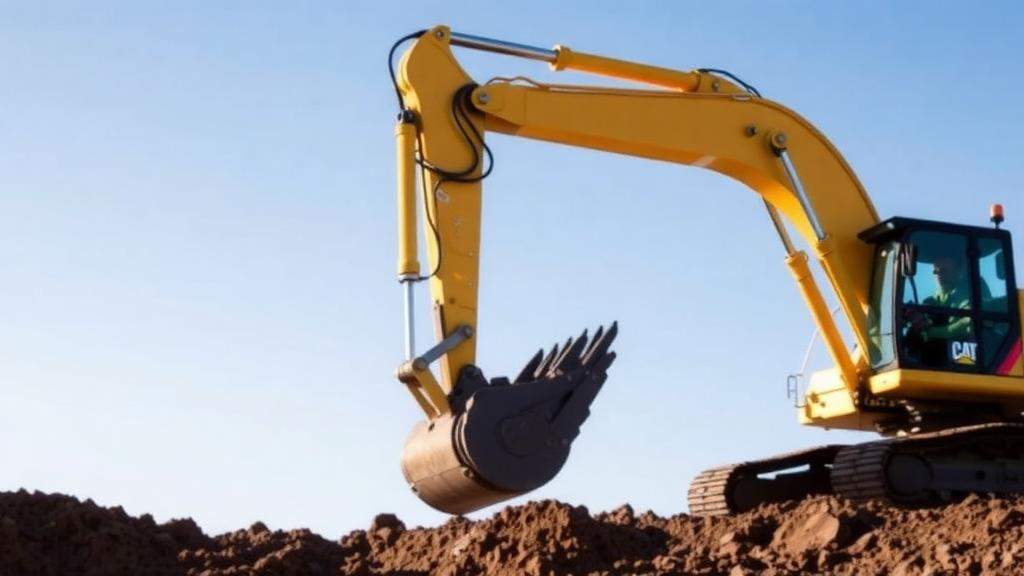
Hydraulic excavators are among the most punishing machines ever built, and the boom and stick that form their digging arms absorb some of the harshest loads in engineering. A new study from researchers at Shaanxi University of Technology, working with colleagues at SANY Heavy Equipment and Chongqing University, has now taken a detailed look at how these structures actually respond when they are forced through real digging motions under different ways of describing the loads they face. The work, published as a preprint in Mechanical Sciences, combines field measurements, classical dynamics, and parametric finite element modeling to answer a deceptively simple question: does it matter which load model engineers use when they check whether an excavator arm will survive the dig?
The team, led by Yijian Zhang and corresponding author Zhigui Ren, focused on a 20-ton backhoe excavator, the workhorse class of machine found on construction sites worldwide. Rather than relying on idealized textbook load cases, they began with data collected from field tests, capturing the actual compound digging trajectories that an operator performs when the bucket cuts, curls, and drags through soil. From these measured paths, the researchers identified four typical compound digging trajectories and then isolated the critical postures at which the cutting and loading resistance reached its peak. These worst-case positions became the starting point for the high-load structural analysis that followed.
To translate motion into structural loading, the authors built a dynamic model of the working device using D’Alembert’s principle, a classical approach that treats accelerating machine components as if they were in static equilibrium by adding inertial forces to the balance of external loads. This allowed them to compute the forces acting on the boom and stick at each critical posture, accounting not only for the resistance at the bucket but also for the inertia of the heavy links themselves as they swing and extend through the dig. The result was a set of joint loads and reaction forces that reflect what the structure genuinely experiences during aggressive digging, rather than a simplified static snapshot.
The heart of the study lies in its comparison of three different load schemes applied under identical postures and boundary conditions. The first scheme used the excavation resistance measured directly in the field, representing what the machine actually encountered. The second applied the conventional compound digging force, a standard theoretical load representation used in excavator design practice. The third applied the limit compound digging force, a theoretical maximum that assumes the machine is working at the edge of its tractive and hydraulic capability. Because all three schemes were evaluated at the same postures with the same constraints, any differences in the predicted structural response could be attributed purely to the choice of load representation.
For each load scheme, the researchers constructed corresponding parametric finite element models of the boom and stick and computed the equivalent stress and deformation across the structures. Finite element analysis divides a component into thousands of small elements and solves for how each one deforms and carries stress, giving engineers a detailed map of where a structure is working hardest. By keeping the models parametric, the team could ensure that geometry and meshing stayed consistent across the three load cases, making the comparison as clean as possible. The approach mirrors how industrial design teams evaluate heavy structures, but here it was applied systematically to test the sensitivity of the results to the load model itself.
The findings offer reassurance on one front and caution on another. Across all three load schemes, the high-stress distributions and the overall deformation modes of both the boom and the stick turned out to be broadly similar. In other words, whichever load representation an engineer chooses, the same regions of the structure emerge as the critical ones, and the general pattern of bending and distortion remains consistent. This suggests that the qualitative picture of structural behavior during compound digging is robust, and that design decisions guided by any of these load models will point toward the same structural hot spots.
Where the schemes diverge is in severity. The limit compound digging force produced higher maximum equivalent stress than either the measured excavation resistance or the conventional compound digging force, making it the most conservative of the three for strength evaluation. That conservatism has practical value: if a design passes a strength check under the limiting load, it carries an inherent margin against the harsher realities of the field. For engineers selecting design loads, the study provides evidence that the limit load scheme offers a safe upper bound, while measured data can refine the assessment when a more realistic picture is needed.
The deformation results revealed a subtler story, particularly for the stick. Under the limiting load condition, the boom showed a significant increase in deformation, as might be expected when the applied forces grow toward their theoretical maximum. The stick, however, exhibited non-monotonic variation in its deformation, meaning that more load did not simply translate into more deflection. The researchers attribute this to the combined effects of load direction and working posture: as the machine moves through different digging positions, the angle at which the resistance acts on the stick changes, sometimes amplifying bending and sometimes partially relieving it. This posture-dependent behavior underscores why trajectory-based analysis, grounded in measured motion, matters for components whose loading direction shifts continuously through a dig.
The practical implications reach from the drawing office to the quarry. Excavator working devices are typically designed against standardized load cases, and this study suggests that those conventions capture the essential stress patterns but may understate peak severity compared with limiting loads. By anchoring the analysis in field-measured trajectories, the researchers have given designers a way to connect what operators actually do with machines to what the structures must endure. The work can support more informed selection of design loads and guide structural optimization of the boom and stick, potentially reducing weight without sacrificing safety or extending fatigue life in the regions that matter most.
There is also a broader lesson in methodology here. The study demonstrates a pipeline that many heavy-equipment developers could adopt: measure real operating trajectories in the field, extract the critical postures where resistance peaks, build a dynamic model with D’Alembert’s principle to compute the loads, and then run consistent parametric finite element comparisons across competing load schemes. Because the preprint is under open review at Mechanical Sciences, with discussion open until mid-November 2026, the community has the opportunity to scrutinize and strengthen the approach before final publication. For a machine class whose arms swing through millions of loaded cycles over a service life, understanding exactly how load assumptions shape structural verdicts is not an academic nicety. It is the difference between a boom that lasts and one that does not, and this study moves that understanding onto firmer, measured ground.
Subject of Research: Structural response of a 20-ton hydraulic excavator working device under measured digging trajectories and different load characterization schemes
Article Title: Structural Characterization of Excavator Working Device Based on Measured Digging Trajectories and Different Working Loads
Article References: Zhang, Y., Ren, Z., Cao, S., Lv, L., Pang, X., Ren, K., & Zhang, H. (2026). Structural Characterization of Excavator Working Device Based on Measured Digging Trajectories and Different Working Loads. https://doi.org/10.5194/ms-2026-174
Image Credits: AI Generated
DOI: 10.5194/ms-2026-174
Keywords: excavator, working device, boom, stick, digging trajectories, finite element analysis, D'Alembert's principle, compound digging force, structural stress, deformation, design loads, hydraulic excavator
News Source: Denise Maddox. (October 12, 2026). Real Digging Data Reveals How Excavator Arms Really Take the Strain. Scienmag.