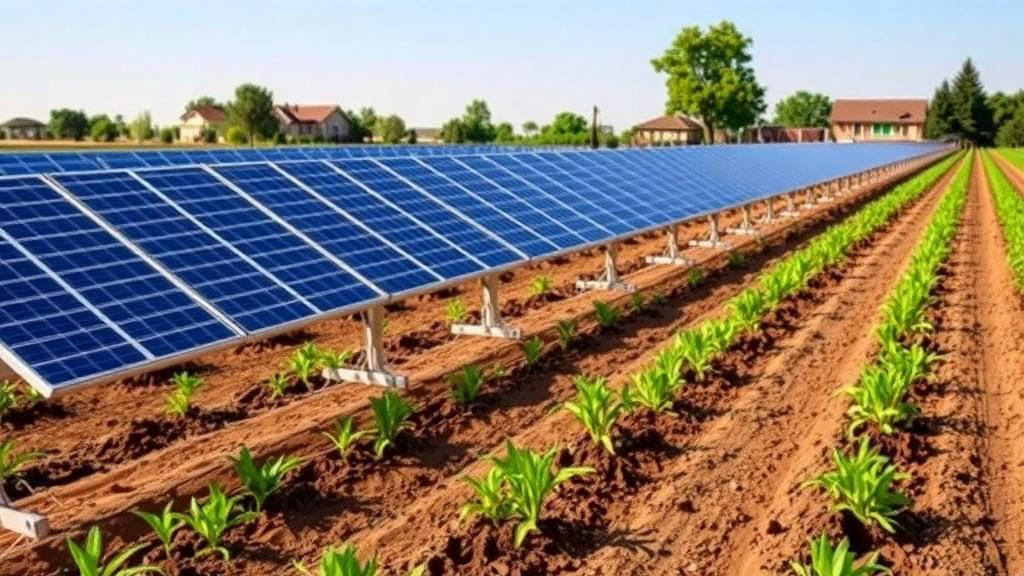
In the arid expanses of Egypt’s New Delta region, where every drop of water counts and the sun beats down relentlessly, a team of Egyptian engineers has built a virtual farm of the future. A new study published in Scientific Reports presents a MATLAB-based simulation framework that fuses artificial intelligence with Internet of Things (IoT) architecture to manage solar-powered irrigation, and its headline numbers are striking: a projected annual water saving of 28.57 percent compared with a conventional fixed-schedule baseline, and a 74.74 percent reduction in motor energy use through adaptive pump-speed control.
The research, led by Ahmed Mashaly of Mansoura National University, together with Ragab A. El-Sehiemy of Kafrelsheikh University and Mohamed Elgohary of Delta University for Science and Technology, addresses a persistent gap in the smart agriculture literature. According to the authors, most existing studies concentrate either on IoT monitoring platforms or on AI prediction models, but rarely integrate both into a single, coherent system. Their framework does exactly that, coupling a long short-term memory (LSTM) neural network for predicting irrigation water requirements with a complete renewable energy management layer that includes photovoltaic generation, battery state-of-charge (SOC) management, and a maximum power point tracking (MPPT) algorithm.
At the heart of the predictive engine sits the LSTM network, a specialized form of recurrent neural network designed to capture long-range temporal dependencies in sequential data. That architecture is well suited to agriculture, where irrigation demand depends not just on today’s weather but on patterns of solar irradiance, temperature, and humidity unfolding over days. Trained and tested on real environmental data drawn from NASA’s POWER database for the New Delta region, the LSTM classified the operating states of the irrigation pump with an accuracy of 96.11 percent. Its recall of 0.9820 indicates that it rarely misses a genuine irrigation event, while its precision of 0.9100 shows that false alarms are comparatively uncommon. The resulting F1-score of 0.9446 balances those two qualities into a single figure of merit.
Those numbers matter because the model was not operating in isolation. The team benchmarked the LSTM against two widely used alternatives, an artificial neural network (ANN) and a support vector machine (SVM), and found the LSTM outperformed both. Robustness testing across multiple independent training runs showed stable performance, an important consideration for any system intended to run autonomously in the field, where retraining conditions vary and overfitting to a single dataset can quietly degrade reliability.
The energy side of the framework is equally deliberate. A photovoltaic system, whose output power depends on solar irradiance and panel efficiency, feeds the irrigation pump through an MPPT algorithm that continuously adjusts the operating point to extract the maximum available power from the panels. A battery storage subsystem, tracked through its state of charge, buffers the mismatch between when the sun shines and when the crops need water. Rather than running pumps at fixed speed, the framework adapts pump speed to actual demand, which is where the dramatic 74.74 percent reduction in motor energy consumption comes from. In conventional irrigation, motors often run at full power regardless of need; adaptive control trims that waste.
Water savings arise from a different mechanism. Instead of irrigating on a rigid timetable, the system predicts how much water the crops will actually consume and schedules irrigation accordingly, using a soil-moisture error term to correct deviations between predicted and measured conditions. Against an assumed conventional fixed-schedule baseline, the simulated annual water saving reached 28.57 percent. For a country like Egypt, which faces severe water scarcity and is developing the New Delta as new agricultural land, savings of that magnitude could translate into substantially more farmland served by the same water allocation.
The researchers also stress-tested their design. A sensitivity analysis examined how the system responds to moderate variations in environmental and operating conditions, and the model remained stable. That resilience is critical for real-world deployment, where sensor noise, weather variability, and component aging are the norm rather than the exception. The framework further includes a conceptual IoT communication architecture, envisioning field sensors, controllers, and remote monitoring linked through technologies such as GSM and long-range wide area networks, so that the intelligence demonstrated in simulation could eventually govern physical hardware.
It is worth emphasizing what the study does and does not claim. This is a simulation framework, validated against real environmental data but not yet demonstrated on deployed hardware in a working field. The water and energy savings are estimates relative to a modeled baseline, and the authors position the work explicitly as a promising start toward future hardware implementations of intelligent, solar-powered irrigation devices. Even so, the integration is what sets the work apart: prediction, power management, storage control, and communication are designed together rather than bolted together after the fact.
The broader implications extend beyond Egypt. Agriculture consumes the majority of the world’s freshwater withdrawals, and solar-powered irrigation is expanding rapidly across regions where grid electricity is unreliable or absent. A framework that pairs machine learning forecasts with renewable energy management could help farmers squeeze more output from both scarce inputs, water and sunlight. The MATLAB environment also makes the approach reproducible and adaptable, allowing other researchers to plug in local climate data and re-tune the models for their own conditions.
From the sun-scorched fields of the New Delta to the growing literature on AI-driven smart farming, the study offers a template for how simulation can de-risk the next generation of agricultural technology. If future hardware trials confirm the simulated gains, the combination of LSTM forecasting, adaptive pump control, and solar energy management could become a cornerstone of sustainable irrigation in water-stressed regions worldwide.
Subject of Research: An AI-IoT simulation framework using LSTM networks for smart solar-powered irrigation and renewable energy management
Article Title: A MATLAB-based AI-IoT simulation framework for LSTM-driven smart solar irrigation and renewable energy management
Article References: A MATLAB-based AI-IoT simulation framework for LSTM-driven smart solar irrigation and renewable energy management. (n.d.). https://doi.org/10.1038/s41598-026-74935-0
Image Credits: AI Generated
DOI: 10.1038/s41598-026-74935-0
Keywords: smart irrigation, LSTM, artificial intelligence, Internet of Things, photovoltaic systems, renewable energy, MATLAB, water efficiency, maximum power point tracking, battery state of charge, smart agriculture, Egypt
News Source: Faith Mcneil. (October 12, 2026). AI-Powered Solar Irrigation Framework Cuts Water Use by Nearly 29 Percent in Simulation. Scienmag.