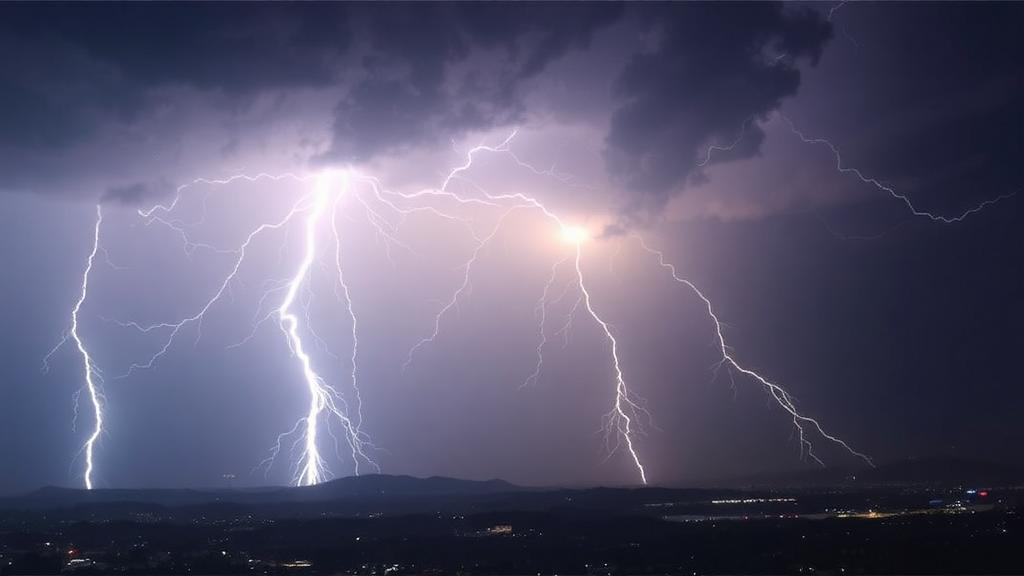
Every thunderstorm that rumbles across a landscape does more than light up the sky and rattle windows. Inside each lightning channel, air is heated to temperatures hotter than the surface of the Sun, and at those extremes nitrogen and oxygen molecules that normally ignore each other are torn apart and forced to combine. The result is nitrogen oxides, or NOx, a family of gases that governs the production of ozone in the lower atmosphere and shapes the oxidizing capacity of the entire troposphere. Lightning is one of the principal natural sources of these gases, contributing roughly ten percent of total global NOx emissions, equivalent to between three and seven teragrams of nitrogen per year. Yet pinning down exactly how much NOx a single flash produces has proven to be one of the most stubborn problems in atmospheric chemistry, with published estimates varying by more than an order of magnitude.
A new study published in Atmospheric Chemistry and Physics by Francisco J. Pérez-Invernón of the Instituto de Astrofísica de Andalucía in Granada and an international team of collaborators has now tackled that problem with an unusually powerful combination of instruments. The researchers focused on the Ebro Valley in northeastern Spain, a region of notably high lightning activity where airflows shaped by the Mediterranean Sea, the Atlantic Ocean, the Pyrenees and the Iberian thermal low frequently converge to spark thunderstorms. By pairing optical lightning observations from the Meteosat 12 Lightning Imager, the first lightning detector of Europe’s Meteosat Third Generation fleet in geostationary orbit, with ground-based radio measurements from a 24-station Lightning Mapping Array, the team was able to characterize individual flashes in unprecedented detail and connect their properties to the amount of NOx they generate.
The technical challenge is formidable. Satellites such as the TROPOspheric Monitoring Instrument, TROPOMI, flying on the Sentinel-5 Precursor spacecraft, can measure nitrogen dioxide columns from orbit with a horizontal resolution of about 3.5 by 5.5 kilometers at nadir. But the NOx they see over a storm is a mixture: some of it was freshly injected by lightning, some was lofted from the boundary layer, some arrived from distant sources, and some is stratospheric. Disentangling the lightning contribution requires knowing both the vertical distribution of the lightning-produced gases and the background against which they appear. The team addressed this by running high-resolution simulations with the WRF-Chem atmospheric model, nudged toward the actual lightning flashes observed by Meteosat 12, so that the model reproduced where and when the storms deposited their chemical payload. Comparing paired simulations with and without fresh lightning emissions allowed the researchers to calculate the fraction of the measured column attributable to lightning in each pixel, as well as the air mass factors needed to convert measured slant columns into vertical column densities.
The lightning observations themselves came from two complementary systems. The Lightning Imager aboard Meteosat 12, launched in December 2022 and declared operational in late 2024, stares continuously at the full Earth disk from geostationary orbit, detecting the 777-nanometer optical emission of atomic oxygen in lightning discharges with a CMOS detector sampling at one kilohertz. It records for each flash a suite of properties: the illuminated footprint, the total radiance, the duration, and the temporal evolution of the optical signal. On the ground, the recently upgraded eXtended Catalonia Lightning Mapping Array, XCALMA, tracks the very high frequency radio impulses emitted by stepped leaders as they carve lightning channels through the cloud, reconstructing the three-dimensional geometry of each flash without any distortion from intervening cloud layers. From XCALMA data the team extracted total flash channel length, flash volume and flash duration, quantities that no space-based optical sensor can measure directly.
Between July 2024 and May 2025, the researchers identified eighteen thunderstorm days that satisfied strict quality criteria, including at least 650 flashes detected by the Lightning Imager within the well-covered region of the mapping array and a mean flash age of less than 3.5 hours before the TROPOMI overpass, which occurs at roughly 13:30 local solar time. For each storm they computed the lightning NOx production efficiency, defined as the moles of NOx produced per flash, using a retrieval that accounts for the detection efficiency of each lightning system and the exponential decay of NOx during the hours between flash occurrence and satellite observation. The results were striking in their internal consistency: using Meteosat 12 flashes with an assumed five-hour NOx lifetime yielded 37 plus or minus 25 moles of NOx per flash, while using the ground-based mapping array yielded 31 plus or minus 24 moles per flash, with slightly higher values of 41 and 38 moles when a three-hour lifetime was assumed.
The heart of the study lies in how these production efficiencies relate to the physical characteristics of the flashes themselves. Across the eighteen storms, the team found consistent positive correlations between lightning-produced NOx per flash and nearly every flash property they examined. Longer flash channels produced more NOx, as expected from laboratory and modeling work showing that production scales with the volume of air heated by the discharge. Larger flash volumes, longer flash durations, brighter optical radiances and bigger illuminated footprints all correlated positively with per-flash production. The strongest linear relationships emerged when the ground-based channel length, volume and duration measurements were used, with the mapping array metrics proving to be better proxies for NOx production than the satellite optical properties, likely because cloud cover attenuates and distorts the light that reaches geostationary orbit.
One of the most intriguing findings concerns continuing currents, the slow transfer of charge that can persist for tens to hundreds of milliseconds after a cloud-to-ground stroke. Earlier work on rocket-triggered lightning suggested that these slow discharge processes account for roughly eighty percent of the total NOx produced per flash, but confirming this in natural storms has been nearly impossible because continuing currents hide below cloud and are poorly detected by optical sensors from space. The team devised new variables from the Lightning Imager data, counting the number of time-contiguous optical groups per flash and the fraction of flashes showing at least five milliseconds of uninterrupted optical signal. These continuity measures correlated positively, though weakly, with NOx production, and less strongly than total flash duration measured on the ground. The gap between the two correlations hints that significant lightning activity below the cloud, invisible to the satellite, contributes to the chemical budget, and that radio-frequency mapping remains essential for a complete picture.
The study also clarified how the detection efficiency of the new geostationary instrument behaves. The mapping array detected between 1.3 and 6.5 times more flashes than Meteosat 12 over the same storms, and the ratio of the two counts grew for more active thunderstorms, confirming that the satellite’s detection efficiency drops as flash rates rise. The satellite performed relatively better for brighter flashes, particularly cloud-to-ground flashes, which the analysis showed tend to be longer, larger and more luminous than intracloud flashes. Flashes initiating at lower altitudes, where cloud-to-ground activity predominates, were also more extensive and more energetic. These calibration insights matter beyond Spain: as the global constellation of geostationary lightning mappers expands, understanding their biases is essential for anyone using their data to estimate lightning’s chemical or climatic influence.
The broader implications reach into climate modeling and air quality forecasting. Lightning-produced NOx is roughly six times more efficient at driving ozone production than anthropogenic NOx, generating about a hundred ozone molecules per NOx molecule emitted, and it influences the tropospheric budgets of methane and carbon monoxide. Because climate change is expected to alter thunderstorm frequency and intensity, models need accurate, flash-property-aware parameterizations of lightning emissions. This study moves the field toward that goal by demonstrating that flash geometry, duration and brightness, measurable from space, carry real information about per-flash chemistry. The team estimates that their refinements, including lightning-nudged simulations and the upgraded mapping array, reduce the total uncertainty of satellite-based production estimates from the previously reported range of twenty to fifty percent down to roughly twelve to forty percent. With the upcoming Sentinel-4 spectrometer and the Meteosat Third Generation Infrared Sounder set to provide coincident air composition and humidity profiles over Europe, the Ebro Valley is poised to remain a natural laboratory where the chemistry of thunderstorms is finally being written down, flash by flash.
Subject of Research: Lightning-produced nitrogen oxide emissions measured with satellite and ground-based lightning observations over the Ebro Valley, Spain
Article Title: Characterizing lightning NOx production in the Ebro Valley with meteosat 12 LI and LMA observations
Article References: Pérez-Invernón, F. J., Gordillo-Vázquez, F. J., van der Velde, O., Montanyà, J., López Trujillo, J. A., Pineda, N., Loyola, D., Seo, S., Knote, C., Fierro, A. O., & Huntrieser, H. (2026). Characterizing lightning NO x production in the Ebro Valley with meteosat 12 LI and LMA observations. Atmospheric Chemistry and Physics, 26(19), 14277-14301. https://doi.org/10.5194/acp-26-14277-2026
Image Credits: AI Generated
DOI: 10.5194/acp-26-14277-2026
Keywords: lightning, nitrogen oxides, NOx, Meteosat 12, Lightning Imager, Lightning Mapping Array, TROPOMI, WRF-Chem, thunderstorms, atmospheric chemistry, ozone, Ebro Valley
News Source: Caitlin Barrett. (October 12, 2026). How Big, Bright Flashes Make More Pollution: Lightning’s Nitrogen Footprint Measured From Space. Scienmag.