

• HOME
  • NEWS
  • EXPLORE
    • CAREER
      • Companies
      • Jobs
    • EVENTS
    • iGEM
      • News
      • Team
    • PHOTOS
    • VIDEO
    • WIKI
  • BLOG
  • COMMUNITY
    • FACEBOOK
    • INSTAGRAM
    • TWITTER
Thursday, April 2, 2026
BIOENGINEER.ORG
No Result
View All Result
  • Login
  • HOME
  • NEWS
  • EXPLORE
    • CAREER
      • Companies
      • Jobs
        • Lecturer
        • PhD Studentship
        • Postdoc
        • Research Assistant
    • EVENTS
    • iGEM
      • News
      • Team
    • PHOTOS
    • VIDEO
    • WIKI
  • BLOG
  • COMMUNITY
    • FACEBOOK
    • INSTAGRAM
    • TWITTER
  • HOME
  • NEWS
  • EXPLORE
    • CAREER
      • Companies
      • Jobs
        • Lecturer
        • PhD Studentship
        • Postdoc
        • Research Assistant
    • EVENTS
    • iGEM
      • News
      • Team
    • PHOTOS
    • VIDEO
    • WIKI
  • BLOG
  • COMMUNITY
    • FACEBOOK
    • INSTAGRAM
    • TWITTER
No Result
View All Result
Bioengineer.org
No Result
View All Result
Home NEWS Science News Biology

Hostage situation or harmony? Researchers rethink symbiosis

Bioengineer by Bioengineer
July 27, 2017
in Biology
Reading Time: 2 mins read
0
Share on FacebookShare on TwitterShare on LinkedinShare on RedditShare on Telegram
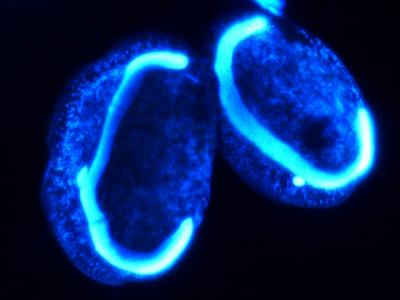
IMAGE

Credit: Vittorio Boscaro and Patrick Keeling

Relationships where two organisms depend on each other, known as symbiosis, evoke images of partnership and cooperation. But a new study in Nature Ecology and Evolution shows that, when it comes to certain microorganisms, symbiotic partners are actually being held "hostage".

The international research team, led by biologists from the University of British Columbia, studied a freshwater bacterium called Polynucleobacter that often lives inside the single-celled protozoan, Euplotes, to better understand the relationship between symbionts, or organisms in symbiotic relationships.

"Most people think symbiosis means there is an evolution toward harmony, a perfect balance of the two partners," says Vittorio Boscaro, a biologist at UBC and lead author of the study. "But although the host needs the bacterium to survive, the bacterium doesn't gain any advantage in this relationship."

In fact, the researchers were able to determine that Euplotes hosts constantly "snatch up" useful bacteria like Polynucleobacter from the environment, and then later discard and replace them with "fresh" symbionts.

"They're being replaced, just like you change your clothes," said Patrick Keeling, a UBC microbiologist and senior author of the study. "You take advantage of your symbiont until it's no longer useful, and then you get a new one."

The team examined what was happening between the microbes by analyzing the genome of Polynucleobacter. Once it is snatched up by Euplotes, it leads to major changes to the Polynucleobacter genome.

While these changes are not unexpected, the researchers were surprised to learn how the genome changes over time. Typically, we think of evolution in terms of adaptation to survive. In the case of symbiotic Polynucleobacter, they found that the genome was changing and losing genes at random and ultimately ceasing to be useful to their host.

"I like to think of the relationship being more like death row than cooperation–sure the symbiont is kept safe and well-fed in the short term, but ultimately it's not a good place to be," said Keeling.

The researchers believe such insight may lead to a conceptual change of evolutionary processes and their complexity.

The paper was published in Nature Ecology & Evolution: https://www.nature.com/articles/s41559-017-0237-0.

###

Media Contact

Heather Amos
[email protected]
604-822-3213
@UBCnews

http://www.ubc.ca

Original Source

https://news.ubc.ca/2017/07/27/hostage-situation-or-harmony-researchers-rethink-symbiosis/ http://dx.doi.org/10.1038/s41559-017-0237-0

Share12Tweet8Share2ShareShareShare2

Related Posts

Newly Discovered Chronic Pain Circuit Unveils Potential Avenues for Innovative Treatments

Newly Discovered Chronic Pain Circuit Unveils Potential Avenues for Innovative Treatments

April 2, 2026
DNA Transforms from Blueprint to Active Field Agent

DNA Transforms from Blueprint to Active Field Agent

April 2, 2026

UBC Okanagan Study Reveals How Trees Visually Signal Their Spring Rehydration

April 1, 2026

Rising Temperatures from Climate Change Associated with Reduced Newborn Size

April 1, 2026
Please login to join discussion

POPULAR NEWS

  • blank

    Revolutionary AI Model Enhances Precision in Detecting Food Contamination

    96 shares
    Share 38 Tweet 24
  • Imagine a Social Media Feed That Challenges Your Views Instead of Reinforcing Them

    1007 shares
    Share 398 Tweet 249
  • Promising Outcomes from First Clinical Trials of Gene Regulation in Epilepsy

    51 shares
    Share 20 Tweet 13
  • Popular Anti-Aging Compound Linked to Damage in Corpus Callosum, Study Finds

    44 shares
    Share 18 Tweet 11

About

We bring you the latest biotechnology news from best research centers and universities around the world. Check our website.

Follow us

Recent News

Parkinson’s Mutations Cause Lipid Defects, Rescued

Flexible Axon Sheath Enables Complex CNS Myelination

New Research Reveals Unexpected Findings About Urban Peruvians

Subscribe to Blog via Email

Enter your email address to subscribe to this blog and receive notifications of new posts by email.

Join 78 other subscribers
  • Contact Us

Bioengineer.org © Copyright 2023 All Rights Reserved.

Welcome Back!

Login to your account below

Forgotten Password?

Retrieve your password

Please enter your username or email address to reset your password.

Log In
No Result
View All Result
  • Homepages
    • Home Page 1
    • Home Page 2
  • News
  • National
  • Business
  • Health
  • Lifestyle
  • Science

Bioengineer.org © Copyright 2023 All Rights Reserved.
