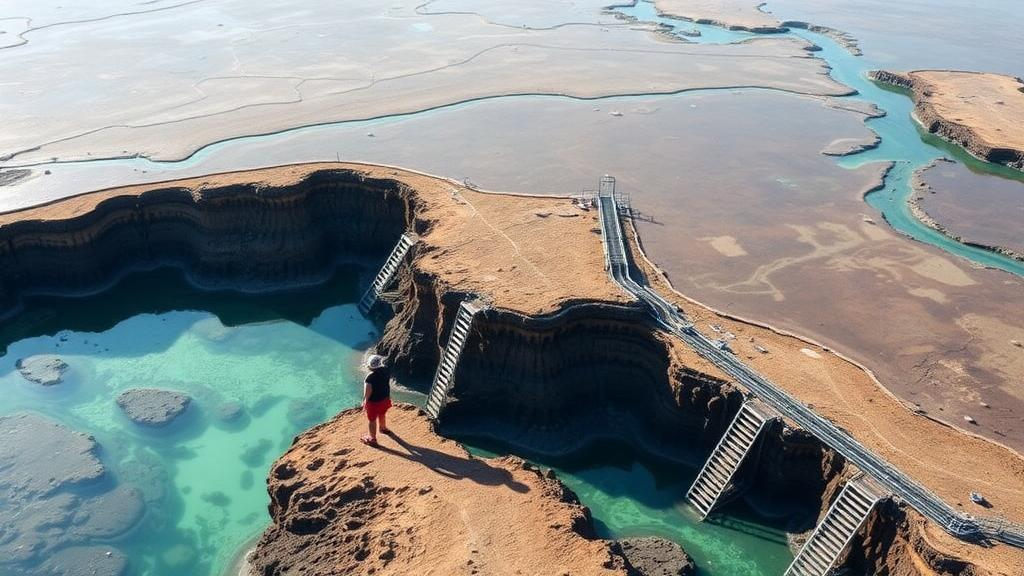
Beneath the wheat and maize fields of China’s North China Plain, water is being pulled from the ground faster than nature can put it back. Decades of intensive irrigation pumping have driven groundwater levels steadily downward, drained aquifer storage, and weakened the natural buffering capacity of one of the world’s most heavily exploited groundwater systems. Predicting how these levels will rise and fall has become a critical challenge for regional water security, and a new study published in iScience offers a fresh answer: a deep learning model that does not just crunch numbers, but is taught the basic physics of how aquifers actually behave.
The research, led by Xiandong Xie and Baizhong Yan of Hebei Province, focuses on Guantao County, a flat agricultural district in Handan City where the winter wheat and summer maize cropping system demands enormous volumes of irrigation water. The team assembled daily groundwater-level records from four shallow and four deep monitoring wells, along with precipitation, potential evapotranspiration, and reconstructed daily agricultural pumping data spanning 2017 through 2024. These wells were deliberately spread across the county’s three distinct groundwater exploitation zones, giving the researchers a spatially varied window into how different parts of the aquifer system respond to the same regional pressures.
At the heart of the study is a tension familiar to anyone working in hydrological modeling. Physically based numerical groundwater models require detailed knowledge of aquifer structure, boundary conditions, and hydrogeological parameters, information that is often incomplete, expensive, or simply unavailable in heavily farmed regions. Data-driven machine learning models, by contrast, can learn patterns directly from monitoring records, but they are essentially statistical curve-fitters. When pumping intensity shifts or recharge conditions change, a purely statistical model can drift into physically implausible territory, and its predictions offer managers little insight into why the water table is moving the way it is.
The researchers’ solution is a process-guided gated recurrent unit, or PG-GRU. A GRU is a type of recurrent neural network that uses gating mechanisms to decide what historical information to retain and what to discard, making it efficient at capturing temporal dependencies in hydrological time series. What sets the PG-GRU apart is that its training is steered by an additional loss term, a process residual that encodes simplified hydrological knowledge. While the network fits the observed water levels, it is simultaneously penalized if its predictions violate a lumped description of how groundwater levels should change in response to recharge, depletion, pumping, and recovery.
Crucially, the team did not impose a single set of physics on all eight wells. Shallow and deep aquifers behave differently, and the model reflects that. For shallow wells, the process guidance combines precipitation recharge, potential evapotranspiration losses, daily pumping, and a recovery term that pulls levels back toward a reference state. For deep wells, where daily meteorological fluxes have weak direct effects, the guidance instead emphasizes cumulative pumping disturbances, represented by moving-average abstraction series over 30-, 60-, or 90-day windows, together with recovery. The coefficients in these equations are optimized alongside the network weights, acting as effective lumped response parameters rather than true hydrogeological constants, a distinction the authors are careful to make.
The performance gains, while incremental, are consistent and meaningful. At the daily scale, the PG-GRU reduced the mean root-mean-square error for shallow wells by about 7.2 percent compared with a conventional GRU, from 0.1967 meters to 0.1825 meters, while the Nash-Sutcliffe efficiency rose to 0.9802. For deep wells, the mean RMSE fell by roughly 6.1 percent to 0.1533 meters, with NSE reaching 0.9988. When the best-performing pumping window was selected for each deep well, the relative improvement climbed to approximately 12 percent, an absolute error reduction of nearly two centimeters. At the coarser dekadal, or ten-day, scale, improvements were smaller, around 4 percent for shallow wells and 2.5 percent for deep wells, because temporal aggregation smooths away many of the short-term signals that process guidance helps capture.
The model also outperformed simpler benchmarks. Multiple linear regression and support vector regression were tested alongside the GRU variants, and the PG-GRU achieved the lowest group-mean RMSE for both shallow and deep wells at both temporal scales. The advantages were most visible during periods of rapid groundwater-level change, exactly the intervals that matter most for early warning in overexploited regions. When the team removed the pumping term from the process residual in a control model, performance degraded, particularly for shallow wells, confirming that explicitly representing agricultural abstraction adds real predictive value rather than decorative complexity.
Perhaps the most intriguing finding concerns time. Deep groundwater does not respond to pumping on a single characteristic timescale, and the sensitivity analysis made that vivid. At the daily scale, the 30-day pumping window produced the lowest four-well mean RMSE, yet individual wells preferred different windows: D1 and D3 performed best with 90 days, D2 with 60 days, and D4 with just 30 days. At the dekadal scale, the 60-day window won on average, while the 90-day window actually performed slightly worse than the plain GRU baseline, suggesting that overly long smoothing can wash out the very disturbance signals the model needs. The lesson is that representing cumulative pumping effects requires matching the temporal window to each well’s response characteristics, not applying a one-size-fits-all averaging period.
The authors are candid about the limits of their work. The process residual provides soft, lumped guidance rather than a solution of the full groundwater flow equations, and vertical leakage and lateral regional flow were not explicitly represented. The monitoring network of eight wells is modest, so the shallow-versus-deep differences observed here should not be read as universal laws of unconfined and confined aquifers. Uncertainties also linger in the reconstructed pumping series, which for 2017 through 2022 were converted from electricity-consumption records using locally calibrated electricity-to-water relationships, and the pumping windows were prescribed rather than learned adaptively by the model.
Even so, the study points toward a compelling future for water management in stressed aquifers worldwide. Centimeter-level gains in predictive accuracy translate into better detection of decline, recovery, and turning points, sharper anomaly detection, and a more trustworthy basis for adjusting pumping quotas and zoning groundwater extraction. The team suggests that future versions could incorporate more wells, spatially explicit pumping distributions, aquifer architecture, and learnable response timescales, potentially through graph-structured or multi-well joint models. As climate variability and agricultural demand continue to squeeze the North China Plain and similar breadbaskets elsewhere, models that blend data-driven flexibility with hydrological common sense may become indispensable tools for keeping precious groundwater systems from slipping past the point of recovery.
Subject of Research: Physics-guided deep learning for multi-timescale groundwater-level prediction under agricultural pumping in the North China Plain
Article Title: Aquifer-differentiated process-guided GRU for multi-timescale groundwater-level prediction
Article References: Xie, X., Yan, B., Wang, T., Han, C., Wei, C., Zhai, Y., Lv, J., & Zhang, M. (2026). Aquifer-differentiated process-guided GRU for multi-timescale groundwater-level prediction. iScience, 29(11), Article 117832. https://doi.org/10.1016/j.isci.2026.117832
Image Credits: AI Generated
DOI: Not provided
Keywords: groundwater, deep learning, GRU, physics-informed machine learning, North China Plain, aquifer, agricultural pumping, water resources, time-series prediction, hydrology, Guantao County, groundwater overexploitation
News Source: Katie Riggs. (October 12, 2026). AI Learns the Physics of Sinking Aquifers to Predict Groundwater Futures. Scienmag.