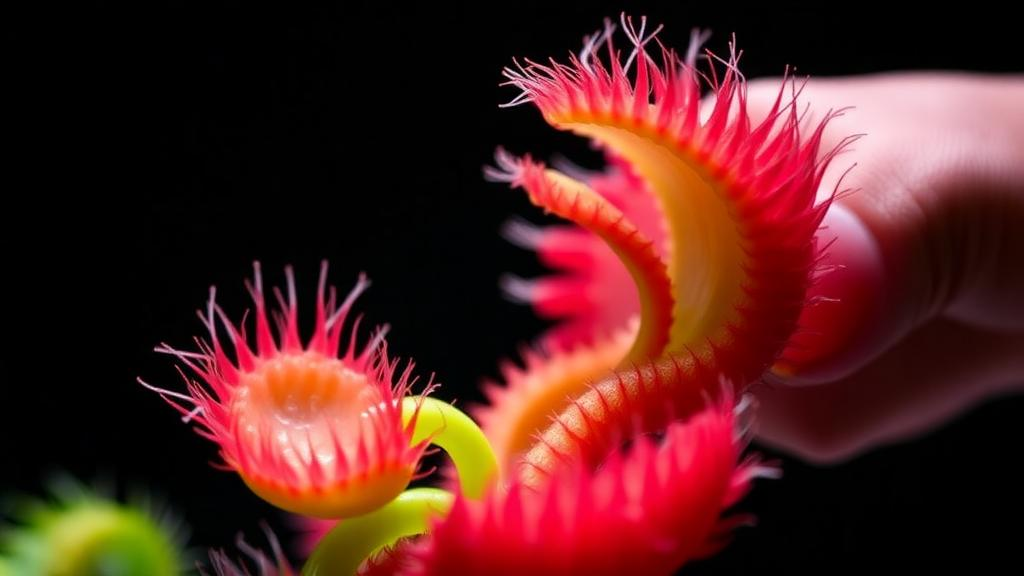
When a Venus flytrap snaps shut on an unsuspecting insect, it performs a feat that roboticists have long struggled to replicate: it senses, decides, and acts with a single integrated structure, with no separate wires connecting its trigger hairs to its closing leaves. A research team at the Korea Advanced Institute of Science and Technology (KAIST), led by Professor Hong Chul Moon of the Department of Chemical and Biomolecular Engineering, has now taken a significant step toward bringing that biological elegance into engineered materials. The team has unveiled the Ionograsper, an ionic soft material that can detect an approaching object without touching it, bend to grasp that object when illuminated with ultraviolet light, and then hold its deformed shape for more than ten minutes after the light is switched off. The work was published online in the international journal Advanced Materials on September 14, 2026, and was selected as the front cover article of Issue 62.
The central problem the researchers set out to address is one that haunts the entire field of soft robotics. Conventional robots rely on a strict division of labor: sensors detect the environment, controllers process the information, and actuators generate movement. In rigid industrial robots, this separation is manageable, because the components can be bolted together with predictable wiring. Soft robots, however, are designed to bend, stretch, and deform flexibly, and bolting discrete sensors and actuators onto such structures multiplies the number of components, increases the amount of wiring, and complicates the overall architecture. Every additional cable is a potential point of failure and a constraint on the natural motion that soft robots are meant to deliver. The KAIST team’s answer was to collapse the roles of skin and muscle into a single polymer film, so that the same material both perceives and moves.
The material itself is a carefully engineered ionic network. In chemistry, an ionic material contains ions, which are small particles carrying either a positive or a negative electric charge, and it is precisely this mobile charge population that allows the material to respond to electrical changes in its surroundings. To build the Ionograsper, the researchers combined azobenzene, a light-responsive compound whose molecular shape changes when it absorbs light, with a hygroscopic polymer that absorbs moisture from the air. Polymers, the workhorse substances of this design, are materials made of small molecules linked into long chains, and plastics and rubber are the most familiar examples. By weaving the photoresponsive azobenzene units into the moisture-loving polymer matrix, the team created a network structure in which ions can migrate freely, setting the stage for both sensing and actuation within one continuous medium.
The sensing mechanism is perhaps the most striking aspect of the design, because it requires no applied sensing voltage at all. When an electrically charged object approaches the material, its electric field reaches into the film and causes the positive and negative ions inside to redistribute. Positive ions drift one way, negative ions the other, and this rearrangement produces a measurable electrical signal even though nothing has physically touched the material. The researchers used this self-generated signal to detect the approach and movement of nearby objects, effectively turning the ambient electric field of the environment into the trigger for perception. It is a principle that echoes the flytrap’s trigger hairs, which convert a mechanical stimulus into an electrical impulse, but here the stimulus is electrostatic proximity rather than contact.
Actuation, by contrast, is driven by light. When the material is irradiated with ultraviolet light, the azobenzene molecules change their molecular shape as they absorb the photons, and at the same time moisture escapes from the irradiated side of the film. The asymmetry between the drying, contracting illuminated face and the moisture-retaining opposite face causes the material to bend toward the light. This photomechanical bending is what allows the Ionograsper to close around an object, in the same way that the two lobes of a Venus flytrap curl inward to secure their prey. Because the bending is triggered remotely by light rather than by embedded heaters, pneumatic lines, or electric motors, the actuation scheme is inherently compatible with the minimal-wiring philosophy that motivated the project.
Shape retention is the third function, and it is what elevates the design from a curiosity to a practical candidate for robotic grippers. When the ultraviolet light is turned off, moisture re-enters the material through nanoscale pores that formed on its surface during irradiation. This rehydration drives the material to bend in the opposite direction, and the film holds its deformed shape for more than ten minutes, until the polymer structure slowly relaxes back toward equilibrium. In practical terms, this means the light source does not need to remain switched on for the material to maintain its grasping position. For a soft robotic hand, that translates directly into lower energy consumption, since power is spent only to initiate the grip rather than to sustain it, and the release notes that the Ionograsper compares favorably with previously reported soft actuators in both power consumption and shape-holding duration.
What makes the study a defining contribution, according to the researchers, is that all three capabilities, proximity sensing, light-driven movement, and temporary shape retention, are realized within a single material rather than assembled from separate devices. The team did not stop at demonstration; they also analyzed how light-induced changes at the molecular level and in the moisture content of the film give rise to bidirectional bending and shape retention, providing a mechanistic understanding of the coupled processes. This kind of integrated multifunctionality, in which one material performs the work of a sensor, an actuator, and a shape-memory element simultaneously, is rare in soft matter engineering and points toward a future in which robotic bodies are built from materials that are, in a meaningful sense, their own nervous systems.
Professor Hong Chul Moon framed the achievement in terms of simplification and integration. Rather than attaching a robot’s skin and muscles separately, he explained, the team created a single material that senses objects and moves when it receives light, and a key feature is that it maintains its deformed shape even after the light is turned off. He added that the team plans to combine the material with artificial intelligence control technologies and to develop it into a sensing and actuation material for physical AI robots, the emerging class of machines that must interpret and manipulate the physical world with minimal human supervision. The vision is a robotic hand whose very substance performs the perception and the grasping, leaving the computational layer free to focus on higher-level decisions.
The work remains firmly at the research stage, and the team is candid about its current limitations. The material at present detects electrically charged objects, which means uncharged targets would not trigger the ion-redistribution sensing mechanism, and its actuation depends on ultraviolet light, a wavelength band that is less convenient than visible light for many practical settings. The researchers have laid out a clear roadmap for the next phase: increasing the sensing distance, accelerating the actuation speed, improving durability under repeated use, and enhancing the load-bearing capacity of the film. They also plan to make the material responsive to visible or near-infrared light, which would broaden its compatibility with everyday illumination and with the low-power optical sources favored in compact robotic systems.
The study, titled A Multifunctional Ionograsper Enabling Ion-Redistribution Proximity Sensing and Structural-Reconfiguration-Driven Bidirectional Actuation, was a collaborative effort across institutions. Professor Yong Min Kim of the School of Chemical Engineering at Jeonbuk National University served as first author, joined by co-authors Jin Han Kwon, Hyeon Woo Yang, Sungryong Kim, and Gyeong Rok Lee of KAIST, with Professor Hong Chul Moon of KAIST’s Department of Chemical and Biomolecular Engineering as corresponding author. The research was supported by a National Research Foundation of Korea grant funded by the Korean Ministry of Science and ICT, and by the Nano and Material Technology Development Program through the NRF, also funded by the Ministry of Science and ICT. If the team’s planned improvements succeed, the humble Venus flytrap may end up teaching engineers not just how to build a better gripper, but how to dissolve the boundary between a robot’s senses and its muscles altogether.
Subject of Research: A multifunctional ionic soft material integrating proximity sensing, light-driven actuation, and shape retention for soft robotics
Article Title: KAIST develops a Venus flytrap-inspired ‘robot hand’ material that senses objects and grasps them under light
Article References: KAIST develops a Venus flytrap-inspired ‘robot hand’ material that senses objects and grasps them under light. (n.d.). Original publication
Image Credits: AI Generated
DOI: Not provided
Keywords: soft robotics, ionic materials, Venus flytrap, biomimetics, actuators, proximity sensing, azobenzene, shape retention, UV light, KAIST, polymers, physical AI
News Source: Denise Maddox. (October 11, 2026). Venus Flytrap-Inspired Soft Material Senses Objects and Grasps Under Light. Scienmag.