Low-frequency noise is one of the most stubborn problems in modern acoustics. Sound waves below a few hundred hertz diffract around ordinary barriers and penetrate deep into structures, and the devices traditionally used to absorb them scale with wavelength, quickly becoming impractically bulky. In aerospace applications, where rocket launches generate punishing acoustic loads and combustion instabilities threaten engine reliability, the problem is acute. In recording studios and concert halls, intrusive bass rumble degrades sound quality in ways that conventional treatments cannot fix. Now, a team of researchers reporting in Advanced Science has unveiled a compact acoustic resonator that uses magnetic negative stiffness to absorb broadband low-frequency sound beyond what thermodynamics was thought to allow, potentially rewriting the rules of noise control.
The fundamental obstacle is the stiffness of air itself. When sound compresses the air inside a resonator cavity, the trapped air behaves like a stiff spring, and this stiffness grows as the cavity shrinks. A compact device therefore has a very stiff air cavity, and to push its resonance down to useful low frequencies, engineers must add a large acoustic mass. The result is a sharp, narrow absorption peak that misses most of the noise spectrum. Passive approaches such as porous materials help by converting the compression of air from an isentropic process into an isothermal one, which lowers the effective stiffness by a factor equal to the ratio of specific heats for air, roughly 7/5. But even this so-called thermodynamic limit demands cavity depths on the order of one-eighth of a wavelength, which at 100 hertz means tens of centimeters of depth per absorber.
The key insight behind the new work is that instead of adding mass, one should reduce stiffness, and the most powerful way to do that is with negative stiffness. A structure exhibits negative stiffness when, upon being displaced from equilibrium, it generates a force in the same direction as the displacement, producing a negative slope in its force-displacement curve. Because magnetic attraction and repulsion scale with the inverse square of distance, magnets are a natural source of such behavior. The idea of using magnetic negative stiffness against the positive stiffness of an air cavity was first explored theoretically in 2000, but subsequent experimental attempts ran into two recurring failure modes: initial force imbalance and rotational instability of the moving magnetic element, both of which introduced parasitic stiffness that canceled the intended benefit.
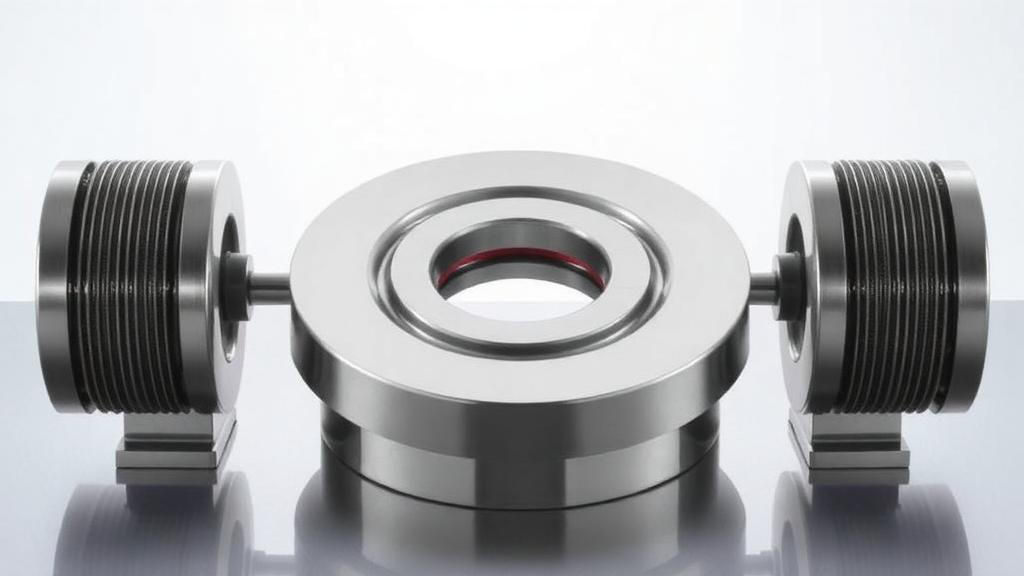
The new device, called the Acoustic Resonator with Magnetic Bearing, or aRMB, solves these problems with an elegant arrangement. A fixed outer ring magnet faces a moving inner magnetic disk across a fixed radial air gap, so the negative stiffness arises from repulsive forces rather than attraction. The inner disk is attached to a rigid steel rod that slides in a linear ball bearing, which constrains the angular motion that plagued earlier designs while allowing nearly friction-free axial movement. Radial stability comes for free from the magnet geometry itself: displace the disk sideways and the magnetic forces push it back to center, so the magnetic pair functions as a contactless bearing. Calculations show this configuration delivers 1.96 times the negative stiffness of a comparable attraction-based design for the same magnet volume, and shrinking the radial gap can boost the effect further.
To quantify progress, the researchers introduced a stiffness ratio kappa, defined as the sum of the magnetic negative stiffness and any parasitic positive stiffness, divided by the original stiffness of the pure air cavity. A value of zero means the negative stiffness has exactly canceled all parasitic stiffness, matching the thermodynamic baseline of a plain air cavity. A value of minus 2/7 corresponds to the limit achieved by filling the cavity with porous material. Values between minus 1 and zero represent genuinely effective negative stiffness that beats the thermodynamic limit, while dynamic stability requires the ratio to stay above minus 1. Fitting their model to previously published data, the team found that earlier magnetic and buckling-plate devices never actually reached this effective regime; their fitted stiffness ratios remained stubbornly positive, meaning parasitic effects had swallowed the benefit.
Experimentally, the team tested the aRMB in an impedance tube using the standard two-microphone transfer function method. The moving assembly, a piston of about 20.6 grams, oscillates against a 90-millimeter-deep cavity. With no magnets, the resonance sat at 79.1 hertz and the stiffness ratio measured a positive 0.22, matching theory. As progressively stronger magnet types were installed, the ratio fell to minus 0.01, minus 0.25, and finally minus 0.35, driving the resonance down to 57.8 hertz while the acoustic mass stayed constant. Crucially, the strictest comparison, against the bare air-cavity stiffness without any suspension, showed the total stiffness reduced by a factor of 1.57, which the authors identify as the first demonstrated breakthrough of magnetic negative stiffness over classic resonator designs.
The head-to-head comparison with the classic approach is striking. At a 70-millimeter cavity depth, the magnet-enhanced resonator shifted its resonance from 85.6 to 62.8 hertz and reached a stiffness ratio of minus 0.40, already beyond the porous-material thermodynamic limit of minus 0.286. Tuned against an optimized perforated-panel design targeting the same frequency and damping, the aRMB delivered 1.57 times the total low-frequency absorption and a bandwidth 65 percent wider over the two lowest octaves from 31 to 125 hertz. The device also proved robust: absorption curves were essentially identical at sound pressure levels from 95 to 105 decibels, and simulations indicate stable linear operation up to about 125 decibels, near the threshold of pain, beyond which the magnet displacement exceeds a critical point of no return.
The potential goes further still. By narrowing the magnet air gap from 3.5 to 2.5 millimeters and replacing the acrylic plate with a lightweight conical diaphragm inspired by loudspeaker construction, simulations show the stiffness ratio could reach minus 0.80, equivalent to making the effective cavity five times deeper. Under those conditions, the total absorption over the 31-to-125-hertz range would rise 3.21-fold relative to the best classic design, with an effective bandwidth five times broader. The authors caution that these advanced configurations pose real manufacturing challenges, since tighter tolerances make the system sensitive to misalignment and an imperfect diaphragm can excite unwanted higher-order modes. But these are engineering hurdles, not barriers of principle.
What makes the work compelling is its decoupling of acoustic performance from physical size. For decades, the pursuit of deep subwavelength metamaterial absorbers has often produced complicated structures whose added mass exceeds the optimum and whose stiffness is left untouched or even increased. By contrast, stiffness tuning with magnetic negative stiffness lowers the optimal mass as well, compounding the broadband benefit. The researchers suggest their platform could seed a new class of acoustic metamaterials for aerospace, transportation, and consumer electronics, wherever miniaturization and low-frequency performance collide. If the manufacturing challenges can be mastered, the humble resonator, reinvented with a magnetic bearing, may finally bring compact, broadband silence within reach.
Subject of Research: Magnetic negative stiffness in compact acoustic resonators for broadband low-frequency sound absorption
Article Title: Absorption of Broadband Low‐Frequency Sound Beyond the Thermodynamics Limit: An Acoustic Resonator With Magnetic Bearing
Article References: Hu, Y., Zhang, Z., Huang, B., Han, X., Kilcoyne, H. B., & Huang, L. (2026). Absorption of Broadband Low‐Frequency Sound Beyond the Thermodynamics Limit: An Acoustic Resonator With Magnetic Bearing. Advanced Science, 13(56), Article e76584. https://doi.org/10.1002/advs.76584
Image Credits: AI Generated
DOI: 10.1002/advs.76584
Keywords: acoustics, negative stiffness, magnetic bearing, sound absorption, low-frequency noise, acoustic resonator, acoustic metamaterials, thermodynamic limit, impedance tube, noise control, aerospace, stiffness tuning
News Source: Denise Maddox. (October 11, 2026). Magnetic Bearing Resonator Shatters the Thermodynamic Limit of Low-Frequency Sound Absorption. Scienmag.