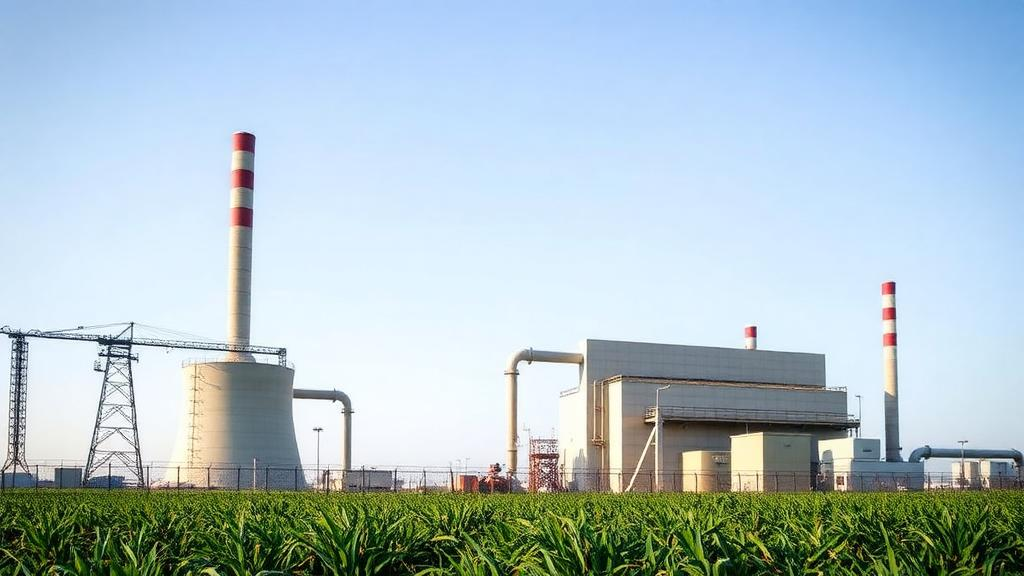
Across Europe, thousands of biogas power plants hum along day and night, burning methane produced by fermenting organic waste and crops, generating electricity and heat with almost no regard for what the electricity market actually needs. In an era when wind and solar floods the grid on sunny afternoons and vanishes on calm winter evenings, that rigid, heat-driven operating mode wastes one of the continent’s few dispatchable renewable resources. A new modeling study published in the journal Heliyon by Felix Meurer, Michael Bucksteeg, and Christoph Weber of the University of Duisburg-Essen asks a deceptively simple question: what would it take, economically and politically, to make these plants flex with the grid instead of against it?
The answer, according to their large-scale simulations of the entire European electricity system, is a combination of stronger carbon pricing and a temporary, carefully designed subsidy that nudges operators toward market-oriented behavior. Neither instrument alone is likely to be sufficient, the researchers argue, and the reasoning behind that conclusion reveals a great deal about how the value of flexibility emerges, and sometimes fails to emerge, in modern power markets.
To understand the problem, it helps to look at how biogas plants are built and regulated. Most European biogas electricity comes from combined heat and power units that are contractually obligated to supply a local district heating network. Because heat demand must be met whenever it arises, the plants effectively run as must-run generators, burning gas continuously regardless of electricity prices. Yet the underlying resource has latent flexibility: biogas can be accumulated in storage tanks before combustion, heat can be buffered in thermal storage, and the generating unit itself can be oversized relative to the rated gas flow so that it can run hard for a few hours and then rest. The study characterizes four representative German plant types, with overbuilding factors ranging from about 1.25 to 2.17 and gas storage capacities of six to nine hours, capturing the real diversity of the roughly 5.18 gigawatts of flexible-capable biogas capacity in Germany.
The researchers embedded this detailed plant representation into the WILMAR Joint Market Model, an optimization-based simulation of the European electricity market that schedules every generation unit across all 8,760 hours of a year to minimize total system costs. The model captures fuel and carbon costs, start-up expenses, minimum run times, part-load efficiencies, reserve requirements, cross-border transmission, and even regional district heating markets. For the case study, the team simulated the year 2025 using weather data from 2016, fuel prices from before the European energy crisis, and carbon prices ranging from a low of 26 euros per tonne, echoing the pre-2020 era, to a reference of 70 euros, a higher sensitivity at 90 euros, and an ambitious 110 euros consistent with a trajectory toward 180 euros by 2030.
The baseline comparison between flexible and inflexible operation produced results that are striking precisely because they are modest. Flexible operation shifts biogas generation out of low-demand hours and into high-demand hours, following daily price swings. Plant operators earn more per megawatt-hour, but not dramatically more: between 1.3 percent for the least flexible configurations and 6.9 percent for the most flexible ones. In absolute terms, that is roughly 1 euro to nearly 5 euros of additional revenue per megawatt-hour sold under the 70-euro carbon price. The gains concentrate in the plant types with large storage and high overbuilding, which can concentrate their entire production into the most lucrative hours. Flexibility also carries costs, most visibly in the form of frequent start-ups. The most flexible plant types go from essentially one or two starts per year to around 800, adding thousands of euros per megawatt in start-up costs. Crucially, the additional revenue clearly overcompensates those extra costs, meaning that for plants already equipped with the hardware, flexible operation is economically rational even without any new policy support.
At the system level, the effects are real but constrained by the sheer scale of the grid. When biogas plants feed more electricity during high residual-load hours, they displace some generation from natural gas plants and pumped hydro storage, trim imports, and slightly reduce output from coal and lignite. In low-load hours, reduced biogas output mainly means fewer exports. The net effect on cross-border flows is tiny, around 0.1 terawatt-hours of additional net imports for Germany, and the smoothing effect on residual load gradients is minimal. Still, Europe-wide carbon dioxide emissions fall by about 0.4 megatonnes, and system costs drop. Under the reference scenario, German system costs fall by roughly 33 million euros, while under the 110-euro carbon price the reduction reaches nearly 110 million euros, because higher carbon prices enlarge the price spreads that flexible operation can exploit.
That last observation is central to the paper’s economic logic. Flexibility, the authors emphasize, is not a commodity with intrinsic value; its worth derives entirely from price volatility in the market it serves. Carbon pricing widens the gap between hours when coal- and gas-fired plants set the price and hours when wind, solar, or nuclear do, because it raises the marginal costs of fossil generation. Higher carbon prices therefore do double duty: they generally increase the profitability of carbon-neutral biogas and, more importantly for this analysis, they amplify the reward for shifting generation into expensive hours. The simulations show that every additional 20 euros per tonne of CO2 increases the contribution margin gained through flexible operation by up to about 1.15 euros per megawatt-hour. When the carbon price rises from 70 to 110 euros, the flexible-operation premium for the best-configured plants grows from about 4.80 euros to more than 7 euros per megawatt-hour.
The subsidy alternative works differently. The researchers modeled a bonus-malus scheme in which operators receive an ex-post payment of 10 euros per megawatt-hour for feeding in during the six highest-priced hours of each day, while paying an identical penalty for generating during the six cheapest hours. Inflexible plants pay and receive roughly equal amounts, so the scheme confers no windfall on unchanged behavior. Flexible plants, by contrast, can avoid the malus entirely and collect the bonus, boosting their premium to between roughly 1.9 and 9.3 euros per megawatt-hour depending on plant configuration. In the modeled configuration, the net bonus payments amount to about 38.6 million euros per year, a figure comparable to the societal benefit measured as system cost savings. Because the scheme only alters payments after the fact, it strengthens market signals without distorting the price ordering that governs power plant dispatch.
Why not simply rely on the subsidy, or on carbon pricing alone? The authors’ discussion makes clear that the choice hinges on two deep uncertainties. The first is operator behavior: the model assumes perfect coordination and ignores transaction costs, perceived risks, limited automation, and the administrative burden of responding to hourly prices. Relax those assumptions, and the modest computed benefits of flexibility could shrink or vanish, especially for small rural plants with limited digital infrastructure. Germany’s own experience is instructive here: investment subsidies did succeed in prompting operators to install oversized engines, yet the plants were subsequently operated just as inflexibly as before, suggesting that hardware incentives alone do not change habits. The second uncertainty is political: nobody can reliably predict whether the European Union’s Emissions Trading Scheme will sustain its current elevated price levels, let alone climb toward the trajectories assumed in decarbonization pathways. If carbon prices slump back toward pre-2020 levels, the market’s own incentive for flexible biogas operation weakens considerably.
Hence the study’s policy prescription, which is neither pure market ideology nor permanent interventionism. Strengthen the carbon price signal, through the EU ETS or carbon taxes, so that the fundamental economics of decarbonization reward low-carbon, dispatchable technologies like biogas. At the same time, deploy the bonus-malus subsidy as a temporary behavioral nudge, perhaps for five years, long enough for operators to adopt flexible practices and learn that they pay, but short enough to limit fiscal risk and avoid entrenching a new class of permanent support. Once the practice takes hold, persistent market incentives should sustain it without public money. The researchers note that similar dynamics are emerging globally, from Japan’s Green Transformation carbon pricing strategy to growing interest in biogas across Asia and North America, where flexible bioenergy could likewise stabilize grids dominated by variable renewables. For now, the German case offers the clearest lesson: Europe’s biogas fleet is a sleeping giant of flexibility, and waking it will take both the quiet discipline of the carbon market and a well-timed shove from policy.
Subject of Research: Incentivizing the flexible, market-oriented operation of biogas combined heat and power plants in Europe through carbon pricing and targeted subsidies
Article Title: Incentivizing flexible operation of biogas power plants in Europe – subsidies, markets, or both?
Article References: Meurer, F., Bucksteeg, M., & Weber, C. (2026). Incentivizing flexible operation of biogas power plants in Europe – subsidies, markets, or both?. Heliyon, 12(15), Article e45566. https://doi.org/10.1016/j.heliyon.2026.e45566
Image Credits: AI Generated
DOI: Not provided
Keywords: biogas, flexibility, carbon pricing, EU ETS, subsidies, combined heat and power, renewable energy, electricity markets, energy system modeling, energy transition, Germany, grid integration
News Source: Drew Townsend. (October 11, 2026). Carbon prices and smart subsidies could unlock the hidden flexibility of Europe’s biogas plants. Scienmag.