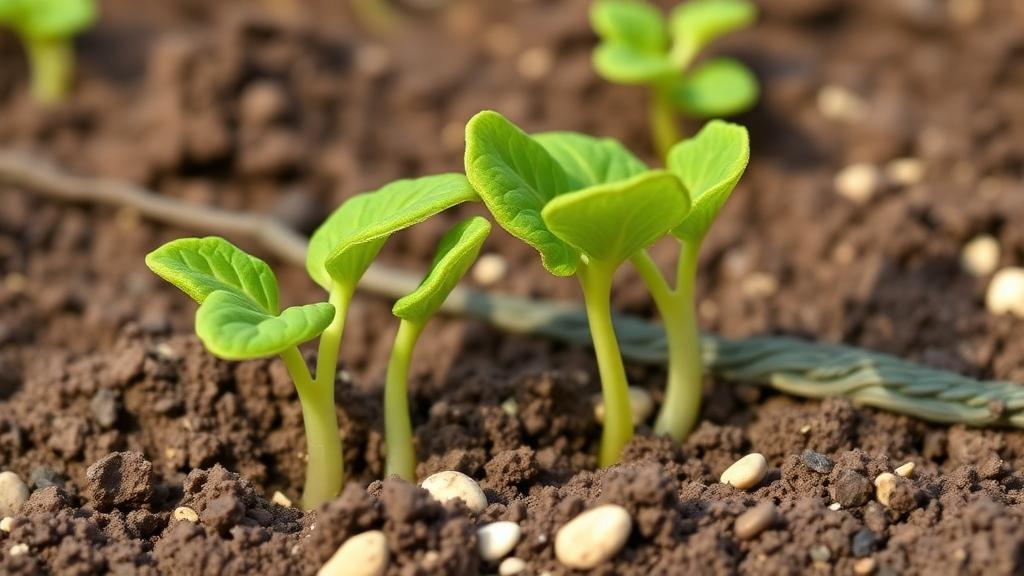
When a seedling breaks through the soil, it faces one of the most dramatic transformations in biology. For most plants, this moment—known as de-etiolation—involves switching from growth in darkness, fueled entirely by stored reserves, to a light-driven, photosynthetic lifestyle. In a new study published in BMC Plant Biology, researchers have revealed how the castor bean plant, Ricinus communis, manages this precarious transition even when its roots are bathed in salty water, and the answer lies in a surprisingly strategic triage system operating inside the seedling’s cotyledons.
Cotyledons, the seed leaves that emerge first from a germinating seed, are usually short-lived structures. In most dicotyledonous crops they wither and drop off within days of germination, their job of fueling early growth quickly done. Castor bean is different. It belongs to a group of epigeal species whose cotyledons persist, turn green, and become fully functional photosynthetic organs. This persistence makes them a critical window of opportunity: if the seedling can establish photoautotrophic capacity in its cotyledons, it gains a foundation for survival that transient cotyledons simply cannot provide.
The research team, led by Jingyao Tian, Yingnan Wang, Xiaoxia Deng, Yueming Li and Jixiang Lin, set out to determine what happens to this delicate process when salt stress enters the picture. Salinity is among the most serious environmental constraints on crop production worldwide, imposing both osmotic stress, which makes it harder for roots to take up water, and ionic stress, in which sodium and chloride ions accumulate to toxic levels. Understanding how salt affects the earliest stages of photosynthetic development could therefore have far-reaching implications for growing oilseed crops in saline soils.
The experiment was elegantly simple in design. Castor bean seedlings were exposed to a salt solution of 150 millimolar sodium chloride, a concentration that represents meaningful agricultural stress, while being brought into the light. The researchers then sampled the cotyledons at five time points—0, 2, 6, 12 and 24 hours of illumination—to track, in fine detail, how the greening process unfolded under saline versus normal conditions. This time-course approach allowed them to capture the dynamics of de-etiolation as it happened, rather than merely comparing endpoints.
The results showed that salt stress significantly delayed cotyledon de-etiolation. The mechanism of this delay was traced to disruptions in the assembly of thylakoid membrane protein complexes, the intricate molecular machinery embedded within chloroplast membranes that captures light energy and converts it into chemical energy. Chloroplast ultrastructural development was also impaired, meaning the internal architecture of these organelles—the stacked membranes and fluid-filled spaces where photosynthesis takes place—failed to develop normally under salt exposure during the early hours of light exposure.
Yet the story did not end with damage and delay. As de-etiolation progressed beyond the first twelve hours, the cotyledons mounted a remarkable selective recovery. Rather than attempting to repair everything at once, the seedlings appeared to prioritize the protection of photosystem II integrity, the light-harvesting complex that splits water molecules and provides the electrons that drive the entire photosynthetic electron transport chain. Photosystem II is particularly vulnerable to stress because of its complex architecture and its role in generating reactive oxygen species when damaged, making its protection a logical first line of defense.
This prioritization manifested in several coordinated ways. The cotyledons enhanced their absorption of potassium ions, a strategy that helps maintain ionic homeostasis by counterbalancing the sodium that floods in under saline conditions. Pigment contents rose as well, with elevated levels of both chlorophyll and carotenoids. Chlorophyll is the primary light-capturing pigment, while carotenoids serve a protective role, dissipating excess light energy as heat before it can cause oxidative damage. Together, these increases augmented the photoprotective capacity of the cotyledons at precisely the moment when their developing photosynthetic apparatus was most at risk.
At the protein level, the researchers documented a sophisticated reallocation of resources across the thylakoid membrane. The cotyledons increased the turnover of two critical reaction center proteins: PsaC, the core protein of photosystem I, and PsbA, better known as the D1 protein of photosystem II. The D1 protein is famous among plant biologists as the most rapidly turned-over protein in the chloroplast, constantly damaged by light and continuously replaced. Under salt stress, the castor bean cotyledons accelerated this repair cycle while simultaneously enhancing electron transport mediated by the cytochrome b6f complex, the molecular bridge that shuttles electrons between the two photosystems. The net effect was a photosynthetic apparatus that prioritized photosystem II functional integrity and basal metabolism, accepting reduced photosystem I capacity as the price of keeping the core light reactions running.
The broader significance of these findings extends beyond basic plant physiology. The authors argue that persistent cotyledons of Ricinus communis are not merely transient organs during early germination but serve as a growth buffer and recovery foundation for seedlings under salt stress. By coordinating the modulation of thylakoid membrane protein complexes during de-etiolation, the cotyledons act as the critical window during which the seedling establishes its photoautotrophic capacity—the ability to feed itself through photosynthesis. A seedling that successfully navigates this window, even under salinity, emerges with a far better chance of long-term establishment than one whose cotyledons fail during this period.
This selective recovery mechanism offers new insights into the adaptive functions of persistent cotyledons and provides a theoretical basis for improving seedling establishment in castor bean and other salt-tolerant oilseed crops grown in saline soils. As agricultural pressure pushes cultivation onto marginal, salt-affected land, understanding how the earliest stages of a plant’s life can be buffered against salinity becomes increasingly valuable. The castor bean’s strategy—triage at the molecular level, protecting what matters most first—may well inform future breeding and biotechnological approaches aimed at engineering crops that can green successfully even when the ground beneath them is salt-laden.
Subject of Research: Thylakoid protein adaptation in castor bean cotyledons during de-etiolation under salt stress
Article Title: Functional persistence of cotyledons under salinity: thylakoid protein adaptation during de-etiolation in Ricinus communis
Article References: Tian, J., Wang, Y., Deng, X., Li, Y., & Lin, J. (2026). Functional persistence of cotyledons under salinity: thylakoid protein adaptation during de-etiolation in Ricinus communis. BMC Plant Biology. https://doi.org/10.1186/s12870-026-10030-w
Image Credits: AI Generated
DOI: 10.1186/s12870-026-10030-w
Keywords: Ricinus communis, cotyledons, de-etiolation, salinity stress, thylakoid membrane proteins, photosystem II, chloroplast development, potassium homeostasis, D1 protein turnover, cytochrome b6f, seedling establishment, oilseed crops
News Source: Alan Morgan. (October 11, 2026). Castor Bean Seedlings Fight Salt by Shielding Their Photosynthetic Cotyledons. Scienmag.