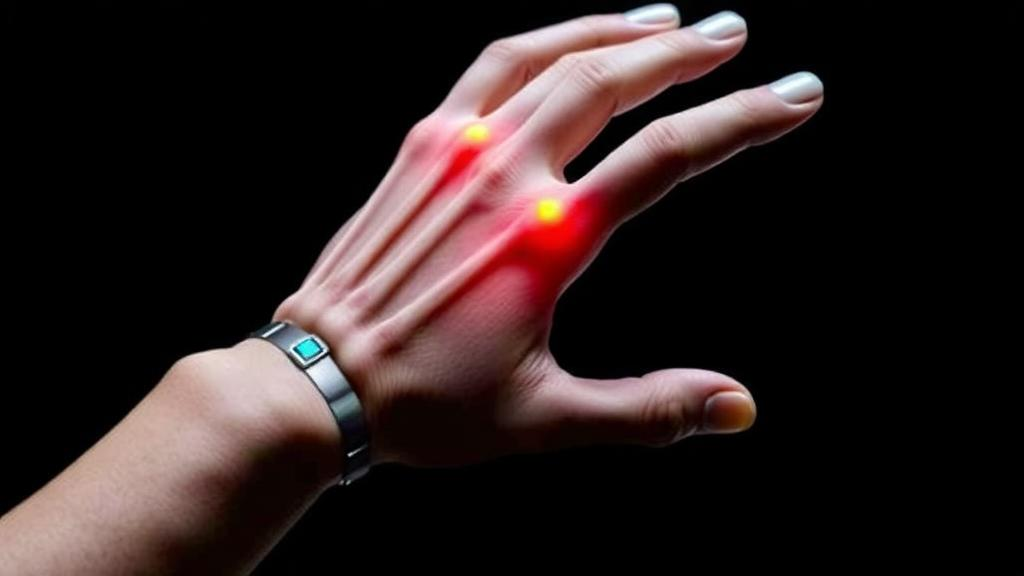
For millions of people living with limb amputation, the interface between the residual limb and a prosthetic socket is a place of constant, invisible negotiation. Pressure that is too high or unevenly distributed can cause discomfort, inflammation, and even skin ulceration, while phantom limb pain and disrupted sensation in the remaining tissue can undermine both prosthetic use and rehabilitation. What has been missing, argue researchers at Zhejiang University of Technology, is a sensing system that does not merely measure pressure but actually perceives it the way biological skin does: locating a touch in real time, judging its intensity, and accumulating harmful stimuli over time into something the nervous system would recognize as pain. Their answer, described in a new study published in Cyborg and Bionic Systems, is a bioinspired perceptual sensor, or BPS, that brings those two perceptual worlds together in a single flexible device.
The architecture of the BPS deliberately mirrors the division of labor found in human skin, where separate populations of mechanoreceptors and nociceptors feed distinct but interacting neural pathways. The haptic module is built around a piezoelectric sensor made from P(VDF-TrFE), a ferroelectric polymer that generates electrical signals in direct response to mechanical deformation. Because piezoelectric devices respond almost instantaneously to changes in load, this pathway can rapidly report where a stimulus lands on the sensing array, how strong it is, and precisely when it is applied or released. The pain module takes a different route: a piezoresistive sensor based on laser-induced graphene embedded in polydimethylsiloxane, coupled to an electrolyte-gated indium tin oxide synaptic transistor. That transistor is the crucial ingredient, because it behaves less like a switch and more like a biological synapse, with electrical activity that depends on its own history.
This distinction matters because most existing tactile systems draw a crude line between touch and pain. A pressure reading crosses a predefined threshold, an alarm sounds, and nothing about the response adapts or remembers. Biological nociception is far richer: signals integrate over time and space, repeated or prolonged stimulation sensitizes the system so that previously tolerable inputs begin to hurt, and sustained adaptation can desensitize it. The chitosan-gated synaptic transistor in the BPS reproduces these dynamics intrinsically. When stimulated, it exhibits excitatory postsynaptic currents, paired-pulse facilitation, and a gradual transition from short-term to long-term plasticity, while its accumulated response grows with stimulus intensity, duration, frequency, and repetition. In other words, the device does not just detect a harmful stimulus; it builds up a memory-like representation of it, emulating pain sensitization and desensitization without any external computation.
The two modules were integrated into a compact 2 by 2 bimodal flexible sensing array, supported by signal-conditioning circuits and a microcontroller that allowed parallel tactile sensing and neuromorphic pain processing to run side by side. The team began by rigorously characterizing the individual components, and the numbers are striking. The piezoresistive pain sensor achieved a sensitivity of 57.9 kPa⁻¹ in the low-pressure range, the regime most relevant to skin-socket contact, with response and recovery times of 31 and 43 milliseconds. The piezoelectric haptic sensor was faster still, responding in as little as 5 milliseconds and recovering in 4, and it remained stable after 2,000 loading cycles, a benchmark of durability that matters enormously for a device intended to be worn all day against moving skin.
Characterization alone, however, would not demonstrate perception. To test whether the BPS could act on what it sensed, the researchers mounted it in a robotic hand and built a closed-loop system around it. The robot successfully distinguished harmless from harmful stimuli, and when the accumulated pain signal exceeded a threshold, it triggered a rapid avoidance response, pulling away from the offending contact. More remarkably, after experiencing a painful event, the system lowered its subsequent warning threshold, so that weaker stimuli now provoked avoidance as well. This is a conditioned-reflex-like behavior, directly analogous to the way a person who has burned a hand becomes newly cautious around warm objects. The protective logic emerged from the sensor’s own synaptic plasticity rather than from a rule written into software, which is precisely what makes the demonstration significant for the field of neuromorphic sensing.
The most consequential test came next. The team deployed the BPS at the residual limb–prosthetic socket interface in participants with transtibial amputation, the most common form of lower-limb loss. During sitting, walking, stair climbing, jumping, and running, the sensor simultaneously recorded the spatial distribution of pressure and pain-related risk signals across the interface. This dual readout allowed the researchers to identify abnormal loading patterns, the hotspots where excessive or repetitive pressure threatens skin integrity, and to support movement adjustment in response. For prosthetic fitting, where clinicians currently rely heavily on subjective reports and intermittent measurements, a continuous, quantitative map of both comfort and harm represents a genuine advance.
Ye Qiu, a researcher at Zhejiang University of Technology and lead author of the study, framed the problem the device solves. Recent approaches that combine pressure sensors with neuromorphic elements such as memristors or transistors, he noted, offer a route toward integrated sensing, processing, and memory, but existing systems still struggle to simultaneously achieve precise real-time localization for haptic perception and the temporal and spatial integration required for pain sensing. Developing a bioinspired perceptual system capable of jointly decoding haptic location and intensity together with spatiotemporal pain information, he argued, is an important step toward more effective sensory restoration and protective feedback in intelligent prostheses. The BPS is designed to be exactly that joint solution, with two synergistic pathways rather than a single modality bolted onto a threshold alarm.
The significance of the work, the researchers contend, lies in unifying real-time haptic localization with spatiotemporal pain accumulation within one perceptual system, producing sensory feedback that more closely resembles human somatosensory processing than conventional pressure-mapping or fixed-threshold warning systems. Because the piezoelectric and neuromorphic pathways operate in parallel, the BPS can identify where and how hard something touches the limb while simultaneously emulating pain-related features such as accumulation, sensitization, and desensitization. That combination supports closed-loop robotic avoidance today and points toward prosthetic rehabilitation feedback tomorrow, with potential applications spanning prosthetic fit assessment, residual-limb health monitoring, and real-time movement adjustment for amputees navigating daily life.
The study is also a showcase of interdisciplinary engineering. The author list spans Ye Qiu, Shihan Wang, Qiangqiang Qian, Yu Yan, Weisheng Wang, Xiu Jia, Shengwei Fan, Yuan Bao, Ye Tian, Yi Song, Aiping Liu, Liu Wang, Liqiang Zhu, and Huaping Wu, drawing together expertise in flexible electronics, materials science, neuromorphic devices, and rehabilitation. The work was supported by the National Natural Science Foundation of China, the National Key Research and Development Program of China, the Natural Science Foundation of Zhejiang Province, and the Fundamental Research Funds for the Provincial Universities of Zhejiang, reflecting sustained institutional investment in the emerging field of bionic and cyborg systems.
The researchers are candid that the human trials conducted so far are feasibility verification rather than clinical deployment. Qiu stated that the team will expand the number of subjects and the types of amputations studied, and will further improve wireless integration, medical-grade packaging, long-term wearing stability, and sensor fixation reliability during dynamic motion, with the goal of advancing the system toward long-term wearable intelligent prosthetics and clinical rehabilitation applications. Those are formidable engineering challenges, since a sensor that performs beautifully in the laboratory must survive sweat, shear, and thousands of gait cycles against living skin. Yet the trajectory is clear. If devices like the BPS mature, prosthetic limbs may one day not only replace lost movement but carry something approaching the body’s own early-warning system, feeling the world and flinching before injury occurs.
Subject of Research: A bioinspired perceptual sensor integrating artificial mechanoreceptors and synaptic transistors for decoding haptic and pain stimuli in prosthetic limbs
Article Title: A bioinspired perceptual sensor for spatiotemporal decoding of haptic and pain stimuli in prostheses
Article References: A bioinspired perceptual sensor for spatiotemporal decoding of haptic and pain stimuli in prostheses. (n.d.). Original publication
Image Credits: AI Generated
DOI: Not provided
Keywords: bioinspired sensor, haptic perception, pain sensing, synaptic transistor, neuromorphic computing, prosthetics, flexible electronics, piezoelectric sensor, piezoresistive sensor, residual limb monitoring, somatosensory feedback, rehabilitation
News Source: Denise Maddox. (October 11, 2026). Bioinspired Sensor Gives Prosthetic Limbs a Human-Like Sense of Touch and Pain. Scienmag.