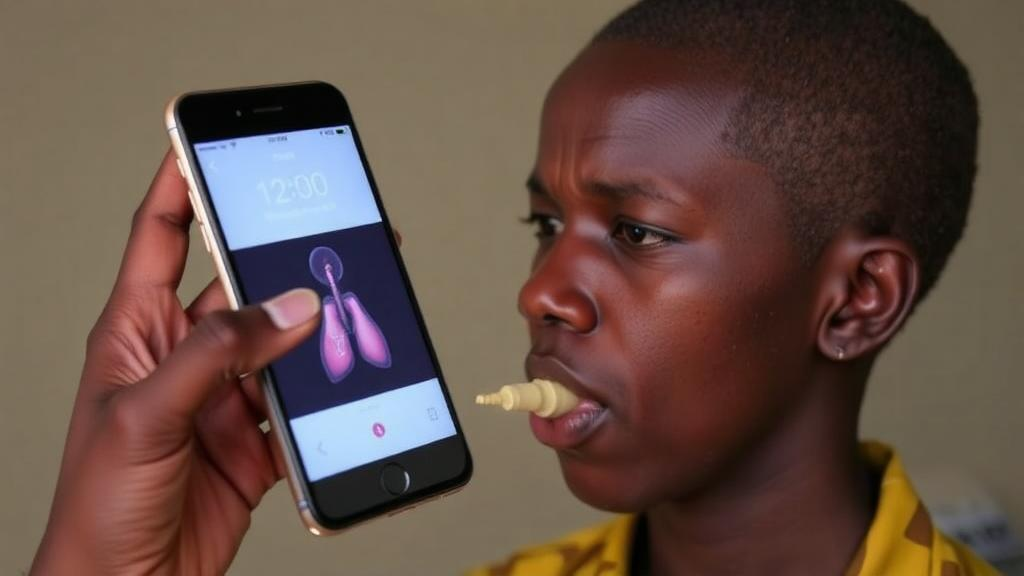
Tuberculosis remains one of the world’s deadliest infectious diseases, and one of its most stubborn diagnostic challenges is deceptively simple: figuring out who actually needs a test. For decades, health programs have relied on a single question—do you have a cough?—to decide who gets referred for sputum testing. But self-reported cough is notoriously unreliable. People cough without noticing, downplay symptoms because of stigma, or report coughs that stem from asthma, smoking, or ordinary colds. A new study from Uganda, published in PLOS Global Public Health, put a technologically elegant alternative to the test: letting smartphones listen, passively and continuously, to see whether the frequency of a person’s coughs could reveal hidden tuberculosis.
The research, led by Patrick Biché of Johns Hopkins University together with colleagues at Makerere University and Ugandan clinical partners, enrolled 884 adults aged 15 and older across two very different settings. Some participants were screened in community settings, where the goal was to find undiagnosed cases among people who had not sought care. Others were tested at health facilities in Kampala, where patients had already come in with symptoms. Every participant underwent microbiological reference testing—the gold standard of Xpert MTB/RIF Ultra molecular testing combined with sputum culture—while also carrying a smartphone running the Hyfe Research app for 48 hours of continuous, passive audio monitoring. The app’s algorithms detect and count cough events automatically, producing an objective, hour-by-hour record of cough frequency without requiring the participant to remember or report anything.
The results, published January 10, 2026, tell a story of genuine biological signal undermined by practical reality. Among the 197 participants who had both valid cough recordings and a definitive TB status—101 from the community arm and 96 from the facility arm—people with tuberculosis coughed measurably more often than people without it. In community settings, the median cough frequency among those with TB was 2.2 coughs per hour, compared with 0.9 coughs per hour among those without the disease. In facilities, the gap was wider: 6.7 coughs per hour for people with TB versus 2.4 for those without. Both differences were highly statistically significant, with Wilcoxon tests yielding P values below 0.0001.
That statistical significance, however, did not translate into diagnostic power strong enough for the field. Using inverse probability weighting to correct for the fact that not every enrolled participant completed both the monitoring and the microbiological testing, the researchers constructed receiver operating characteristic curves and calculated the area under the curve, or AUC, a standard measure of diagnostic discrimination. The smartphone-derived cough frequency achieved an AUC of 0.69 in community settings and 0.76 in facilities. In practical terms, that means the measurement performs meaningfully better than a coin flip but well below the thresholds generally demanded of a stand-alone screening or triage tool, where AUCs approaching 0.90 are typically expected before a test can safely sort patients into testing pathways.
The comparison with conventional symptom screening is instructive. When the researchers analyzed self-reported cough at a fixed sensitivity of 90 percent—meaning the threshold chosen to catch nine out of ten true TB cases—the specificity was a meager 55 percent in community settings and just 36 percent in facilities. In other words, the current standard of care flags enormous numbers of people who do not have tuberculosis, particularly among patients already presenting at clinics, where cough is such a common complaint that it barely discriminates at all. Passive cough monitoring, even at its current modest accuracy, sits in the same rough performance territory as symptom questions, which raises an obvious question: could a device that never forgets and never exaggerates eventually do better than a question that depends entirely on human memory and honesty?
The study also probed whether the smartphone measurements captured something real about respiratory health more broadly. Recorded cough frequency correlated moderately with self-reported cough severity, with scores on the Saint George’s Respiratory Questionnaire—a validated instrument for measuring the impact of lung disease on daily life—and with coughs directly observed by clinic staff during encounters. This triangulation matters. It suggests the app was genuinely detecting coughing behavior rather than ambient noise, speech, or artifacts, lending credibility to the underlying technology even as its diagnostic ceiling became apparent.
But the quantitative results were only half the study. In a mixed-methods design, the team also interviewed the staff who administered the monitoring, then analyzed the transcripts thematically to understand why implementation proved difficult. The barriers they identified were sobering and, in many cases, predictable in hindsight. The phones were visible objects that participants had to carry for two full days, making the monitoring conspicuous in communities where tuberculosis carries heavy stigma and where being seen with a study device could invite unwanted questions about one’s health status. Security concerns added another layer: participants worried about theft or loss of the devices, and staff worried about accountability for expensive equipment distributed in low-resource settings.
These operational frictions had measurable consequences. Only 197 of 884 enrolled participants contributed both valid recordings and definitive TB status, a loss that reflects failed recordings, incomplete monitoring periods, and missing reference tests. The researchers used inverse probability weighting to mitigate the resulting bias, but the attrition itself is a finding: a screening technology is only as good as its ability to function in the hands and pockets of the people it is meant to serve. A cough monitor that produces clean data in a controlled study but fails when carried through markets, buses, and crowded households will not survive contact with real-world deployment.
None of this means the approach is dead. The study’s authors are careful to frame the results as an early evaluation of a technology still under development rather than a verdict on its potential. Cough monitoring has theoretical advantages that symptom questions cannot match: it is continuous rather than episodic, objective rather than subjective, and it generates a quantitative signal that could eventually be combined with other data—symptom scores, risk factors, perhaps acoustic features of the coughs themselves beyond simple frequency—to build more accurate triage algorithms. Machine learning approaches to cough sound analysis are advancing rapidly elsewhere, and frequency counting is arguably the crudest possible use of the audio stream a smartphone can capture.
What the Ugandan study delivers is a clear-eyed map of the road ahead. The biological signal is real: people with tuberculosis do cough more, and a passive smartphone app can detect the difference at a population level. The diagnostic accuracy is not yet sufficient, and the implementation barriers—stigma, device visibility, and security—are not peripheral annoyances but central design problems that any future deployment must solve, perhaps through less conspicuous form factors, shorter monitoring windows, or community-engaged protocols that address stigma directly. For a disease that kills well over a million people each year, most of them in exactly the low-resource settings where this study took place, the prize remains enormous: a screening tool that costs almost nothing beyond a phone many people already own. This study does not hand over that tool, but it rigorously documents both the promise and the price of getting there, and that kind of honest evaluation is precisely what the field needs before the next generation of cough-monitoring technology reaches the communities that stand to benefit most.
Subject of Research: Smartphone-based passive cough frequency monitoring for tuberculosis screening and triage in Uganda
Article Title: Evaluating smartphone-based cough frequency monitoring for tuberculosis screening and triage in Uganda: A mixed-methods evaluation
Article References: Biché, P., Kayondo, F., Nalutaaya, A., Mukiibi, J., Nantale, M., Sung, J., Dowdy, D. W., Katamba, A., & Kendall, E. A. (2026). Evaluating smartphone-based cough frequency monitoring for tuberculosis screening and triage in Uganda: A mixed-methods evaluation. PLOS Global Public Health, 6(10), e0005201. https://doi.org/10.1371/journal.pgph.0005201
Image Credits: AI Generated
DOI: 10.1371/journal.pgph.0005201
Keywords: tuberculosis, smartphone cough monitoring, screening, triage, Uganda, diagnostic accuracy, Hyfe Research app, Xpert MTB/RIF Ultra, cough frequency, implementation barriers, global health, PLOS Global Public Health
News Source: Ophelia Keating. (October 11, 2026). Smartphone Cough Monitoring Shows Promise but Falls Short for Tuberculosis Screening in Uganda. Scienmag.