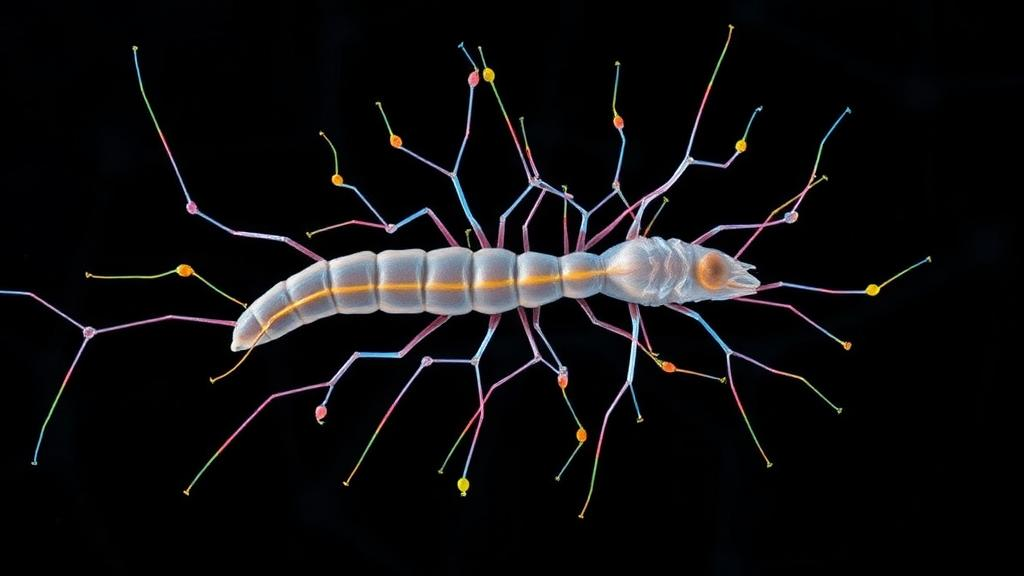
In the tiny roundworm Caenorhabditis elegans, a handful of cells perform one of development’s most demanding feats: they crawl from the animal’s midsection all the way to its tail, navigating past neighbors and barriers to take up a precise final position. A new study published in PLOS Genetics by Vedant D. Jain, Andrew M. Johannesen, Felipe L. Teixeira, and Erik A. Lundquist shows that this journey depends on an unexpectedly broad coalition of well-known neuronal guidance molecules, all funneled through a single Hox gene program. The findings, available under DOI 10.1371/journal.pgen.1012303, suggest that rather than acting as independent signposts, several classic guidance pathways may physically cooperate in one large extracellular signaling complex that a Hox transcription factor switches on at exactly the right time and place.
The migrating cells in question are the descendants of the Q neuroblast, a stem-cell-like precursor on each side of the worm. Hox genes, the famous architects of body patterning, have long been implicated in nervous system development across the animal kingdom, yet the molecular machinery that executes Hox instructions downstream has remained murky. In C. elegans, the antennapedia-like Hox factor MAB-5 is both necessary and sufficient to drive posterior migration of the Q neuroblast descendants, making this system a uniquely clean model for asking what a Hox protein actually tells a cell to do when it needs to move.
The researchers focused on the left-side QL lineage, where MAB-5 activity triggers a carefully choreographed, three-stage migration. In each stage, the cells first extend a lamellipodium, a sheet-like protrusive structure, toward the posterior of the animal, and then translocate their cell bodies in the same direction. The endpoint of this odyssey is strikingly specific: the QL.ap cell differentiates into the PQR neuron, which must settle just posterior to the anus. If any stage of the migration falters, the PQR ends up in the wrong place, giving researchers a visible and quantifiable readout of the underlying machinery.
Earlier work from the same field had established that MAB-5 turns on a gene called efn-4, which encodes an Ephrin ligand. Ephrins and their Eph receptors are among the most celebrated guidance molecules in biology, best known for steering axons and migrating cells in vertebrate embryos. When efn-4 is mutated, the third and final stage of QL.ap migration fails, and the PQR neuron comes to rest immediately anterior to the anus instead of behind it. That subtle but previously undescribed phenotype was the clue that opened the current investigation: if disrupting one guidance ligand produces such a precise defect, other known neuronal development genes might be hiding in the same process.
To hunt for them, the team systematically screened worms carrying mutations in established signaling pathways, scoring each mutant for the telltale third-stage PQR placement defect. Three suspects emerged. Disruptions in SAX-3, the worm homolog of the Robo receptor that responds to Slit cues in other animals, produced the phenotype. So did disruptions in UNC-6, the nematode version of Netrin, another canonical guidance ligand family. Finally, perturbing heparan sulfate proteoglycans, sugar-decorated extracellular molecules famous for modulating growth factor and guidance signals, also derailed the final migration stage. The fact that three separate, textbook signaling systems all converge on the same microscopic event is the study’s central surprise.
Intriguingly, the effects of losing any one of these pathways in isolation were weak compared with the dramatic failure seen in efn-4 mutants. That asymmetry hinted that the pathways are not acting in parallel, redundantly backing each other up. The researchers therefore built double mutants, combining mutations in pairs of the identified pathways, and asked whether the defects would synergize, producing far worse outcomes than either single mutant alone. They did not. The absence of genetic synergy is a classic signature of molecules operating in a single common pathway rather than in independent, additive branches, and it reframed the entire question: these guidance systems are not competitors or backups but collaborators in one mechanism.
That genetic conclusion gains plausibility from biochemical work by another research group, cited in the study, showing in vitro that the extracellular domains of these very molecules can bind one another, forming connected communities of interacting proteins and glycans. Ephrins, Robo-family receptors, Netrins, and heparan sulfate proteoglycans are all deployed at the cell surface or in the extracellular matrix, exactly where such a complex would need to assemble. The new genetic data thus dovetail with physical interaction data to suggest a model in which the migrating QL.ap cell assembles, or encounters, a large multi-component extracellular signaling platform whose parts only function properly together.
The model the authors propose is elegant in its division of labor. MAB-5, the Hox transcription factor, acts inside the nucleus to drive expression of EFN-4/Ephrin in the QL.ap cell. EFN-4 then serves as a seed, nucleating the formation of an extracellular signaling complex that incorporates SAX-3/Robo signaling, UNC-6/Netrin signaling, and heparan sulfate proteoglycans. Once assembled, this complex drives the formation of the posterior lamellipodium, the protrusive engine of migration, and thereby pushes the cell body posteriorward in the final stage. In this view, the Hox gene does not micromanage the cytoskeleton directly; instead, it specifies which guidance hardware gets built, and the hardware does the moving.
For developmental biologists, the significance extends well beyond a single neuron in a worm. Hox genes pattern the nervous systems of animals from flies to humans, and a persistent puzzle has been how these transcription factors, which regulate other genes rather than touching the migration machinery themselves, achieve such spatially precise outcomes. The C. elegans work provides a concrete answer in one case: a Hox protein can specify a single extracellular ligand, and that ligand can recruit a whole ecosystem of guidance molecules into a functional complex. If similar Hox-to-Ephrin-to-complex logic operates in other contexts, it could explain how broadly expressed guidance systems produce sharply localized developmental decisions.
The study also carries a methodological lesson that resonates with current trends in genetics. The PQR defect is subtle, a neuron displaced by a small distance rather than a grossly malformed animal, and it surfaced only because the researchers looked for it deliberately. Many genes with mild single-mutant phenotypes are dismissed as unimportant, yet the double-mutant analysis here shows that such genes can be essential components of a shared pathway whose full importance only appears when the anchor gene, efn-4, is removed. As screens grow ever more sensitive and quantitative, the worm’s migrating neuron stands as a reminder that some of development’s most interesting wiring is hidden in its smallest errors, waiting for the right phenotype to be measured.
Subject of Research: Hox-dependent control of Q neuroblast migration by convergent Ephrin, Robo, Netrin, and heparan sulfate proteoglycan signaling in C. elegans
Article Title: EFN-4/Ephrin converges with SAX-3/Robo, UNC-6/Netrin, and Heparan Sulfate Proteoglycan signaling to control MAB-5/Hox-dependent posterior Q neuroblast migration in Caenorhabditis elegans
Article References: Jain, V. D., Johannesen, A. M., Teixeira, F. L., & Lundquist, E. A. (2026). EFN-4/Ephrin converges with SAX-3/Robo, UNC-6/Netrin, and Heparan Sulfate Proteoglycan signaling to control MAB-5/Hox-dependent posterior Q neuroblast migration in Caenorhabditis elegans. PLOS Genetics, 22(9), e1012303. https://doi.org/10.1371/journal.pgen.1012303
Image Credits: AI Generated
DOI: 10.1371/journal.pgen.1012303
Keywords: C. elegans, Hox genes, MAB-5, Ephrin, Robo, Netrin, heparan sulfate proteoglycans, neuroblast migration, PQR neuron, lamellipodium, developmental biology, PLOS Genetics
News Source: Juliet Wilcox. (October 11, 2026). Worm Study Reveals How Hox Genes Steer Migrating Neurons Through a Web of Guidance Signals. Scienmag.