• HOME
  • NEWS
  • EXPLORE
    • CAREER
      • Companies
      • Jobs
    • EVENTS
    • iGEM
      • News
      • Team
    • PHOTOS
    • VIDEO
    • WIKI
  • BLOG
  • COMMUNITY
    • FACEBOOK
    • INSTAGRAM
    • TWITTER
Thursday, April 2, 2026
BIOENGINEER.ORG
No Result
View All Result
  • Login
  • HOME
  • NEWS
  • EXPLORE
    • CAREER
      • Companies
      • Jobs
        • Lecturer
        • PhD Studentship
        • Postdoc
        • Research Assistant
    • EVENTS
    • iGEM
      • News
      • Team
    • PHOTOS
    • VIDEO
    • WIKI
  • BLOG
  • COMMUNITY
    • FACEBOOK
    • INSTAGRAM
    • TWITTER
  • HOME
  • NEWS
  • EXPLORE
    • CAREER
      • Companies
      • Jobs
        • Lecturer
        • PhD Studentship
        • Postdoc
        • Research Assistant
    • EVENTS
    • iGEM
      • News
      • Team
    • PHOTOS
    • VIDEO
    • WIKI
  • BLOG
  • COMMUNITY
    • FACEBOOK
    • INSTAGRAM
    • TWITTER
No Result
View All Result
Bioengineer.org
No Result
View All Result
Home NEWS Science News Biology

CCNY physicists master unexplored electron property

Bioengineer by Bioengineer
July 25, 2017
in Biology
Reading Time: 2 mins read
0
Share on FacebookShare on TwitterShare on LinkedinShare on RedditShare on Telegram
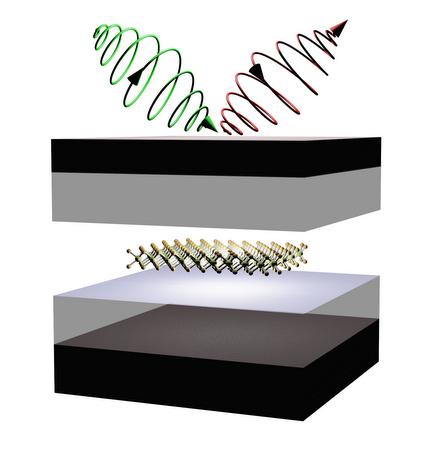
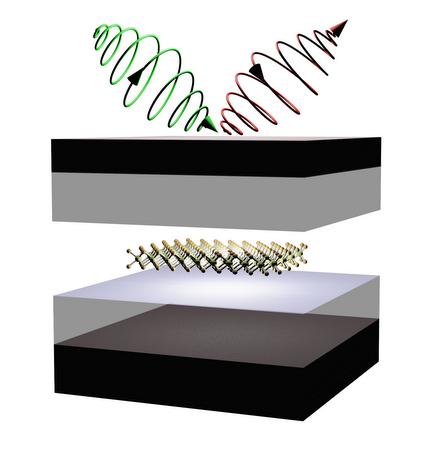
IMAGE

Credit: Image courtesy: Zheng Sun

While the charge and spin properties of electrons are widely utilized in modern day technologies such as transistors and memories, another aspect of the subatomic particle has long remained uncharted. This is the "valley" property which has potential for realizing a new class of technology termed "valleytronics" – similar to electronics (charge) and spintronics (spin). This property arises from the fact that the electrons in the crystal occupy different positions that are quantum mechanically distinct.

Now City College of New York physicists led by Vinod Menon have demonstrated how to manipulate the "valley" property using light by placing two-dimensional semiconductors in a light trapping structure called microcavity. This gave rise to half-light-half matter quasi-particles which have the fingerprint of the "valley" property. These quasi-particles were then optically controlled using a laser to access the electrons occupying specific "valley." The research appears in the latest issue of Nature Photonics and is a major step towards realization of "valleytronic" devices for logic gates.

"Observing this property in traditional semiconductors was not easy. However with the advent of the new class of two-dimensional semiconductors, this property became accessible to manipulation," said Zheng Sun, a graduate student in Menon's research group and lead author of the paper.

###

Other researchers included CCNY graduate students, Jie Gu and Christopher Considine; undergraduate Michael Dollar, postdoctoral researcher Biswanath Chakraborty, Zav Shotan, and Xiaoze Liu; physics professor Pouyan Ghaemi and his postdoctoral researcher Areg Ghazaryan; and Stephane Kena-Cohen (Ecole Polytechnic, Montreal, Canada) also participated in the study.

The work was supported by the NSF through the EFRI 2-DARE program, the ECCS division, the Columbia-CCNY NSF MRSEC Center, the US Army Research Office and a Discovery grant from the Natural Sciences and Engineering Research Council of Canada.

Media Contact

Jay Mwamba
[email protected]
212-650-7580

http://www2.ccny.cuny.edu

Original Source

https://www.ccny.cuny.edu/news/ccny-physicists-master-unexplored-electron-property

Share12Tweet8Share2ShareShareShare2

Related Posts

Newly Discovered Chronic Pain Circuit Unveils Potential Avenues for Innovative Treatments

Newly Discovered Chronic Pain Circuit Unveils Potential Avenues for Innovative Treatments

April 2, 2026
DNA Transforms from Blueprint to Active Field Agent

DNA Transforms from Blueprint to Active Field Agent

April 2, 2026

UBC Okanagan Study Reveals How Trees Visually Signal Their Spring Rehydration

April 1, 2026

Rising Temperatures from Climate Change Associated with Reduced Newborn Size

April 1, 2026
Please login to join discussion

POPULAR NEWS

  • blank

    Revolutionary AI Model Enhances Precision in Detecting Food Contamination

    96 shares
    Share 38 Tweet 24
  • Imagine a Social Media Feed That Challenges Your Views Instead of Reinforcing Them

    1007 shares
    Share 398 Tweet 249
  • Promising Outcomes from First Clinical Trials of Gene Regulation in Epilepsy

    51 shares
    Share 20 Tweet 13
  • Popular Anti-Aging Compound Linked to Damage in Corpus Callosum, Study Finds

    44 shares
    Share 18 Tweet 11

About

We bring you the latest biotechnology news from best research centers and universities around the world. Check our website.

Follow us

Recent News

Bioinspired Asymmetric Design Powers Soft Robotics Actuators

Examining Replicability in Social and Behavioral Sciences

Stoichiometric FeTe Exhibits Superconductivity Breakthrough

Subscribe to Blog via Email

Enter your email address to subscribe to this blog and receive notifications of new posts by email.

Join 78 other subscribers
  • Contact Us

Bioengineer.org © Copyright 2023 All Rights Reserved.

Welcome Back!

Login to your account below

Forgotten Password?

Retrieve your password

Please enter your username or email address to reset your password.

Log In
No Result
View All Result
  • Homepages
    • Home Page 1
    • Home Page 2
  • News
  • National
  • Business
  • Health
  • Lifestyle
  • Science

Bioengineer.org © Copyright 2023 All Rights Reserved.