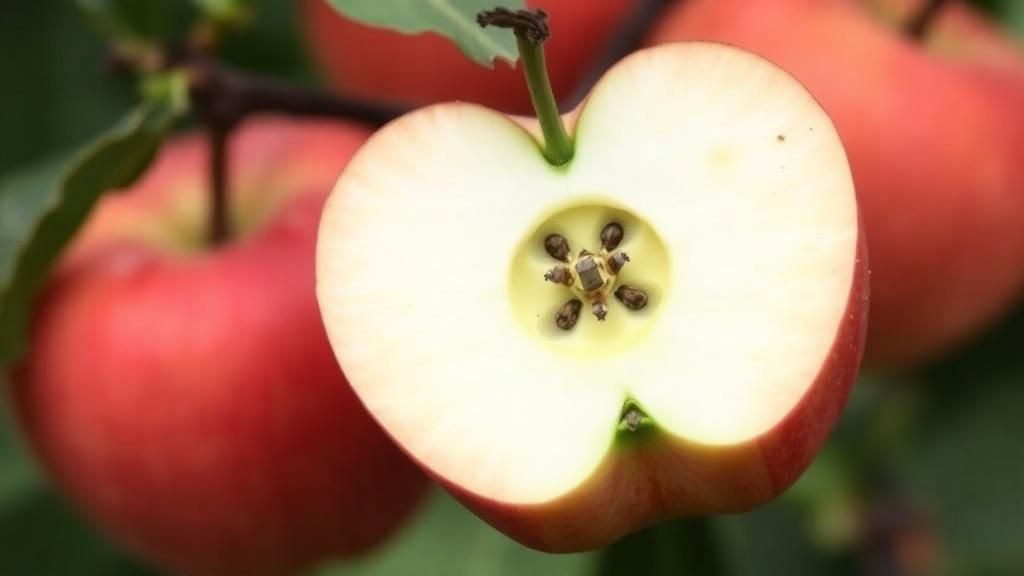
Some plants cheat. Instead of mixing genes through the usual lottery of sexual reproduction, they produce seeds that are essentially clones of themselves, a phenomenon known as apomixis. For crop breeders, the ability to lock a prized hybrid combination into every single seed would be revolutionary, eliminating the need to repeatedly cross parent lines to maintain elite varieties. Yet apomixis remains rare, poorly understood outside a handful of species, and notoriously difficult to detect. A new study published in PLOS Genetics by Charity Z. Goeckeritz, Václav Polcar, Benjamin Gutierrez, Tomáš Urfus, and Alex Harkess now offers plant scientists a faster, cheaper way to find it, and in doing so has uncovered more than a dozen previously unknown apomictic genotypes hiding in plain sight within the United States Department of Agriculture’s apple germplasm collection.
The research team focused on the genus Malus, which includes domesticated apple and its wild relatives. Maintained as living libraries, germplasm collections preserve thousands of genetically distinct accessions from around the world, and they have long been suspected of harboring rare reproductive quirks. The challenge has always been one of scale. Confirming that a plant produces clonal seeds requires comparing the genetic makeup of a mother plant with that of her offspring, traditionally one seedling at a time using laborious molecular markers. With hundreds of accessions and dozens of embryos per accession, the workload quickly becomes prohibitive.
For more than two decades, the dominant screening tool has been flow cytometry, a technique that measures the amount of DNA in individual nuclei. Because apomictic embryos often carry different ploidy levels than their sexual counterparts, for example when an unreduced egg cell is fertilized or when an embryo develops directly from maternal tissue, flow cytometry can flag suspicious seeds quickly. But the method provides only indirect information about the actual genetics of an embryo. It reveals DNA content, not DNA sequence, and it can fail entirely in species whose seed biology or tissue chemistry interferes with the measurement. In Malus, where embryos can show a confusing range of ploidy states even under normal sexual reproduction, flow cytometry alone can leave researchers guessing.
The team’s solution was to turn to whole-genome sequencing, but at deliberately low coverage. Rather than reading an organism’s genome many times over to build a near-complete assembly, they sequenced at an average depth of just 3X to 6X, meaning each position in the genome was read only three to six times on average. At such shallow depth, assembling genomes is impossible, but that is not the goal. Instead, the approach relies on comparing large numbers of genetic variants scattered across the genome between a maternal parent and each of its embryos. If an embryo inherited two identical copies of every chromosome from the mother, as expected under apomixis, the pattern of variants will differ dramatically from that of a sexually produced embryo, which receives only half of its chromosomes from each parent and shuffles them through recombination.
To test the method, the researchers sequenced 55 diverse Malus genotypes and a remarkable 1,216 of their embryos. The scale of the embryo sequencing is what gives the approach its power. Each embryo acts as an independent test of the mother’s reproductive mode, and with more than a thousand data points, the statistical signal of clonal reproduction becomes unmistakable even in noisy, low-coverage data. Out of this effort, the team identified 17 previously undescribed apomictic genotypes, a substantial addition to the known roster of clonal seed producers in a genus where apomixis was considered exceedingly rare.
Intriguingly, the flow cytometry seed screen detected several additional candidates that the sequencing approach initially missed or classified differently. Rather than viewing this as a failure of either method, the researchers used the disagreement productively. By cross-referencing the two datasets, they were able to resolve certain types of reproduction and identify sources of noise in the low-coverage sequencing data, such as residual maternal tissue contamination in dissected embryos or unusual chromosome contributions that mimic partial apomixis. The two techniques, it turns out, are complementary: flow cytometry offers a rapid first pass that is sensitive to ploidy anomalies, while sequencing reveals the underlying genetic reality of each embryo.
The implications extend well beyond apples. Apomixis has captured the imagination of agricultural scientists because it could allow hybrid vigor, the phenomenon where crossbred offspring outperform both parents, to be fixed permanently in seed. In crops like rice and sorghum, recent gene discoveries have enabled synthetic apomixis systems that preserve high-value hybrid genotypes, but these breakthroughs have largely been confined to grasses. Eudicots, the enormous flowering plant lineage that includes apples, tomatoes, potatoes, and most other major crops, have resisted efforts to engineer or discover reliable clonal seed production, partly because the genetic architecture of apomixis appears to differ across lineages and partly because pleiotropic side effects, where apomixis-associated genes disrupt other traits, limit practical adoption.
This is precisely why finding natural apomicts in new groups of plants matters. Every newly discovered natural apomict represents an independent evolutionary experiment, a chance to see which molecular mechanisms plants have converged upon to bypass sex. The Malus genotypes identified in this study now provide raw material for exactly that kind of investigation. Because they sit within a well-characterized genus with abundant genomic resources, they can be compared against their sexual relatives to pinpoint the genes and chromosomal rearrangements that enable clonal embryos, potentially opening a path toward engineering apomixis in crops where it has never existed.
The screening-by-sequencing method itself is designed to be portable. Low-coverage whole-genome sequencing has become dramatically cheaper in recent years, and the computational framework compares variants directly against a maternal reference without requiring any prior knowledge of the species’ reproductive biology. Applied thoughtfully, the authors suggest, the approach could sweep through germplasm collections of virtually any crop or wild relative, converting static repositories of genetic diversity into searchable databases of reproductive novelty. Combined with flow cytometry as a complementary filter, the method provides a new way to visualize the genetic outcomes of both sexual and asexual reproduction in plants, turning what was once a specialist’s puzzle into a routine screening pipeline.
The study also carries a quiet message about the value of biological collections. The 17 new apomicts were not found in remote forests or extreme environments but in rows of cultivated trees maintained for decades by a public germplasm program. Hidden within such collections, the findings suggest, may be many more reproductive anomalies waiting to be discovered, provided researchers have the right tools to look. As sequencing costs continue to fall and computational methods mature, the era in which a thousand embryos can be genotyped for the price of a handful of marker assays may transform how quickly plant science can find, understand, and ultimately harness one of nature’s most coveted reproductive shortcuts.
Subject of Research: Development of a low-coverage whole-genome sequencing method to screen Malus germplasm for apomictic clonal seed production
Article Title: Development of a low-coverage whole genome sequencing screen for apomixis using a diverse set of Malus germplasm
Article References: Goeckeritz, C. Z., Polcar, V., Gutierrez, B., Urfus, T., & Harkess, A. (2026). Development of a low-coverage whole genome sequencing screen for apomixis using a diverse set of Malus germplasm. PLOS Genetics, 22(9), e1012289. https://doi.org/10.1371/journal.pgen.1012289
Image Credits: AI Generated
DOI: 10.1371/journal.pgen.1012289
Keywords: apomixis, Malus, whole-genome sequencing, germplasm, flow cytometry, plant breeding, clonal seeds, PLOS Genetics, eudicots, hybrid vigor, USDA collection, reproductive biology
News Source: Juliet Wilcox. (October 10, 2026). Low-Coverage Genome Sequencing Uncovers Hidden Clonal Seed Formation in Apple Relatives. Scienmag.