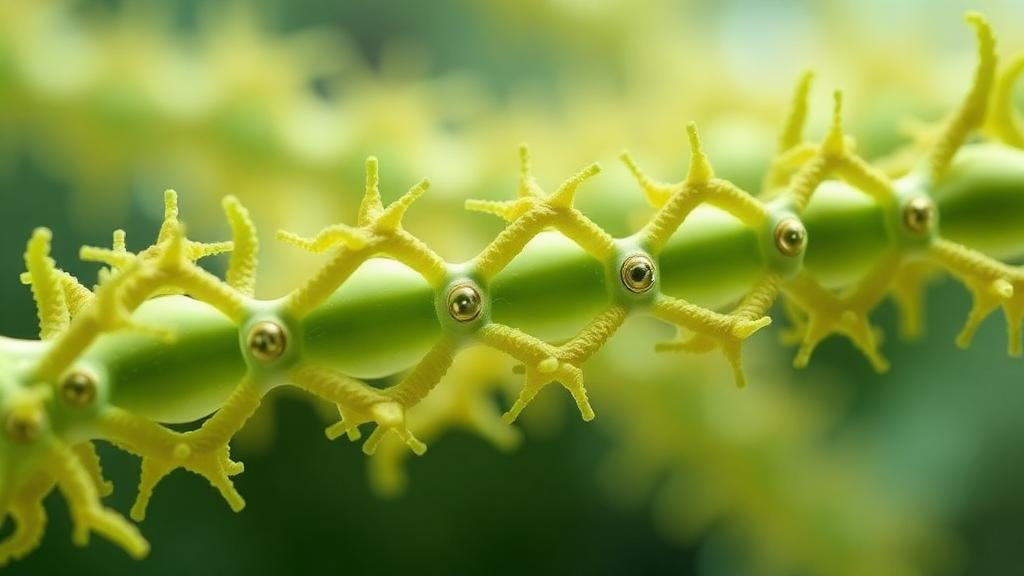
Deep beneath the roots of legumes, a quiet molecular negotiation has been unfolding for millions of years. Soil bacteria known as rhizobia coax bean, pea, clover and their relatives into building specialized organs called nodules, inside which the microbes convert atmospheric nitrogen into a form the plant can use. For decades, biologists assumed this intimate partnership relied on a well-mapped chemical conversation between bacterial signals and plant receptors. Now, a new study published in PLOS Biology suggests the story is far stranger: many rhizobia appear to carry a concealed toolkit of proteins that can directly manipulate the plant’s own genetic machinery, blurring the line between friendly symbiont and genetic hijacker.
The research, led by Albin Teulet and Sebastian Schornack, focuses on a bacterial delivery apparatus called the Type III Secretion System, a syringe-like molecular machine that many disease-causing bacteria use to inject effector proteins directly into host cells. Rhizobia possess this system too, and they use it to ship a family of proteins known as Nodulation Outer Proteins, or Nops, into the cells of their legume hosts. In most rhizobia, these effectors fine-tune the symbiosis, helping the bacteria evade plant immune defenses or adjusting the balance of the partnership. But in a few remarkable lineages, Nop effectors do something far more dramatic: they can trigger nodule organogenesis on their own, bypassing the classical nodulation signals entirely and forcing the plant to build the nitrogen-fixing home the bacteria need.
What has frustrated researchers until now is that these effector proteins are almost impossible to interpret by looking at their amino acid sequences alone. They have diverged so radically over evolutionary time that standard computational searches, which hunt for telltale sequence signatures of known protein functions, come up essentially empty. The result has been a catalogue of mysterious proteins with no obvious purpose. Teulet and Schornack attacked this problem with a different strategy: instead of comparing sequences, they compared shapes, using the AlphaFold2 artificial intelligence system to predict the three-dimensional structures of rhizobial effectors and then searching structural databases for proteins with matching folds.
This approach, sometimes called structural proteomics, paid off spectacularly. The analysis revealed that rhizobial effectors are not amorphous blobs of uninterpretable sequence but modular machines, assembled like molecular Lego from a repertoire of 22 distinct structural units. Each unit is a recognizable domain with its own likely biochemical activity, and different effectors combine these units in different arrangements. This modular architecture explains both the bewildering sequence diversity of the proteins and their functional versatility: evolution can shuffle, duplicate and fuse these building blocks to generate new effectors with novel combinations of capabilities, all while the underlying structural logic remains conserved and detectable.
The most striking discovery concerns what those building blocks actually do. Many Nop effectors, the study found, harbor domains that bind nucleic acids, the DNA and RNA molecules at the heart of gene expression. Some carry modules that resemble transcription factors, the proteins that switch plant genes on and off. Others contain domains suggestive of post-transcriptional regulation, the ability to intercept and modify RNA messages after they leave the nucleus. Perhaps most surprising of all, some effectors appear to include RNA-dependent RNA polymerase domains, enzymes capable of copying RNA molecules, a function associated in plants with gene silencing and antiviral defense. In other words, these supposedly gentle symbiotic proteins look, structurally, like a cryptic arsenal of genetic regulators.
The evolutionary implications sharpen when the comparison extends beyond rhizobia. The same structural units identified in the symbionts turn up in specific plant pathogens, including gall-inducing bacteria of the genus Pantoea, which form tumor-like growths on their hosts. Crucially, in these pathogens the predicted structural units align with DNA-binding domains that have already been validated experimentally in the laboratory. That correspondence gives the computational predictions real weight: if the same fold in a pathogen is a proven DNA-binding module, the matching fold in a rhizobial effector very likely performs a comparable function. Symbiont and pathogen, it seems, have converged on the same molecular strategy for pulling the levers of host biology.
Among the newly characterized components, one stands out for what it implies about how bacteria might seize control of plant development. The researchers discovered a domain they named BPN, short for B3 and PUA-like nucleic acid binding. Its structure closely mimics the B3 domain, a DNA-binding module found in a large family of plant transcription factors that regulate processes including seed development and hormone responses. A bacterial protein carrying a structural mimic of a plant-specific regulatory domain points to a direct and elegant mechanism of hijacking: the effector could enter the plant nucleus, bind the same DNA sequences that the plant’s own B3 transcription factors target, and either compete with them or redirect their activity, rewiring developmental gene networks from the inside.
This finding reframes the boundary between mutualism and pathogenesis. Plant pathogens manipulate host development to create feeding structures and galls; rhizobia manipulate host development to create nodules. Both, according to the new work, may deploy modular effector proteins that act as direct genetic modulators rather than merely signaling from outside the cell. The difference lies not in the mechanism but in the outcome: one interaction costs the plant, the other, in most contexts, pays dividends in the form of fertilizer-grade nitrogen. Yet the shared toolkit suggests that symbiosis and disease are variations on a single evolutionary theme, with the same domain-fusion strategy recycled across dramatically different lifestyles.
The study also highlights how artificial intelligence is transforming the study of fast-evolving proteins. Sequence-based methods have long been the workhorse of molecular biology, but they fail precisely where evolution has scrambled the text while preserving the structure. Structure prediction changes the calculus: folds persist far longer than sequences, so proteins that look unrelated at the letter level can be recognized as cousins at the shape level. For effector biology in particular, a field dominated by rapidly diversifying virulence and symbiosis factors, AlphaFold2-mediated searches offer a way to annotate proteins that have resisted decades of conventional analysis, converting a catalogue of unknowns into a map of testable functions.
The road ahead is experimental. Structural predictions generate hypotheses, and each of the 22 identified modules now invites targeted biochemical testing: does the predicted DNA-binding domain actually bind DNA, does the RNA polymerase domain actually copy RNA, does the BPN mimic genuinely compete with plant B3 factors in the nucleus? Answering those questions will clarify how rhizobia that bypass classical nodulation signaling actually accomplish the feat, and may reveal general principles of how bacteria, symbiotic or pathogenic, reprogram host gene expression. For agriculture, the stakes are tangible. Understanding the molecular grammar of nodule initiation could eventually help engineers nitrogen-fixing symbioses in crops that currently lack them, a long-sought goal with the potential to reduce fertilizer dependence worldwide. What began as a puzzle about uninterpretable bacterial proteins has opened a window onto the deepest layer of the legume-microbe conversation: the direct manipulation of the plant’s own genetic script.
Subject of Research: Structural characterization of Type III effector proteins in symbiotic rhizobia and their predicted roles as transcriptional and post-transcriptional modulators of host plant gene expression
Article Title: Type III effectors of symbiotic Rhizobia include diverse predicted transcriptional and post-transcriptional modulators
Article References: Teulet, A., & Schornack, S. (2026). Type III effectors of symbiotic Rhizobia include diverse predicted transcriptional and post-transcriptional modulators. PLOS Biology, 24(10), e3004038. https://doi.org/10.1371/journal.pbio.3004038
Image Credits: AI Generated
DOI: 10.1371/journal.pbio.3004038
Keywords: rhizobia, Type III secretion system, Nop effectors, AlphaFold2, structural proteomics, nodule symbiosis, transcription factors, B3 domain, nucleic acid binding, plant pathogens, Pantoea, host gene regulation
News Source: Juliet Wilcox. (October 10, 2026). Symbiotic Bacteria Carry a Hidden Arsenal of Gene-Controlling Weapons, Structural Study Reveals. Scienmag.