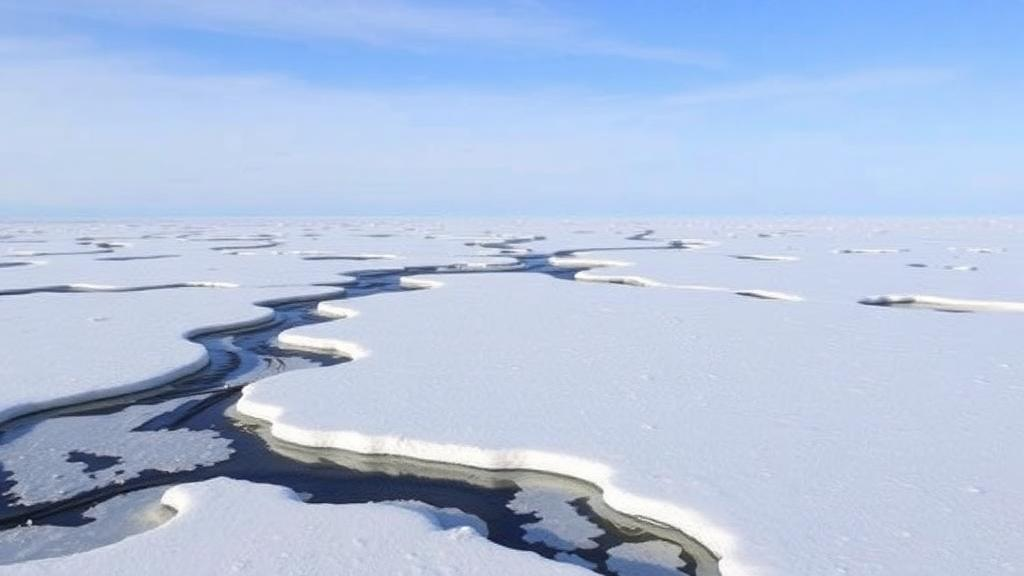
Deep in the Canadian High Arctic, on the windswept coast of Melville Island, the ground is tearing itself open. An international team of researchers has now taken one of the most detailed looks yet at what happens to ancient organic carbon when hillslope permafrost collapses, and their findings carry a sobering implication: the carbon exposed by the deepest thaw features may be far less protected against decomposition than anyone had assumed. The study, published in the journal SOIL, was led by Maxime Thomas of the Earth and Life Institute at Université catholique de Louvain, together with colleagues in Belgium, France and Canada, and focused on the Cape Bounty Arctic Watershed Observatory in Nunavut.
The stakes could hardly be higher. Northern circumpolar permafrost holds roughly 1,000 petagrams of carbon in its first three meters, about half of all the soil carbon stored in every other terrestrial ecosystem on Earth combined. Models estimate that carbon dioxide and methane released from Arctic soils could add between 55 and 230 petagrams of carbon in CO2-equivalent terms to the atmosphere by 2100, a quantity comparable to the emissions of industrialized nations. Yet most of these projections rest on gradual thawing, the slow deepening of the seasonally thawed active layer. What happens during abrupt thaw, when the ground itself collapses, remains far less constrained, even though existing simulations suggest thermokarst terrain could deliver a climate feedback similar in magnitude to gradual thaw emissions.
At Cape Bounty, the team examined two contrasting types of hillslope thermokarst. The first is an active layer detachment, a one-time landslide in which the thawed surface layer slides downslope over tens of meters, exposing a shallow headwall. The second is a retrogressive thaw slump, a feature that keeps growing year after year as frozen deposits thaw and ground ice melts at its headwall, which can retreat by tens of meters each summer. The slump sampled in the study was still actively retreating at up to one meter per year when the team visited in August 2018, exposing fresh, previously perennially frozen sediment with every passing season.
The researchers’ central question was deceptively simple: how much of the organic carbon in these exposed sediments is actually locked away by interactions with minerals, and how much is sitting free, ready to be devoured by microbes once thaw releases it? In soils, organic matter can be stabilized in several ways. Plant fragments unattached to minerals decay quickly. Carbon trapped inside soil aggregates gains physical protection lasting decades to a century. Carbon can also form cation bridges with negatively charged clay surfaces, or bind into organo-metallic complexes with metals such as iron, aluminum, manganese and calcium, or adsorb onto poorly crystalline iron oxides, some of the most effective mineral sorbents for dissolved organic carbon. These chemical associations can preserve carbon for hundreds to thousands of years under stable conditions.
To disentangle these mechanisms, the team combined an unusually broad analytical toolkit. X-ray diffraction characterized the crystalline mineralogy of the sediments, which proved remarkably similar across all profiles, dominated by quartz, feldspars, micas and secondary clays such as kaolinite, illite, vermiculite and chlorite. Portable X-ray fluorescence, calibrated against inductively coupled plasma optical emission spectrometry, quantified total iron, aluminum, manganese, calcium and potassium. Sodium pyrophosphate extraction targeted organo-metallic complexes, ammonium oxalate extraction targeted poorly crystalline oxides, and a two-stage aggregate and density fractionation protocol, using wet sieving and heavy liquid separation with sodium polytungstate, separated free particulate organic matter from mineral-associated carbon.
The results paint a nuanced picture. Chemically stabilized carbon, in the form of small biopolymer fragments bound by chemical bonds, accounts for 13 plus or minus 5 percent of total organic carbon as organo-metallic complexes, and up to 6 plus or minus 2 percent associated with poorly crystalline iron oxides, giving roughly 20 plus or minus 4 percent of total organic carbon chemically bound to minerals or metallic cations. When physical protection of particulate matter in aggregates and larger chemically stabilized molecules is added, the total mineral-protected share rises to 64 plus or minus 10 percent. Aluminum emerged as the dominant metal in complexes and the best predictor of complexed carbon, explaining 89 percent of its variance in the team’s mixed-effect models, ahead of iron and far ahead of manganese.
The most striking finding, however, concerns depth. In the sediments exposed by the actively retreating thaw slump, the proportion of organo-metallic complexes plummets from about 18 percent of total organic carbon in surface samples at 2 to 22 centimeters to a mere 1 percent in the deepest samples at 50 to 70 centimeters. The deep layers are also richer in water-soluble calcium and potassium, with higher electrical conductivity and pH, signatures of sediments that were previously perennially frozen and never underwent meaningful soil development. Because all four profiles share the same mineralogy, the team attributes the pattern not to bedrock differences but to the slump’s retrogressive nature, which guarantees a fresh supply of poorly weathered, weakly protected deep sediment every summer until the feature stabilizes.
This vulnerability matters because thaw slumps are projected to intensify across the Arctic, with terrain susceptible to hillslope thermokarst expanding by roughly 250,000 square kilometers by the end of the century. A first-order mass balance suggests the Cape Bounty slump exposes about 13.5 kilograms of organic carbon per square meter of headwall, versus about 9.8 kilograms for the active layer detachment, and that the slump’s exposed carbon is less mineral-stabilized, at roughly 17.2 percent versus 18.4 percent. In the deepest slump horizon, more than half of the total organic carbon takes the form of free particulate organic carbon, the pool most readily accessible to microbial degradation. Comparable studies at the Peel Plateau in Canada and the Batagay mega-slump in Siberia found the same shallow-to-deep decline in chemically protected carbon, reinforcing the conclusion that historical permafrost thaw dynamics are a first-order control on carbon stability.
Context also shapes how much protection minerals can offer in the first place. The roughly 20 percent chemical stabilization measured at Cape Bounty sits at the low end of Arctic values, about half the 43 plus or minus 20 percent reported for comparable thermokarst and Yedoma sediments in Siberia and Canada. The authors point to Cape Bounty’s extreme setting: at nearly 75 degrees north, some 800 to 900 kilometers farther north than the comparison sites, with a polar desert climate averaging minus 14.8 degrees Celsius and under 150 millimeters of precipitation per year. Such cold, dry conditions allow only limited pedological development and few opportunities for mineral-organic bonds to form. Peatland environments, by contrast, show similarly low mineral-bound proportions but for the opposite reason, their abundant carbon simply saturating the available mineral surfaces.
The team is careful to note the limits of the work, which rests on four distinct profiles, and to flag open questions, including the fate of carbon carried downstream in slump debris tongues and the possibility that calcium-mediated stabilization, which their extraction methods could not isolate, adds uncounted protection. They also caution that shifts in pH or redox conditions, for instance from water saturation, could release mineral-bound carbon, although the well-drained, near-neutral terrain of hillslope thermokarst makes such changes less likely at Cape Bounty. Still, the message for climate models is clear. As abrupt thaw carves ever deeper into frozen ground, it is not just the quantity of carbon being exposed that matters, but its armor, and the deepest layers may be arriving in the modern carbon cycle with the least of it.
Subject of Research: Mineral-bound organic carbon stability in permafrost soils exposed by hillslope thermokarst in the Canadian High Arctic
Article Title: Mineral-bound organic carbon exposed by hillslope thermokarst terrain: case study in Cape Bounty, Canadian High Arctic
Article References: Thomas, M., Fouché, J., Titeux, H., Morelle, C., Bemelmans, N., Lafrenière, M. J., Heslop, J. K., & Opfergelt, S. (2026). Mineral-bound organic carbon exposed by hillslope thermokarst terrain: case study in Cape Bounty, Canadian High Arctic. SOIL, 12(1), 633-664. https://doi.org/10.5194/soil-12-633-2026
Image Credits: AI Generated
Keywords: permafrost, thermokarst, organic carbon, soil science, Arctic, retrogressive thaw slump, active layer detachment, organo-mineral interactions, iron oxides, climate feedback, Cape Bounty, greenhouse gases
News Source: Alan Morgan. (October 10, 2026). Deep Thaw in the High Arctic Exposes Vulnerable Soil Carbon, Study Finds. Scienmag.