Mung beans have long been prized in Asian cuisines not only for their versatility but also for a quieter, more medically interesting quality: their starch digests slowly, producing a gentle rise in blood sugar rather than the sharp spike associated with refined carbohydrates. That low-glycemic reputation, however, is fragile. Conventional processing—soaking, cooking, milling, and the mechanical abuse that comes with industrial food production—can rupture the delicate cell walls that encase starch granules inside the bean, handing digestive enzymes far easier access to their target. A new study published in npj Science of Food reports a counterintuitive solution: a treatment that deliberately perturbs the bean’s structure with ultrasound, then uses that perturbation to rebuild the barriers against digestion, ultimately lowering the predicted glycemic impact of mung bean starch.
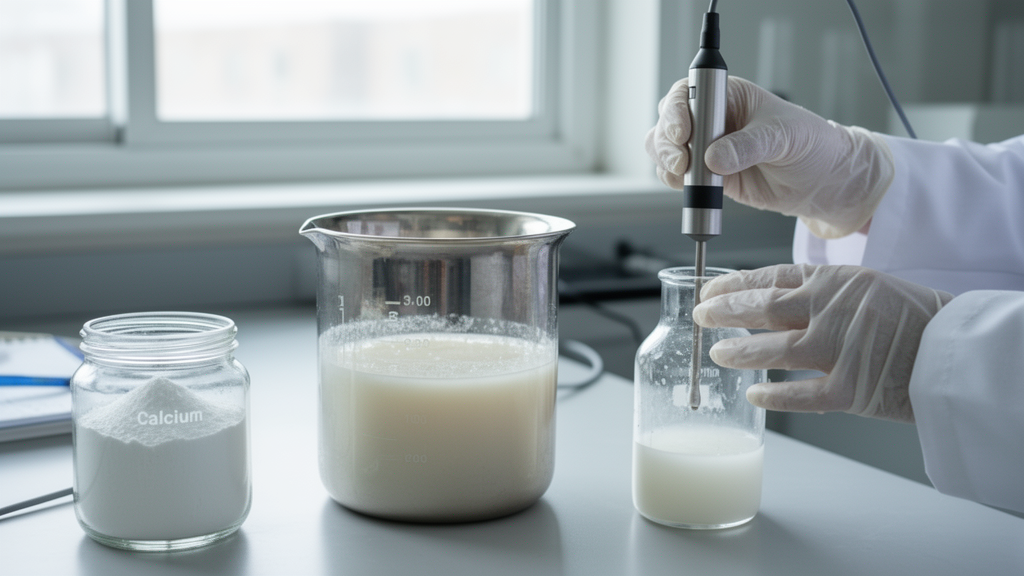
The research, led by Qingyu Yang and Zudi Li of Shenyang Normal University together with colleagues at Beijing Technology and Business University, centers on a technique called thermosonication—the simultaneous application of heat and high-intensity ultrasound waves—paired with calcium chloride. On its face, the combination sounds like it should make starch more digestible, not less. Ultrasound generates microscopic cavitation bubbles in water; when those bubbles collapse, they release intense local shockwaves that tear open plant cell walls and increase their permeability. In most food-processing contexts, that kind of damage is exactly what processors try to avoid, because exposed starch is starch that digestive enzymes can rapidly convert to glucose.
The Chinese team’s insight was to treat that permeability as an opportunity rather than a liability. Once the cell walls become more permeable, calcium ions from the surrounding calcium chloride solution can penetrate deep into the tissue and accumulate where they would otherwise be excluded. Calcium is not an innocent bystander in plant cell-wall chemistry. It preferentially binds to non-methyl-esterified galacturonic acid residues, the charged building blocks of pectin, the gel-like polysaccharide that glues cell walls together. When calcium ions cross-link these negatively charged residues, they form what biologists call an egg-box structure: a rigid, orderly lattice in which each calcium ion sits cradled between two pectin chains like an egg in a carton.
The measurements in the study show that the combined treatment increased the proportion of non-methyl-esterified galacturonic acid in the cell walls, providing more binding sites for calcium, and that calcium accumulation rose accordingly. The practical consequence was a strengthened cell-wall barrier. Digestive enzymes such as alpha-amylase must first adsorb onto the surface of their substrate before they can cleave it, and the reinforced walls made that adsorption harder while simultaneously inhibiting the enzyme’s activity once it did make contact. In effect, the treatment turned the bean’s own architecture into a slow-release mechanism, forcing enzymes to queue at a gate that had just been reinforced.
What makes the finding scientifically notable is that most previous work on calcium’s role in starch digestibility focused exclusively on the starch granule itself—how calcium ions interact with amylose and amylopectin chains, or how they alter gelatinization. The cell wall, by contrast, has often been treated as passive packaging that processing inevitably destroys. By demonstrating that the wall can be actively engineered to resist enzymatic attack, the study reframes the problem: digestibility is not a property of starch alone but of the entire structural hierarchy in which the starch is embedded, from the pectin network of the wall down to the crystalline packing of the granule.
And the starch level of that hierarchy did change too, in ways that reinforce the wall-level effect. The combined treatment reduced starch damage—the fraction of granules whose crystalline order has been physically disrupted—and promoted granule aggregation, clustering individual granules into larger masses that enzymes penetrate more slowly. Within the granules, the researchers documented an increase in amylose content, the linear starch fraction that retrogrades into enzyme-resistant forms, along with greater short-range molecular order and the emergence of V-type diffraction features, the X-ray crystallographic signature of amylose complexes that resist hydrolysis. Resistant starch, the fraction that escapes digestion in the small intestine entirely, increased, while double-helical organization and relative crystallinity—structures that enzymes can attack—decreased.
The net result of these coordinated changes, at both the wall and the granule, was a measurable reduction in starch hydrolysis under simulated digestion and a lower estimated glycemic index, the laboratory proxy for how sharply a food raises blood glucose. For a legume whose commercial value depends partly on its suitability for diabetic and low-glycemic diets, that is a meaningful outcome. It suggests that processors need not choose between the texture and convenience benefits of modern processing and the nutritional profile that makes mung bean starch special; with the right sequence of physical and chemical treatments, both can be preserved.
The technique itself deserves attention from a food-engineering standpoint. Thermosonication is already used in the industry for applications such as microbial inactivation, emulsification, and extraction, because it delivers intense mechanical energy without the prolonged cooking times that degrade flavor, color, and vitamins. Calcium chloride is cheap, food-grade, and widely used as a firming agent in canned vegetables and tofu production, where it performs essentially the same pectin cross-linking chemistry that the study exploits. Combining the two is therefore less a novel invention than a clever repurposing: the cavitation damage that ultrasound normally inflicts becomes the delivery mechanism for the calcium that repairs and reinforces the structure. The treatment is, in principle, scalable with existing equipment.
There are, of course, the usual caveats that separate a laboratory result from a supermarket shelf. The glycemic index here was estimated from in vitro digestion kinetics, not measured in human volunteers, and the relationship between simulated and real physiological responses is imperfect. The study also reports structural correlates of digestibility rather than clinical outcomes, so the ultimate test—whether mung bean foods treated this way actually blunt post-meal glucose excursions in people—remains to be performed. Sensory qualities, cooking behavior, and shelf stability after ultrasound treatment would all need evaluation before the method could be adopted commercially.
Even so, the conceptual contribution is likely to outlast the specific application. The work demonstrates that the cell wall is not merely an obstacle that processing erodes but a tunable component of food structure that processing can deliberately strengthen. As food scientists search for ways to slow carbohydrate digestion without resorting to additives or reformulation, strategies that work with the plant’s native architecture—using its own pectin chemistry as the target—offer an appealing path. A humble mung bean, zapped with sound waves and bathed in calcium, may have just shown how the next generation of low-glycemic foods gets built: not by stripping structure away, but by putting it back, stronger than before.
Subject of Research: Thermosonication-assisted calcium chloride modification of mung bean cell walls and starch structure to reduce starch digestibility
Article Title: Thermosonication-assisted CaCl2 treatment reduces mung bean starch digestibility through cell-wall structural modification and starch reorganization
Article References: Yang, Q., Xu, D., Zhao, L., Zheng, C., Liu, S., & Li, Z. (2026). Thermosonication-assisted CaCl2 treatment reduces mung bean starch digestibility through cell-wall structural modification and starch reorganization. npj Science of Food. https://doi.org/10.1038/s41538-026-01189-5
Image Credits: AI Generated
DOI: 10.1038/s41538-026-01189-5
Keywords: mung bean, starch digestibility, thermosonication, calcium chloride, cell wall, resistant starch, glycemic index, pectin, alpha-amylase, food processing, starch structure, low-glycemic foods
News Source: Alan Morgan. (October 10, 2026). Ultrasound and Calcium Team Up to Make Mung Bean Starch Harder to Digest. Scienmag.