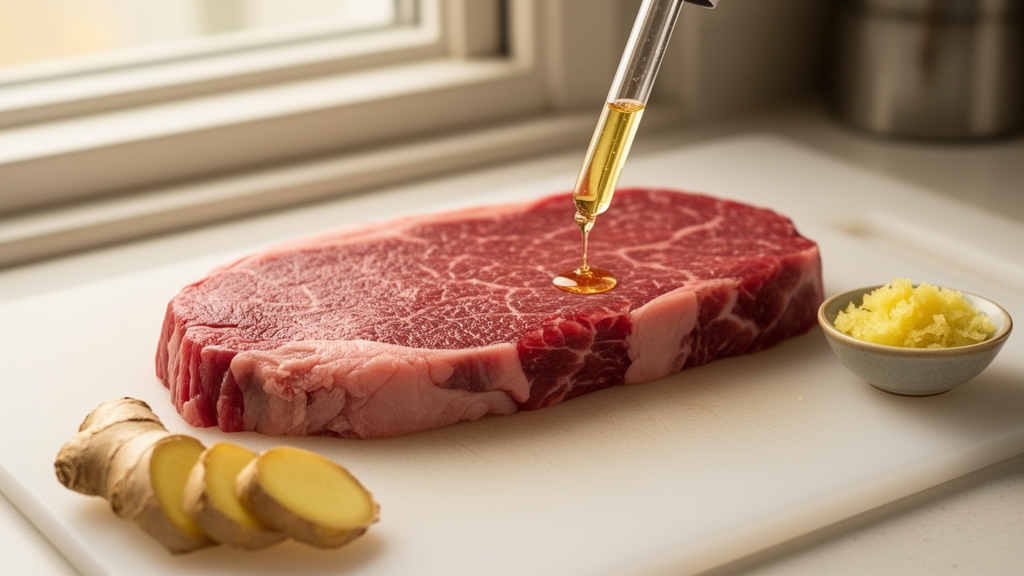
Ginger has spent centuries in the kitchen as a spice, a remedy, and an occasional folk trick for softening tough cuts of meat. A new study published in Food Science & Nutrition suggests the folk wisdom has real biochemistry behind it. Researchers at the University of Tuscia in Italy found that a crude extract from fresh ginger rhizomes can tenderize chicken and pork more gently and, in some respects, more effectively than two of the food industry’s best-known plant enzymes, papain from papaya and bromelain from pineapple. The work offers a detailed picture of how a humble rhizome could become a clean-label tool for meat processing.
The active ingredient at the heart of the study is zingibain, a cysteine endopeptidase designated EC 3.4.22.67. Like papain and bromelain, zingibain cleaves peptide bonds in proteins, but it shows a particular appetite for myofibrillar proteins, the contractile machinery of muscle, and for connective tissue proteins. Because myofibrillar proteins, chiefly myosin and actin together with regulatory proteins such as troponins and tropomyosin, account for 50 to 60 percent of total muscle protein, an enzyme that targets them efficiently can reshape the texture of a steak or a chicken breast from the inside out.
To test how such an enzyme behaves across different animals, the team prepared crude aqueous extracts from fresh ginger at three concentrations and compared them against commercial bromelain and papain preparations standardized to identical protein levels. The substrates were purified myofibrillar proteins extracted from chicken breast and pork loin, two muscles chosen as models with distinct structures and functional properties. Reactions ran at 4 degrees Celsius and pH 6, mimicking the refrigerated conditions of real marination, and proteolytic activity was tracked spectrophotometrically over time.
The kinetic data revealed a striking asymmetry. Ginger extract displayed its highest catalytic performance against chicken myofibrils, reaching the greatest maximum reaction velocity of any enzyme tested at the highest concentration, with a Vmax of about 84.77 units per milligram of enzyme protein. On pork myofibrils, the same extract was considerably less active. Bromelain, by contrast, performed comparatively better on pork, where lower apparent Km values at higher enzyme concentrations drove its catalytic efficiency sharply upward. The authors attribute these differences to the intrinsic architecture of the two muscles: in chicken, disruption of Z-disks and actin-myosin cross-bridges occurs relatively rapidly after slaughter, whereas porcine muscle weakens more slowly and resists enzymatic attack longer.
Having identified the most efficient preparations, the researchers moved from the model system to whole meat. Cubes of chicken breast and pork loin, all cut to identical dimensions, were marinated for 6 or 12 hours in water, bromelain, papain, or ginger extract, then cooked. A key measurement was the myofibrillar fragmentation index, or MFI, which rises as myofibrils are broken into smaller pieces. All three enzymes raised MFI in both meats, and chicken fragmented faster and more extensively than pork. But the temporal patterns differed: papain and bromelain kept fragmenting the tissue as marination lengthened, while ginger produced its most pronounced relative increase in fragmentation during the first 6 hours, then plateaued, behaving as a milder, self-limiting tenderizer.
That restraint proved technologically important. Excessive proteolysis can wreck the protein network that holds water in meat, and the cooking yield data showed exactly that trade-off. Papain-treated chicken consistently lost the most weight during cooking, indicating that aggressive enzymatic breakdown destabilized the protein matrix during heating. Ginger-treated samples of both species, meanwhile, achieved the highest or near-highest cooking yields after 12 hours of marination, statistically comparable to the water controls and significantly better than papain or bromelain. Water-holding capacity told a complementary story: in chicken, moderate proteolysis after 6 hours improved water entrapment, while prolonged treatment eroded it, and pork showed a blunted response overall, consistent with its tougher myofibrillar scaffolding.
Color measurements added another dimension. In raw chicken, ginger-marinated samples retained redness better than controls or samples treated with the other enzymes, an effect the authors link to the antioxidant phenolic compounds that ride along in the crude ginger extract and help protect myoglobin from oxidation. After cooking, enzymatic marination produced large treatment-dependent color shifts in both meats, with papain causing the most dramatic alterations. Ginger-treated samples partially preserved reddish tones after cooking, particularly in pork, suggesting that the extract modulates pigment chemistry as well as protein structure.
The final test was whether any of this registers on the palate. A 25-member sensory panel, untrained but experienced in meat evaluation, compared cooked samples marinated for 6 hours in water or ginger extract under blind conditions. Ginger marination lifted scores across the board in both meats, with statistically significant gains in odor intensity, flavor, and overall acceptability in pork, and marked improvements in odor, flavor, sapidity, chewiness, and juiciness in chicken. Notably, the ginger-derived aroma was positively received and introduced no off-notes, while metallic or ferrous perceptions actually declined in the treated samples. The sensory gains tracked the instrumental data: controlled myofibrillar modification and preserved water retention translated directly into juicier, more tender eating.
The broader significance of the study lies in its demonstration that enzyme effects cannot be divorced from muscle biology. The same extract that excels on chicken may underperform on pork, and the same treatment that improves tenderness at 6 hours may degrade water retention at 12. For a meat industry under pressure to replace synthetic additives with natural, clean-label ingredients, crude ginger extract emerges as a promising middle path, a tenderizer strong enough to restructure muscle protein yet gentle enough to preserve cooking performance, color, and flavor. As the authors conclude, the response of meat to plant proteases depends on the enzyme, the muscle, and the clock, and ginger, it turns out, keeps remarkably good time.
Subject of Research: Proteolytic activity of ginger extract on myofibrillar proteins and meat quality
Article Title: Proteolytic Activity of Zingiber officinale Extract: Interaction With Myofibrillar Proteins of Different Origins and Functional Effects in Meat Systems
Article References: Crinò, A., Fabrizi, C., Menci, A., & Liburdi, K. (2026). Proteolytic Activity of Zingiber officinale Extract: Interaction With Myofibrillar Proteins of Different Origins and Functional Effects in Meat Systems. Food Science & Nutrition, 14(10), Article e72459. https://doi.org/10.1002/fsn3.72459
Image Credits: AI Generated
DOI: 10.1002/fsn3.72459
Keywords: ginger, zingibain, plant proteases, meat tenderization, myofibrillar proteins, papain, bromelain, chicken breast, pork loin, marination, water-holding capacity, sensory analysis
News Source: Alan Morgan. (October 9, 2026). Ginger Enzymes Outperform Papain and Bromelain at Tenderizing Meat, Study Finds. Scienmag.