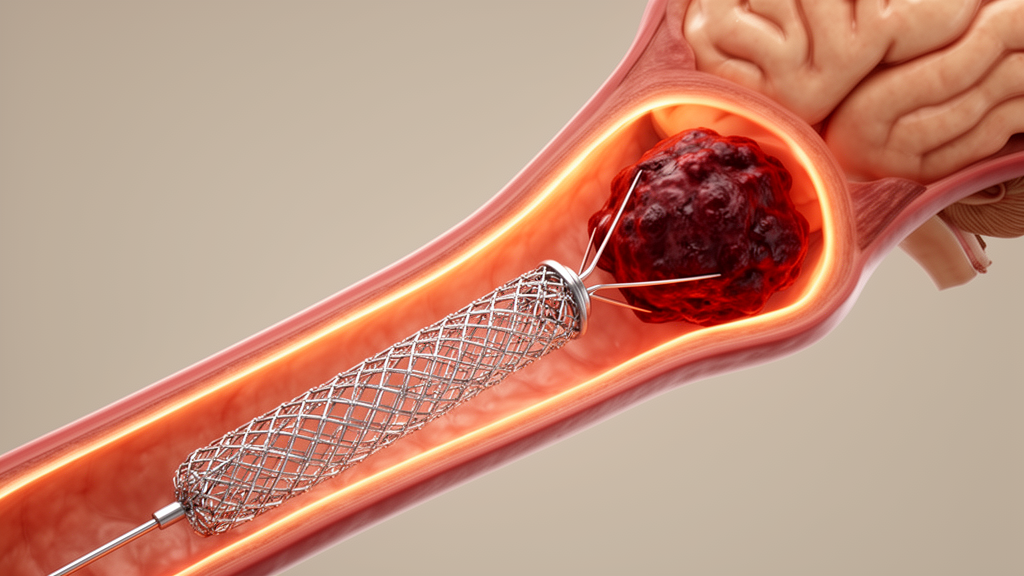
When a stroke-causing clot refuses to budge, the consequences can be devastating. Endovascular thrombectomy, the catheter-based procedure that has transformed acute stroke care over the past decade, fails to restore blood flow in up to one in five patients. For those individuals, the blocked artery remains shut, brain tissue continues to die, and clinicians are left with an agonizing decision made in real time at the angiography table: should they push further and deploy a stent inside the blocked vessel, or stop the procedure and accept the occlusion? A new analysis of one of the world’s largest stroke registries now offers the most detailed real-world picture yet of what happens when interventionalists choose to stent.
The study, published in the Journal of Neurology, drew on the German Stroke Registry—Endovascular Treatment, a prospective, industry-independent registry spanning 25 centers across Germany. Researchers led by Malte Konrad of the University Medical Center Hamburg-Eppendorf screened 18,069 patients treated between June 2015 and December 2023 and focused on those with acute ischemic stroke caused by occlusion of the middle cerebral artery, the vessel most commonly implicated in disabling strokes. After excluding patients with non-MCA or bilateral occlusions, 14,714 patients remained eligible. Among them, intracranial stenting was deployed as a rescue maneuver in just 352 cases, or 2.4 percent, underscoring how sparingly the technique is used even in high-volume centers.
The central challenge in evaluating rescue stenting is that it is not applied randomly. Interventionalists opt for a stent in particular patients, under particular circumstances, and any naive comparison between stented and non-stented patients would be hopelessly confounded. To address this, the team employed propensity score matching, a statistical technique that pairs each stented patient with a control patient of nearly identical baseline profile. The model accounted for age, pre-stroke disability measured on the modified Rankin Scale, stroke severity on the National Institutes of Health Stroke Scale, comorbidities including atrial fibrillation and dyslipidemia, early CT findings captured by the ASPECTS score, occlusion location, intravenous thrombolysis, and the number of retrieval attempts. After matching, 218 stented patients were compared with 218 controls whose thrombectomy had failed, defined as a final modified Thrombolysis in Cerebral Infarction score below 2b, and who received no further endovascular treatment.
The matching worked. Standardized mean differences for all covariates fell below 0.1, indicating that the two groups were statistically indistinguishable at baseline: median age around 70 years, similar stroke severity, similar comorbidity burden, similar imaging scores, and a median of three retrieval attempts in both groups. What differed was the outcome. At 90 days, patients who received a rescue stent had a median modified Rankin Scale score of 3, compared with 5 in the control group, on a scale where 0 means no symptoms and 6 means death. In ordinal regression, stenting was associated with a shift toward better functional outcomes, with an adjusted common odds ratio of 0.41, meaning the odds of landing in a worse disability category were substantially reduced.
The safety signals were equally striking. Malignant middle cerebral artery infarction, the feared complication in which massive swelling of the dying brain tissue leads to herniation and often death, occurred in only 1 percent of stented patients versus 8 percent of controls. Ninety-day mortality was 26 percent in the stenting group compared with 37 percent among controls. Most importantly for a technique that involves leaving a metal scaffold inside a freshly occluded cerebral artery, the rate of symptomatic intracranial hemorrhage, defined by ECASS II/III criteria as new bleeding accompanied by a neurological deterioration of at least four NIHSS points, was statistically identical between groups at 4 percent versus 5 percent. In other words, the apparent survival and functional benefits came without any detectable excess bleeding penalty.
The technical explanation for these findings likely lies in reperfusion itself. Successful reperfusion, defined as an mTICI score of 2b or 3, is the single strongest determinant of good outcome after thrombectomy, and rescue stenting achieved it in 87 percent of cases, with complete recanalization in 56 percent. That is remarkable considering these were precisely the patients in whom standard clot-retrieval devices had already failed, often because underlying atherosclerotic disease, resistant embolus, or vessel dissection was keeping the artery closed. A stent mechanically props the vessel open where a stent-retriever could not clear it, restoring perfusion to salvageable tissue. Restored flow, in turn, is a well-established protector against the infarct swelling that drives malignant edema, which plausibly explains the dramatic reduction in that complication.
Subgroup analyses reinforced the consistency of the association. Whether patients were young or old, had mild or severe baseline deficits, favorable or unfavorable early CT scans, or few or many prior retrieval attempts, stenting was linked to better 90-day outcomes, and formal interaction testing found no significant effect modification by any of these variables. Notably, the lack of interaction with the number of passes suggests that the benefit was not confined to stents deployed early or late in the procedure, though the authors caution that prospective studies specifically designed to identify the optimal timing of rescue stenting are still needed.
The findings land in a contentious evidentiary landscape. Observational registries such as RES-CAT and RESCUE-ICAS have previously reported higher rates of functional independence after rescue stenting without clear increases in hemorrhage, and a meta-analysis of 1,595 patients found a pooled recanalization rate of 82 percent with nearly fourfold higher odds of good outcome. Yet the randomized ANGEL-REBOOT trial from China initially dampened enthusiasm, reporting no difference in 90-day functional outcome and higher rates of periprocedural complications in the stenting arm. Intriguingly, extended follow-up of that trial told a different story: at one year, stented patients showed improved functional outcomes and dramatically reduced stroke recurrence, at 4 percent versus 13 percent, hinting that keeping the vessel open pays dividends that short-term endpoints miss. The German registry data now complement these randomized results by demonstrating that, in the messier reality of everyday practice, the feared complication rates may be lower than trial data suggested.
The authors are careful about what their study can and cannot prove. Propensity matching cannot eliminate residual confounding, and the decision to stent, made at the discretion of the treating interventionalist under time pressure, may encode unmeasured factors such as the perceived cause of the occlusion or operator expertise. Detailed procedural variables, including stent type and the antiplatelet regimens patients received afterward, were not uniformly captured, and post-procedural dual antiplatelet therapy in the stenting group represents a potential source of unmeasured difference. The analysis was also restricted to middle cerebral artery occlusions, and a substantial fraction of patients had to be excluded for missing covariates. Longer-term outcomes beyond 90 days remain unknown in this cohort.
Nevertheless, the message for the field is clear and, in the words of the researchers, hypothesis-generating: when thrombectomy fails, walking away may not be the only defensible option. With rescue stenting currently performed in fewer than 3 percent of eligible cases and no guideline-supported recommendations to steer practice, treatment varies widely between operators and institutions. The German registry suggests that, in experienced hands, deploying a stent after failed reperfusion is associated with more patients walking out of the hospital rather than dying or remaining disabled, and with no measurable increase in dangerous bleeding. What is needed now, the authors conclude, are randomized trials that establish standardized patient selection criteria and clarify the optimal timing and technique of rescue stenting, so that this high-stakes bedside decision can finally rest on evidence rather than instinct.
Subject of Research: Rescue intracranial stenting after failed endovascular thrombectomy for acute ischemic stroke due to middle cerebral artery occlusion
Article Title: Intracranial rescue stenting in the German stroke registry: a propensity score-matched multicenter study
Article References: Intracranial rescue stenting in the German stroke registry: a propensity score-matched multicenter study. (n.d.). https://doi.org/10.1007/s00415-026-14180-7
Image Credits: AI Generated
DOI: 10.1007/s00415-026-14180-7
Keywords: acute ischemic stroke, endovascular thrombectomy, intracranial stenting, failed reperfusion, German Stroke Registry, propensity score matching, middle cerebral artery occlusion, modified Rankin Scale, symptomatic intracranial hemorrhage, malignant MCA infarction, ANGEL-REBOOT trial, real-world evidence
News Source: Cassandra Pierce. (October 9, 2026). Rescue Stents May Turn Failed Stroke Procedures Into Better Outcomes, German Registry Suggests. Scienmag.