Deep in the tungsten mines of central Rwanda, a handful of crystals no bigger than a grain of dust has just rewritten the mineralogical record books. Researchers led by Frédéric Hatert of the University of Liège have described yttrotungstite-(Nd), a previously unknown mineral species recovered from the oxidized zones of the Nyakabingo tungsten mine near Kigali. The International Mineralogical Association’s Commission on New Minerals, Nomenclature and Classification approved the species under number IMA 2023-064, and the full description now appears in the European Journal of Mineralogy.
The new mineral is a neodymium-bearing tungsten oxide hydrate with the ideal formula NdW2O7(OH)(H2O). As its name implies, it is the neodymium analogue of two better-known species, yttrotungstite-(Ce), dominated by cerium, and yttrotungstite-(Y), dominated by yttrium. All three belong to the yttrotungstite group, a small family of rare-earth tungstates that form only under the peculiar chemical conditions created when primary tungsten ores break down in the presence of water and air. The abbreviation assigned to the new species is Ytgs-Nd.
The story of the discovery begins not in the field but in a museum drawer. In 1977, the Luxembourgish geologist Paul Antun collected several samples from Nyakabingo during a field campaign in Rwanda and donated them to the National Museum of Natural History in Luxembourg. Decades later, the museum’s curator Simon Philippo spotted unusual yellow-orange bladed crystals among the material, associated with the tungsten minerals anthoinite and hydrokenoelsmoreite. That chance observation set in motion the full analytical campaign that ultimately confirmed a new species.
Nyakabingo itself is a storied locality. Situated roughly ten kilometres north-northwest of Kigali, it lies within the so-called Tungsten Belt of central Rwanda, part of the Mesoproterozoic Karagwe-Ankole Belt that stretches across Central Africa and is famous for its tungsten- and tin-bearing quartz veins as well as niobium-tantalum-tin pegmatites. The deposit is hosted by an alternating sequence of pyritiferous black shales, quartzites and psammites that experienced low-grade greenschist-facies metamorphism. Argon-argon dating of muscovite from the mineralized veins yielded an age of 992.4 ± 1.5 million years, tying the vein systems to the region’s G4 granites, which are considered the ultimate source of the tungsten.
Two distinct stages of tungsten mineralization shaped the deposit. The first produced scheelite, calcium tungstate, together with massive ferberite, an iron tungstate. The second transformed scheelite into striking pseudomorphs known as reinite, in which ferberite replaces the original mineral while preserving its pseudo-octahedral crystal shape. During a final stage of meteoric alteration, ferberite, feldspar and pyrite were attacked by surface waters, generating clays, iron oxides and a cascade of secondary tungsten phases. It is in these oxidized zones, within samples showing a honeycomb texture, that yttrotungstite-(Nd) crystallized alongside anthoinite and microcrystalline yellowish octahedra of hydrokenoelsmoreite.
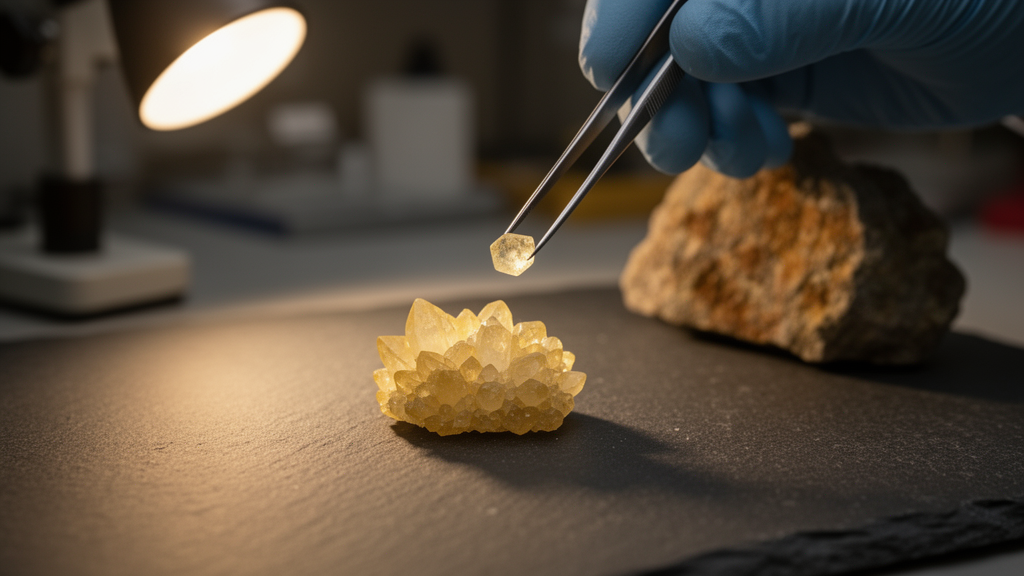
In hand specimen terms, the new mineral is easy to miss. It forms transparent, yellow-orange tabular crystals that reach a maximum length of just 100 micrometres, frequently assembled into radiating, starburst-like aggregates. The dominant crystal form is the pinacoid {010}, and the characteristic monoclinic angle of about 105 degrees between the a and c axes is clearly visible on the plates. Twinning parallel to (001) was observed optically, mirroring behaviour documented in yttrotungstite-(Ce). The mineral leaves a white streak, shows a vitreous lustre, does not fluoresce, and is remarkably soft, with a Mohs hardness of only 1, comparable to talc. It is brittle, with one perfect cleavage on (010) and excellent cleavages on (100) and (001).
Because the crystals are so tiny and so scarce, the team could not measure density directly; instead they calculated a value of 6.25 grams per cubic centimetre from the chemical data and the refined unit cell. Optically the mineral is biaxial, with refractive indices of 1.90 and 2.10 measured under sodium light, an optical plane parallel to (010), and pleochroism ranging from light yellow to yellow. The high refractive indices and exceptional density reflect the mineral’s heavy elemental cargo: tungsten is one of the densest elements in the crust, and packing it together with rare-earth cations produces some of the most optically extreme properties seen in hydrous minerals.
The chemistry was pinned down with a Jeol JXA-8200 wavelength-dispersive electron microprobe in Milan, using 17 point analyses at 15 kilovolts with a beam diameter of 3 micrometres. Energy-dispersive measurements confirmed the absence of fluorine. Normalized to 15 positive charges with one hydroxyl group and one water molecule per formula unit, the empirical composition reads (Nd0.36Sm0.13Ce0.12Pr0.08La0.06Gd0.06Y0.05Dy0.03Yb0.02Ca0.01)Σ0.92(W2.02P0.02)Σ2.04O7(OH)(H2O). In other words, the large cation site is a veritable museum of rare-earth elements, with neodymium dominant but samarium, cerium, praseodymium, lanthanum, gadolinium, yttrium, dysprosium and ytterbium all present in measurable amounts, a fingerprint of the complex rare-earth budget of the host rocks.
X-ray diffraction provided the structural proof. Powder data collected in Debye-Scherrer geometry with molybdenum radiation gave unit-cell parameters in excellent agreement with single-crystal results: a = 5.8534(3), b = 8.6881(3), c = 7.0488(4) angstroms, beta = 105.336(5) degrees, and a unit-cell volume of 345.70 cubic angstroms, refined in the monoclinic space group P21/m to a final R1 value of 0.0362. The architecture consists of kinked chains of edge-sharing WO6 octahedra running parallel to the b axis, which the large NdO8 polyhedra stitch together by sharing edges and corners with neighbouring octahedra. Viewed down the b axis, the two kinds of polyhedra occupy alternating planes stacked along the [-101] direction. Neodymium sits in an unusually large eight-coordinated site best described as two tetragonal pyramids sharing a common basal edge, with an average Nd-O bond length of 2.446 angstroms, while the strongly distorted WO6 octahedron mixes three short bonds of 1.764 to 1.881 angstroms with three long bonds reaching 2.204 angstroms.
Bond-valence calculations and Raman spectroscopy sealed the case for the unusual formula. Bond-valence sums matched the ideal values for tungsten, neodymium and the framework oxygens, while the OH5 site summed to 0.84, characteristic of a hydroxyl group, and the OW6 site summed to only 0.33, the signature of a neutral water molecule. Raman spectra recorded at the University of Luxembourg with a 633-nanometre laser showed intense W-O stretching bands between roughly 600 and 1000 wavenumbers, with the strongest peak at 930 wavenumbers assigned to the shortest tungsten-oxygen bonds, and five O-H stretching bands between 3350 and 3600 wavenumbers whose positions match the hydrogen-bond distances measured in the crystal structure. Beyond confirming the new species, the study prompted a nomenclature cleanup: applying the same bond-valence logic to the older species shows that yttrotungstite-(Y) and yttrotungstite-(Ce) also contain one hydroxyl group and one water molecule per formula unit, so their formulas have been revised to YW2O7(OH)(H2O) and CeW2O7(OH)(H2O), unifying the whole group. Holotype material is preserved in the collections of the National Museum of Natural History in Luxembourg, catalogue number WPA504, and at the Laboratory of Mineralogy of the University of Liège, catalogue number ULG 21981, ensuring that this tiny but scientifically rich piece of Rwanda’s geological heritage will remain available to researchers for generations.
Subject of Research: Crystallographic and chemical characterization of the new rare-earth tungstate mineral yttrotungstite-(Nd) from Rwanda
Article Title: Yttrotungstite-(Nd), a new mineral species from the Nyakabingo tungsten mine, Kigali, Rwanda
Article References: Hatert, F., Philippo, S., Vignola, P., & Guennou, M. (2026). Yttrotungstite-(Nd), a new mineral species from the Nyakabingo tungsten mine, Kigali, Rwanda. European Journal of Mineralogy, 38(4), 373-382. https://doi.org/10.5194/ejm-38-373-2026
Image Credits: AI Generated
Keywords: yttrotungstite-(Nd), new mineral species, neodymium, tungsten, Nyakabingo mine, Rwanda, crystal structure, rare-earth elements, secondary mineralization, X-ray diffraction, Raman spectroscopy, IMA approval
News Source: Bethany Barker. (October 9, 2026). Tiny Yellow Crystals From Rwanda Reveal a Brand-New Neodymium Mineral. Scienmag.