In the tropical city of Port Harcourt, Nigeria, where malaria transmission is a constant background presence, physicians faced a uniquely tangled diagnostic problem during the COVID-19 pandemic: patients arriving with fever, fatigue, and mild respiratory symptoms could be infected with the SARS-CoV-2 virus, with malaria parasites, or with both at once. Each of these conditions is known to disturb the blood’s delicate clotting balance, but how those disturbances differ—and whether they differ between men and women—has remained poorly documented. A new case-control study conducted between November 2021 and March 2022 provides some of the clearest answers yet for a resource-limited setting, showing that even mild infections leave measurable fingerprints on platelet behavior and clot breakdown, and that sex quietly shapes some of those fingerprints.
The research, led by Erens Spiff Ekprikpo, Stella Urekweru Ken-Ezihuo, and Zaccheaus Awortu Jeremiah and published in PLOS Global Public Health, enrolled 220 participants aged 20 to 65 years. The cohort was divided evenly into four groups of 55 people each: healthy controls, individuals with confirmed malaria, individuals with mild COVID-19, and individuals co-infected with both pathogens. Each group was deliberately balanced by sex, containing 22 females and 33 males, a design choice that allowed the investigators to probe whether biological sex modified the hemostatic response rather than simply averaging over it. The study followed STROBE reporting guidelines, the international standard for observational studies, lending additional rigor to its design and analysis.
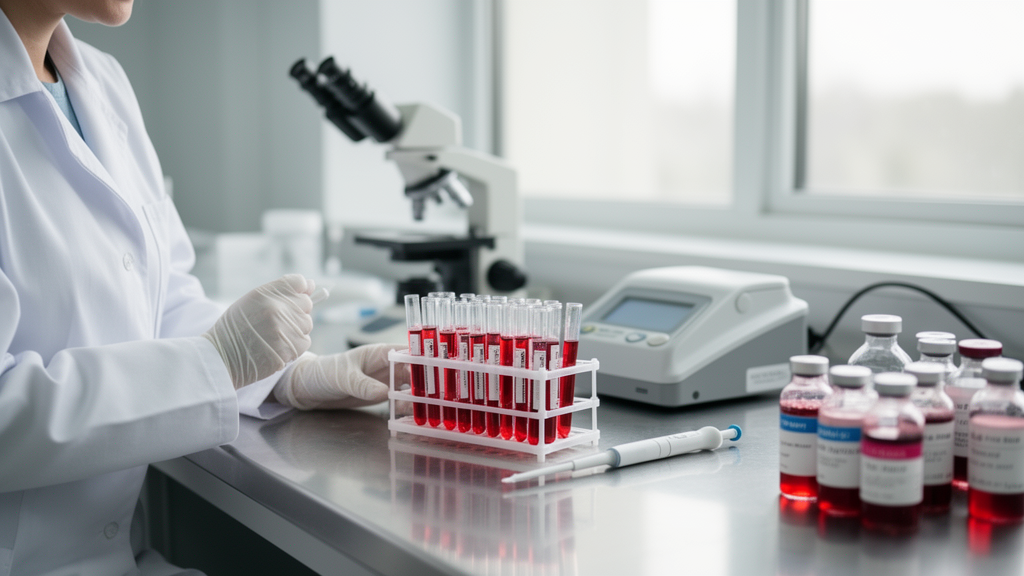
The technical core of the investigation rested on two families of measurements. Platelet indices—including platelet count, mean platelet volume, and platelet distribution width, abbreviated PDW—were obtained using a Sysmex XP-300 automated hematology analyzer. PDW reflects the variability in platelet size within a blood sample; a wider distribution suggests the bone marrow is releasing a heterogeneous population of platelets, often a sign of accelerated platelet turnover or activation. D-dimer and fibrinogen, meanwhile, were quantified with a sandwich enzyme-linked immunosorbent assay. D-dimer is a degradation fragment produced when the body dissolves a fibrin clot, so elevated levels signal active clot formation and breakdown, while fibrinogen is the soluble protein precursor that polymerizes into fibrin strands during clotting. Together, these markers span both the cellular and protein arms of hemostasis.
The headline finding was remarkably consistent: PDW was significantly elevated in every infected group compared with healthy controls. Controls averaged 13.27 plus or minus 1.20 femtoliters, while the malaria group averaged 15.19 plus or minus 1.47 fL, the COVID-19 group 15.17 plus or minus 1.51 fL, and the co-infected group 15.58 plus or minus 1.45 fL. The differences across groups were highly significant, with an F statistic of 25.850 and a p value below 0.001. In practical terms, all three infection states—viral, parasitic, and combined—pushed platelet size variability upward by a similar margin, suggesting a shared pathway of platelet activation and turnover regardless of which pathogen triggered it.
D-dimer told a more nuanced story. Levels climbed across the infected groups but peaked in the co-infected participants, who averaged 552.80 plus or minus 402.46 nanograms per milliliter, a difference that reached statistical significance with F equal to 2.816 and p equal to 0.040. This pattern implies that the fibrinolytic system—the machinery that dissolves clots—was working hardest when both pathogens were present simultaneously. Clinicians in endemic regions have long suspected that malaria and COVID-19 could compound each other’s prothrombotic effects, and these numbers offer quantitative support for that suspicion even among patients whose illnesses never became severe.
Perhaps the most intriguing results emerged from the two-way analysis of variance, which tested whether infection group and sex interacted in shaping each marker. For the platelet indices themselves, no significant group-by-sex interaction appeared, meaning platelet responses were broadly similar between men and women. But for fibrinogen the interaction was emphatic, with F equal to 18.42 and p below 0.001, and for D-dimer it was also significant, with F equal to 3.14 and p equal to 0.026. In other words, the protein side of the clotting system responded differently depending on whether the patient was male or female, even when the infection itself was comparable.
Sex-stratified comparisons sharpened that picture. PDW was significantly higher in females than males within the malaria group, with p equal to 0.012, and within the co-infected group, with p equal to 0.033. D-dimer, by contrast, was significantly higher in males only in the malaria group, with p equal to 0.021. These divergent patterns hint at underlying biological differences—possibly involving hormones, iron status, or sex-specific regulation of inflammation and coagulation—that deserve closer study. They also carry a practical warning: interpreting a single cutoff value for these markers without accounting for the patient’s sex could mislead clinicians working in malaria-endemic areas.
One negative finding is equally important for interpreting the study. The researchers observed no significant correlations between the platelet indices and the fibrinolytic markers, meaning that a patient’s platelet size variability did not predict their D-dimer or fibrinogen levels. This statistical independence suggests that platelet activation and fibrin turnover are governed by at least partly separate mechanisms in these mild infections. Rather than being redundant, the two marker families may therefore offer complementary information about different limbs of the hemostatic response, and measuring both could yield a richer clinical picture than either alone.
The study’s setting gives its conclusions particular weight. Most of what is known about COVID-19 coagulopathy comes from hospitalized patients in high-income countries, where severe disease dominates the clinical picture and malaria is rare. By focusing on mild cases in Port Harcourt, the investigators demonstrated that hemostatic perturbation is detectable even before patients become critically ill, and they did so in the exact environment where such knowledge is most needed. Automated hematology analyzers like the Sysmex XP-300 are widely available in district laboratories across sub-Saharan Africa, and D-dimer assays are increasingly accessible, making both markers realistic tools rather than laboratory luxuries.
The authors analyzed their data with SAS 9.4 and JMP 14.3, and the statistical framework—analysis of variance with sex as a factor—was well suited to the question at hand. Still, as a case-control study of mild disease, it cannot establish causation or track how these markers evolve as illness progresses, and the balanced but unequal sex composition of each group reflects the epidemiology of the infections themselves. Future longitudinal work could follow patients from infection through recovery to see whether elevated PDW and D-dimer normalize and whether early hemostatic changes predict later complications. For now, the study establishes that PDW and D-dimer are accessible, informative indicators of hemostatic alteration in mild COVID-19, malaria, and co-infection, and that sex must be part of the interpretive equation in tropical clinical practice.
Subject of Research: Sex-specific hemostatic responses measured by platelet distribution width and D-dimer in mild COVID-19, malaria, and co-infection in Nigeria
Article Title: Sex-specific hemostatic responses and alterations of Platelet Distribution Width (PDW) and D-dimer in mild COVID-19, Malaria, and co-infection in a tropical setting: A case-control study in Port Harcourt, Nigeria
Article References: Sex-specific hemostatic responses and alterations of Platelet Distribution Width (PDW) and D-dimer in mild COVID-19, Malaria, and co-infection in a tropical setting: A case-control study in Port Harcourt, Nigeria. (n.d.). https://doi.org/10.1371/journal.pgph.0007465
Image Credits: AI Generated
DOI: 10.1371/journal.pgph.0007465
Keywords: COVID-19, malaria, co-infection, platelet distribution width, D-dimer, fibrinogen, hemostasis, sex differences, Nigeria, case-control study, tropical medicine, platelet indices
News Source: Kristina Jarvis. (October 9, 2026). Mild COVID-19 and Malaria Leave Distinct Blood Clotting Signatures in Men and Women. Scienmag.