For more than four decades, the evaporative light scattering detector, or ELSD, has quietly underpinned quality control in the pharmaceutical, biomaterials, and food manufacturing industries. Marketed as a universal detector, it can identify compounds that are invisible to conventional ultraviolet or visible spectroscopy, provided only that the analyte is less volatile than the solvent carrying it. Yet despite its ubiquity, the physics happening inside the instrument has remained remarkably opaque. Now a team at the University of Cambridge has delivered the first comprehensive experimental characterisation of what actually happens as droplets travel through the detector, from the moment they are atomised to the instant they scatter laser light as dried particles. The work, published in the journal Aerosol Research by Frederick Bertani, Joshua Hassim, and Simone Hochgreb of the Department of Engineering, fills a gap that has persisted since the technique was first described in the 1980s.
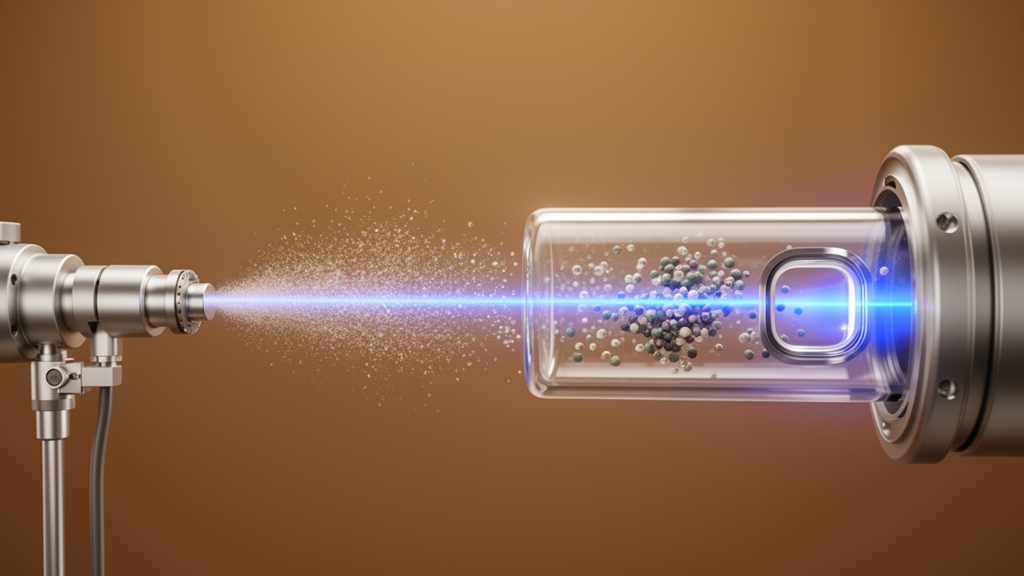
The principle behind the ELSD is elegantly simple. In liquid chromatography, a separated analyte dissolved in a mobile phase arrives at the detector, where the eluent is nebulised into a fine spray. The droplets pass through a heated evaporator tube that strips away the solvent, leaving behind dry analyte particles. A laser beam then illuminates the particle stream, and the scattered light provides the detection signal. Because the response depends on scattering rather than on any optical absorption by the analyte itself, the detector can handle an enormous range of compounds. But the signal strength ultimately hinges on how many particles there are, how large they are, and what shape they have taken after drying, and until now no one had measured those quantities directly inside a working instrument.
The Cambridge team chose three analytes with deliberately contrasting properties: caffeine, which serves as the standard calibration sample in Agilent ELSD instruments; dextran, a large-molecular-weight water-soluble polymer representative of the macromolecules the detector is often asked to analyse; and citric acid, a small non-cyclic molecule with low volatility. Aqueous solutions of each were prepared at concentrations of 0.125, 0.25, 0.5, and 1 grams per litre, sonicated to ensure complete dissolution, and fed continuously into an Agilent 1290 Infinity II ELSD. Steady-state operation, rather than the conventional pulsed injections from a chromatography column, was essential because the particle sizing instruments and electron microscopy required far longer sampling timescales than a transient pulse could provide.
Reconstructing the initial droplet distribution posed a formidable measurement challenge. Water evaporates so rapidly that no single instrument can capture the full size range in situ. The researchers therefore combined two complementary techniques. A phase Doppler particle analyser, or PDPA, provided rapid, spatially resolved measurements of droplets larger than roughly two micrometres, sampled just one millimetre from the nebuliser tip along the spray centreline. Below that threshold, an aerodynamic aerosol classifier paired with a condensation particle counter covered the gap between about 200 nanometres and two micrometres, though it required sampling through tubes and could not resolve individual positions in the spray. To bridge the two regimes, the team used dioctyl sebacate, a low-vapour-pressure oil with negligible evaporation at room temperature, as a non-evaporating surrogate liquid measurable by both instruments simultaneously.
By comparing the well-mixed PDPA and classifier measurements across the overlapping size range, the researchers derived diameter-dependent loss and transfer functions that corrected for gravitational settling in the liquid trap and diffusional and inertial losses in the sampling lines. The result was a reconstructed log-normal droplet distribution for the oil surrogate with a mode near 450 nanometres and a geometric standard deviation of 1.08. Applying established correlations for twin-fluid coaxial pneumatic nebulisers, which relate the Sauter mean diameter to the Reynolds, Weber, and Ohnesorge numbers of the liquid and gas flows, the team then translated this distribution to water. Because water has a higher surface tension than the oil, more energy is needed to shatter the liquid jet, and the predicted water droplet mode shifted upward to about 550 nanometres, with a correspondingly lower peak number concentration to conserve the liquid volume flow.
Downstream of the evaporator, the dried particles were characterised with a scanning mobility particle sizer operated over a size range of 8 to 232 nanometres, with each condition repeated three times for reproducibility. The measurements revealed clear differences among the analytes. Citric acid produced the lowest overall concentrations and the smallest mean diameters, consistent with its high effective density, while dextran behaved remarkably similarly to caffeine despite its much larger molecular weight, hinting at comparable effective densities after drying. In every case, the peak of the distribution grew with analyte concentration, and the distributions were skewed toward larger sizes rather than perfectly log-normal, a signature of size-dependent impaction at the instrument’s Y junction and labyrinth diffuser cartridge, which strip out the largest droplets before they reach the evaporator.
A simple mass-conservation calculation, equating the analyte mass in an initial droplet to the mass of a final spherical particle at bulk density, provided a sanity check on the measurements. For a concentration of 1 gram per litre, the model predicted final mode diameters of 46 nanometres for citric acid and 52 nanometres for caffeine, which could be compared against measured modes of 35 and 65 nanometres respectively. The discrepancies proved informative in both directions. The under-prediction for caffeine pointed to a lower effective particle density than the bulk crystal value, a conclusion borne out by microscopy showing that dried caffeine particles are far from spherical. The over-prediction for citric acid suggested that dissolved analyte may lower the surface tension of the solution, producing smaller initial droplets than the pure-water reconstruction assumes.
Scanning electron microscopy of particles collected on carbon-coated transmission electron microscopy grids, platinum-coated for conductivity and imaged at 5 kilovolts, exposed striking morphological diversity. Caffeine formed elongated, needle-like crystalline particles, echoing literature reports of caffeine crystallising into needles in bulk, a shape with potentially significant consequences for how the particles scatter the detector’s laser light. Dextran yielded approximately spherical particles spanning a wide range of diameters, frequently agglomerated into larger clusters, matching previous observations of dried dextran. Citric acid, unexpectedly, produced roughly spherical, non-agglomerated particles that preferentially collected around the holes of the grids, suggesting liquid-like surface properties during deposition. This contrasts sharply with bulk drying studies, in which citric acid forms crystals with multi-layer agglomerate networks, indicating that crystallisation within atomised droplets follows a different path than crystallisation in a bulk solution.
The study establishes, for the first time, a full experimental picture of particle formation and evolution inside an ELSD, from atomisation through evaporation to detection, and provides the benchmark data against which a companion paper validates a numerical model of aerosol transport, evaporation, and scattering in the instrument. Because the light-scattering signal depends directly on particle size, number, and morphology, the findings explain why detector response varies across analytes and open a route to optimising instrument geometry and operating conditions for specific applications. The authors suggest that the combined experimental and modelling framework could enable improved detector designs and more robust analytical methods across pharmaceutical, biomaterials, and food science research, turning a long-standing black box into a quantitatively understood instrument.
Subject of Research: Experimental characterisation of droplet drying and particle formation inside an evaporative light scattering detector
Article Title: Size distribution and particle morphology of analytes dried through the evaporative light scattering detector – Part 1
Article References: Bertani, F., Hassim, J., & Hochgreb, S. (2026). Size distribution and particle morphology of analytes dried through the evaporative light scattering detector – Part 1. Aerosol Research, 4(2), 311-323. https://doi.org/10.5194/ar-4-311-2026
Image Credits: AI Generated
Keywords: evaporative light scattering detector, aerosol science, particle size distribution, nebulisation, spray drying, phase Doppler particle analysis, aerodynamic aerosol classifier, scanning electron microscopy, caffeine, dextran, citric acid, liquid chromatography
News Source: Russell Cooper. (October 9, 2026). Inside the Universal Detector: First Measurements Reveal How Analyte Particles Form in an ELSD. Scienmag.