Nearly half of the roughly 120 million people forcibly displaced worldwide are women, and a new study argues that their daily lives in Europe are shaped by a quiet, constant negotiation of power. Published in the Scandinavian Journal of Occupational Therapy, the research followed nine women with experiences of forced migration living in urban Sweden and Germany, and found that ordinary activities—learning a language, riding a bicycle, tending a garden plot, volunteering at a women’s organisation—function as tactical responses to structural forces that systematically limit their participation in society. The study, led by Sarah Scheer of Karolinska Institutet with colleagues in Sweden, Germany, Chile and Spain, offers one of the most detailed qualitative portraits to date of how displaced women rebuild daily routines under conditions they did not choose and cannot fully control.
The theoretical engine of the study is a framework borrowed from philosophy and migration studies: the tactic–strategy continuum, developed by De Certeau and elaborated for migrant populations by Sereke and Drzewiecka. Strategies, in this account, belong to the powerful—migration offices, welfare agencies, employers, refugee centres—institutions that set the terms of access to housing, work, healthcare and language education. Tactics belong to those who must build their lives within frameworks designed by others. The researchers treat tactics and strategies not as a binary but as points on a continuum of action, and they ask what everyday ‘techniques’ women deploy to overcome or sidestep barriers, negotiate state integration requirements, and counter racist exclusions. The answer, they find, is written into the smallest details of daily life.
The study’s second analytical lens is intersectionality, understood through the work of postcolonial feminist scholar Chandra Talpade Mohanty. Rather than treating gender, ethnicity, religion, age, disability, education and legal status as separate variables, the researchers examined how these dimensions overlap and compound one another in concrete situations. A highly educated physician from a conflict zone, for instance, faces a very different set of barriers than a woman with limited literacy, even when both hold the same temporary residence permit. The framework also foregrounds solidarity among women as a form of resistance, a theme that turned out to be central to the findings.
Between August 2021 and October 2025, the team conducted semi-structured qualitative interviews lasting 45 to 90 minutes, in German, English, Swedish, Dari and Farsi, with interpreters and trained cultural brokers supporting some sessions. Participants ranged from 21 to 49 years old and lived in cities, where access to language courses, public transport and jobs is better than in rural areas but where bureaucracy and competition for housing and work are fiercer. The interviews were analysed using reflexive thematic analysis, with intersectionality applied as a critical reflexivity tool across all six analytical steps. The researchers were explicit about their own positionality: the first author is a migratised occupational therapist with roots in Pakistan, and several co-authors have personal histories of exile and voluntary migration, including one who grew up during Chile’s dictatorship and later worked with survivors of human rights violations.
The analysis produced four themes, and the first captures the emotional terrain on which everything else unfolds: moving between uncertainty and hope. Participants described waiting years for residence permits and language courses, living in a liminal state one woman called being ‘lost in the woods’, torn between countries, ‘not there and not here at the same time – like a ghost’. One participant, Amira, waited more than three years for a permit and access to a German course while experiencing severe depression: ‘No place to live, no work, no language.’ The researchers interpret this enforced waiting as a strategic exercise of power—what other scholars call slow violence and necropolitics, the bureaucratic machinery that makes some lives wait indefinitely. Against this, the women’s tactics were strikingly concrete. One participant, Naima, denied language classes in 2016, wrote new German words on her wall to memorise them and raised her hand declaring ‘I want, I want’ whenever anyone at the refugee centre mentioned work. Another summed up her survival philosophy in five words: ‘Information is more than money.’
The second theme, disrupted narratives, documents how migration severs the story a person tells about her own life. Amira, a former specialist physician, described needing to ‘wear my white coat’ but being unable to practise medicine in Germany, working instead as a nursing assistant and feeling ‘like a small human’. Professional validation processes took years, and the researchers note that high qualifications can paradoxically make labour market re-entry harder, because the gap between previous status and available work is so wide. Other participants described precariousness rooted in family structure: financial dependence on partners, full responsibility for childcare, and no personal time or independent social network. One woman relied on her partner for housing and finances while unable to work as a midwife, describing herself as feeling like a ‘small child’—a metaphor the researchers read as infantilisation produced by oppressive living conditions.
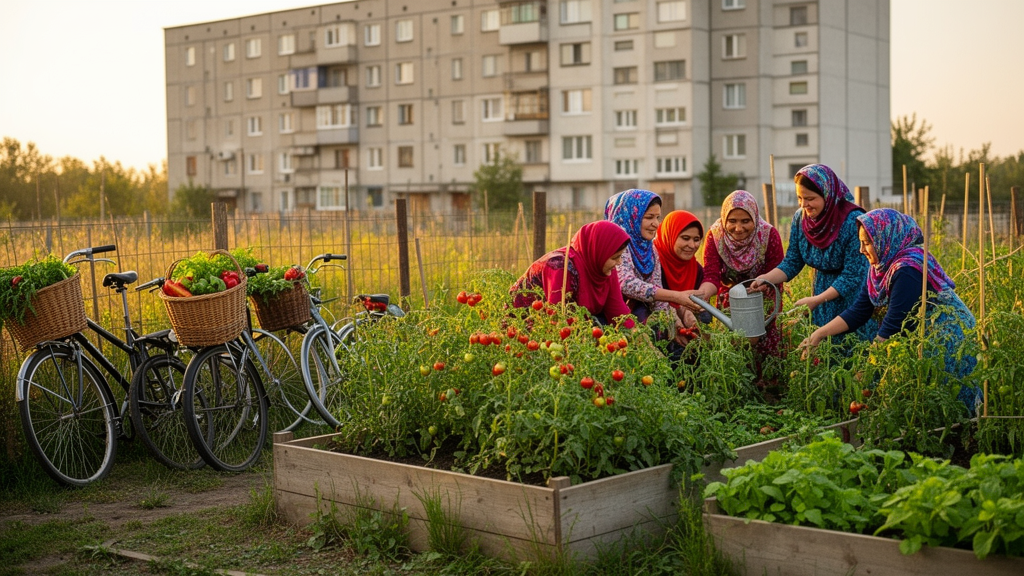
The third theme is the study’s most vivid: nature-based occupations as tactics of freedom. Bicycling emerged as far more than transport. For women who had been barred from cycling in their countries of origin by gender restrictions, learning to ride in Germany or Sweden carried symbolic weight connected to gender equality, independence and health—one participant said she had to bicycle every day ‘because of bad thoughts. I have nightmares.’ The researchers situate this within a long history: the bicycle has been a ‘tool for liberty’ in women’s rights movements since the late nineteenth century. Gardening played a parallel role. One participant rented an allotment where her family could simply be together in peace; another claimed a patch of green in her neighbourhood to plant a vegetable from home, creating a living link between her past and present. The researchers interpret these cultivated spaces as ‘gaining territory’—small, physical reversals of the power imbalance that otherwise defines displaced women’s lives.
Solidarity, the fourth theme, operates at a different scale. Participants volunteered in NGOs supporting refugee women, counselled peers on breast cancer screening and contraception, explained how the German and Swedish systems work, and taught other women to ride bicycles. Naima, who lives with a disability herself, declared: ‘No matter if I get money or not, I want to help the women.’ Her volunteering made her more independent and strengthened her position within dominant social structures, even though it brought no economic stability. Another participant recalled the moment her sense of self shifted on arriving in Europe: ‘I am in Europe, I am not just a housewife anymore.’ Drawing on Mohanty’s account of cross-cultural feminist solidarity, the researchers argue that these practices are not merely mutual aid but forms of resistance to structural violence—collective occupations that counteract the absence of state and institutional initiatives enabling a good life for displaced women.
The methodological choices deserve attention because they shape what the study can claim. The team used information power rather than saturation to justify the sample size, conducted analysis meetings guided by critical reflexivity, and evaluated quality against Tracy’s eight criteria for excellent qualitative research, including sincerity, resonance and meaningful coherence. Interpreters were matched to participants by sex and ethnic background, and every participant received a follow-up phone call days after her interview, along with contact details for psychosocial support networks—a safeguard reflecting the interviewers’ therapeutic experience with trauma. The long data collection window, stretching across election cycles, pandemic restrictions and shifting migration policies, is framed as a strength, because it captured how political change altered participants’ everyday conditions in real time.
The implications reach beyond academia. The authors argue that occupational therapists—health professionals who specialise in enabling meaningful daily activity—are uniquely positioned to support displaced women, but only if they understand everyday life as tactics and strategies in motion, shaped by intersecting power dynamics. Rather than treating a client’s difficulty attending a language course as an individual deficit, a therapist applying this lens would ask which structural barriers, gendered expectations and legal constraints are at play, and might work with the tactics women already use: cycling groups, gardening projects, solidarity networks. The researchers go further, insisting that practitioners must become allies and advocates rather than reproducing existing power imbalances in clinical settings. In a European policy climate marked by stricter border controls and the new EU Asylum and Migration Pact, the study is a reminder that integration is not something that happens to people—it is something people actively, ingeniously do, one bicycle ride, one planted seed and one act of solidarity at a time.
Subject of Research: Intersectional power dynamics and everyday occupations among women with experiences of forced migration in urban Sweden and Germany
Article Title: Tactics and Strategies Operating in Everyday Life Among Women with Experiences of Forced Migration
Article References: Scheer, S., Asaba, E., Buerk, T., Guerrero, M., & Mondaca, M. (2026). Tactics and Strategies Operating in Everyday Life Among Women with Experiences of Forced Migration. Scandinavian Journal of Occupational Therapy, 33(1), Article 9. https://doi.org/10.1007/s44474-026-00011-5
Image Credits: AI Generated
DOI: 10.1007/s44474-026-00011-5
Keywords: forced migration, refugee women, intersectionality, occupational therapy, power dynamics, solidarity, bicycling, gardening, social participation, qualitative research, Sweden, Germany
News Source: Ophelia Keating. (October 9, 2026). How Refugee Women Turn Bicycles, Gardens and Solidarity Into Everyday Acts of Power. Scienmag.