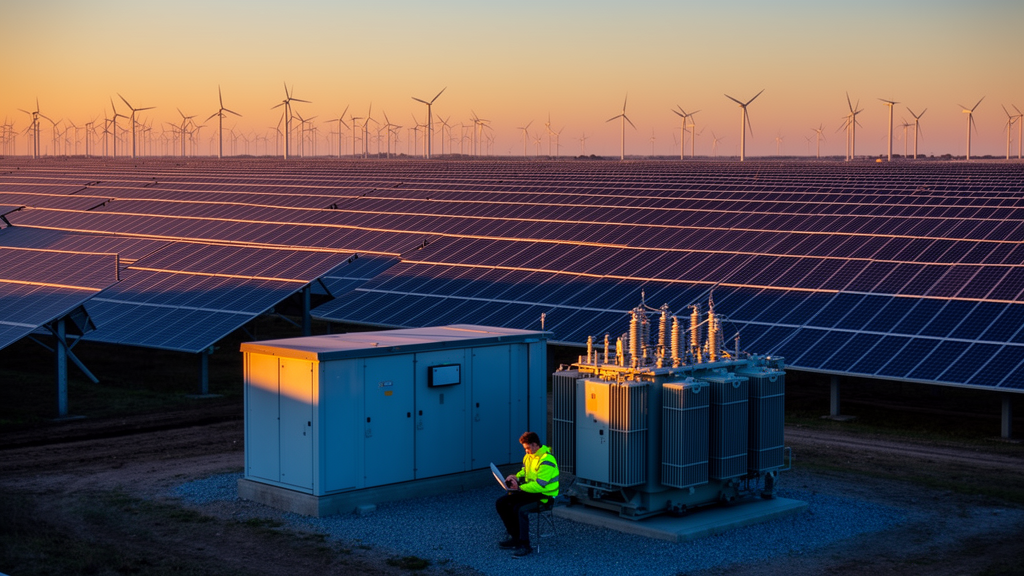
The world’s power grids are undergoing the most profound transformation since electrification began. Coal plants and gas turbines are being retired in favor of millions of solar panels, wind turbines and battery systems, all stitched together by digital communication networks. But according to a new Perspective published in Nature Reviews Electrical Engineering, this green transition is quietly creating one of the most consequential security dilemmas of the modern era. A team of researchers from Imperial College London, the University of Bristol, Aalborg University, the University of Trieste, KTH Royal Institute of Technology and the National Technical University of Athens argues that renewable-dominated grids are not merely harder to defend than their predecessors; they are fundamentally different machines, with attack surfaces and failure modes that today’s fragmented defenses were never designed to handle.
The core of the problem is a double squeeze. On one side, renewable generation depends on vast fleets of digitally connected devices: inverters that convert direct current from solar panels into grid-compatible alternating current, controllers that coordinate battery storage, and aggregators that bundle thousands of rooftop systems into virtual power plants. Every one of these devices is a potential entry point for an adversary. On the other side, the retirement of conventional synchronous generators strips away the physical inertia that once made grids forgiving. In a traditional system, massive spinning turbine rotors acted as shock absorbers, buying operators seconds or even minutes to respond to disturbances. Inverter-based resources provide no such buffer. The result, the authors warn, is that a cyber compromise can now cascade into physical infrastructure and interrupt electricity service faster than ever before in the history of power systems.
The evidence that this threat is not theoretical has been accumulating rapidly. The Perspective cites reports of rogue communication devices discovered in solar power inverters, alongside research demonstrating orchestrated exploitation campaigns that could destabilize the grid through vulnerabilities in commercial solar equipment. Even more striking is recent work on electromagnetic interference, which showed that deliberately corrupting sensor signals on photovoltaic inverters could cause denial of service, suppress power output or inflict physical damage across five commercially available devices and a real microgrid testbed. In other words, the boundary between a cyberattack and a physical attack is dissolving. An adversary no longer needs to touch a substation breaker to trip it; manipulating the data flowing into a control algorithm can achieve the same destructive outcome.
What makes the situation particularly dangerous, the researchers argue, is the physics of inverter-dominated grids. Classical power system stability was built on well-separated phenomena: angle stability, frequency stability and voltage stability each evolved their own analytical tools and countermeasures. With high penetrations of inverter-based resources, these dynamics increasingly couple with fast electromagnetic modes, and the distinction between grid-forming inverters, which set their own voltage and frequency references, and grid-following inverters, which synchronize to the existing grid, is best understood through a unifying duality theory. This coupling means that a small, precisely targeted perturbation, what one cited study calls an infinitesimal attack, can push a high-voltage direct current transmission system past a bifurcation point and trigger disproportionate consequences. Attackers armed with such knowledge need only minimal access to inflict maximum damage.
Yet the most provocative claim in the Perspective is not about the attackers. It is about the defenders. Cybersecurity and physics-based power system protection have both matured into sophisticated disciplines over decades, but they remain, in the authors’ words, siloed. Cybersecurity teams harden networks, patch firmware and monitor for intrusions, largely unaware of how their decisions alter the physical dynamics of the grid. Power engineers design control loops, stability margins and protection schemes, largely assuming the cyber layer beneath them is trustworthy. The coordination between these two worlds, precisely where a determined adversary is most likely to strike, remains under-designed. An attacker who understands both domains can exploit the seam between them, staying below the detection thresholds of the cyber defenders while exceeding the tolerances of the physical controllers.
To close this gap, the authors propose reframing cyber resilience as an end-to-end pipeline of cyber-physical coordinated actions spanning the entire attack life cycle, from reconnaissance and initial intrusion through escalation, impact and recovery. Each phase of the pipeline must supply explicit inputs to the next, governed by three shared principles: consequence, meaning that defenses are prioritized by their effect on electricity service rather than by abstract cyber metrics; coordination, meaning that cyber and physical actions are planned jointly rather than independently; and feedback, meaning that the outcome of every defensive action informs the next. This structure deliberately echoes the industrial control system cyber kill chain, but extends it into the physical domain, recognizing that in a renewable-dominated grid the kill chain does not end at a server; it ends at a blackout.
The framework is more than conceptual. In an illustrative case study on the standard IEEE 14-bus test system, the authors demonstrate how measuring the gap between cyber degradation and actual service loss reveals which cyber-physical coordination changes deliver the most resilience enhancement per unit of investment. This is a crucial practical insight, because utilities cannot harden everything at once. Techniques such as moving target defenses, which dynamically reconfigure converter parameters to frustrate deception attacks, detection-triggered mitigation schemes that contain false data injection before it propagates, and cyber-resilient economic dispatch that absorbs load-altering attacks, all compete for limited budgets. A metric that quantifies the translation of cyber compromise into lost service allows operators to rank these options by real-world consequence, drawing on earlier work such as cyber-physical transmission resiliency assessment metrics and preventive-corrective defense strategies that jointly minimize attack-induced impact regions and maximize security margins.
Recovery, often the neglected final act of the resilience drama, receives particular attention. The authors highlight research linking electricity, transportation and cyber networks to enable coordinated restoration after dynamic load-altering attacks, as well as restoration scheduling that accounts for damaged communication infrastructure through ad hoc wireless links, software-defined microgrid formation and 5G-enabled rerouting. They also point to automated vulnerability localization and non-intrusive hot-patching techniques for industrial control systems, and to resilient scheduling of control software updates across radial distribution networks, as essential tools for shrinking the window between compromise and repair. The message is that resilience is not a static property but a time-dependent capacity to withstand, adapt to and recover from high-impact events, a framing that builds on a decade of power system resilience research originally developed for extreme weather.
Real-world incidents lend urgency to this agenda. The 2015 Ukraine blackout demonstrated that false data injection attacks against grid operators could plunge hundreds of thousands of people into darkness. The SolarWinds supply chain compromise and attacks against Danish critical infrastructure showed how deeply adversaries can penetrate industrial networks. Meanwhile, regulators have scrambled to keep pace: NERC has issued guidance on securing distributed energy resources and their aggregators, NARUC and the US Department of Energy have published cybersecurity baselines for distribution systems, and frameworks such as IEC 62351, IEC 62443, the NIST Cybersecurity Framework 2.0 and the European NIS2 directive now define expectations for the sector. Yet standards written for centralized, synchronous grids struggle to address millions of heterogeneous, vendor-supplied devices communicating through protocols like IEEE 2030.5, DNP3, IEC 61850 and OpenADR, each with its own vulnerability profile.
The Perspective closes with a candid list of implementation needs and open research questions for near-term deployment and at-scale coordination. How can intrusion detection systems trained on one vendor’s equipment generalize to another’s? How should trust and encryption be embedded in interoperability standards without crippling the real-time performance that grid control demands? How can game-theoretic models of adversarial interaction, which treat defense as a strategic contest rather than a checklist, be operationalized in control rooms staffed by humans? And how can the emerging load from data centers, whose electricity demand is growing explosively, be integrated into resilience planning rather than treated as just another consumer? None of these questions has a settled answer. But the authors’ central argument is difficult to dismiss: the energy transition and the cyber defense transition must proceed together, as a single engineering project. Decarbonizing the grid while leaving its defenses fragmented across silos would be, in effect, building the cleanest, most sophisticated and most fragile machine civilization has ever depended on, and then handing its blueprint to anyone patient enough to read it.
Subject of Research: Cyber resilience of renewable-dominated power grids
Article Title: End-to-end cyber resilience enhancement for renewable-dominated power grids
Article References: Liu, M., Parisini, T., Lupu, E., Sandberg, H., Hatziargyriou, N., & Teng, F. (2026). End-to-end cyber resilience enhancement for renewable-dominated power grids. Nature Reviews Electrical Engineering. https://doi.org/10.1038/s44287-026-00334-2
Image Credits: AI Generated
DOI: 10.1038/s44287-026-00334-2
Keywords: cyber resilience, power grids, renewable energy, inverter-based resources, grid security, cyber-physical systems, attack detection, grid-forming inverters, false data injection, distributed energy resources, power system stability, critical infrastructure
News Source: Faith Mcneil. (October 9, 2026). The Grid’s Weakest Link: Why Solar and Wind Power Are Rewriting the Rules of Cyber Defense. Scienmag.