A team of food scientists in China has shown that the order in which two wine yeasts are introduced into fermenting grape juice can dramatically reshape the character of the resulting Cabernet Sauvignon, lowering its alcohol content while enriching it with a far more complex bouquet of aromatic compounds. The study, published in npj Science of Food, compared three controlled fermentation strategies using yeasts isolated from the same vineyard environment, and found that a carefully timed sequential inoculation outperformed both conventional monoculture fermentation and simultaneous mixed fermentation on nearly every quality metric that matters to winemakers.
The research, led by Lanlan Hu, Zhen Wang, Xiaohong Wang and Xiuyan Zhang from Huazhong Agricultural University and the Henan Institute of Science and Technology, focused on two indigenous yeast strains: Saccharomyces cerevisiae, the workhorse yeast responsible for completing alcoholic fermentation in virtually all wines, and Hanseniaspora uvarum strain Z5L-22, an apiculate yeast that naturally dominates the early stages of spontaneous fermentation before alcohol levels rise too high for it to survive. Both strains were isolated from local wine-growing environments, meaning the experiment tested a microbial partnership drawn from the same terroir as the grapes themselves rather than commercially manufactured starter cultures.
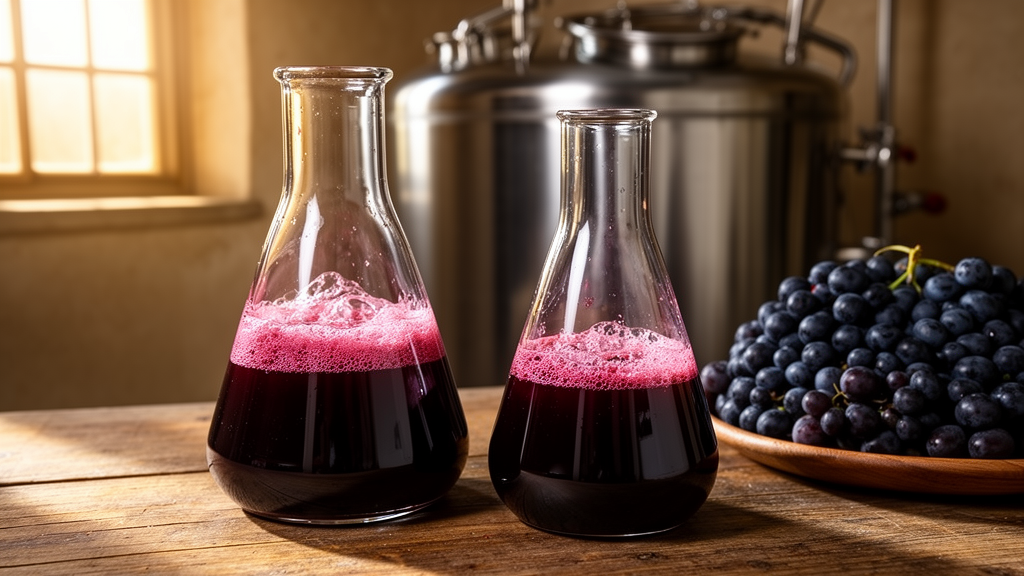
The experimental design was elegantly simple. The researchers set up three fermentation treatments using Cabernet Sauvignon must. The first was pure fermentation, in which S. cerevisiae alone was inoculated at the start, representing the industry standard approach. The second was simultaneous fermentation, in which both S. cerevisiae and H. uvarum were added together at the onset of fermentation. The third was sequential fermentation, in which H. uvarum was introduced first and S. cerevisiae was added two days later, giving the non-Saccharomyces yeast a head start to grow and metabolize before the dominant fermenter took over. Throughout the fermentations, the team tracked microbial population dynamics, sugar consumption, ethanol production, acidity, color, polyphenols and volatile aroma compounds.
The population dynamics revealed why timing matters so much. In both the pure and simultaneous fermentations, S. cerevisiae quickly established overwhelming dominance, effectively crowding out or outcompeting the H. uvarum population before it could make a meaningful contribution to the wine’s chemistry. In the sequential fermentation, however, the two-day head start allowed H. uvarum to deplete nutrients in the must and establish itself, which delayed the growth of S. cerevisiae and extended the overall fermentation. While a prolonged fermentation might sound like a drawback, it gave the non-Saccharomyces yeast a genuine window of metabolic activity during which it could produce flavor-active compounds that a fast, dominant S. cerevisiae fermentation would otherwise suppress.
One of the most commercially significant findings concerns alcohol. Wines made with either mixed-yeast strategy contained less ethanol than the pure-culture control, a result of the non-Saccharomyces yeast consuming sugar through metabolic pathways that divert some carbon away from ethanol and toward other products such as glycerol and carbon dioxide. With consumers and regulators increasingly focused on alcohol levels, and with climate change pushing grape ripeness and potential alcohol ever higher in many wine regions, microbiological approaches to alcohol reduction are attracting serious attention. The sequential fermentation achieved this reduction while simultaneously raising total acidity, a change that can improve the freshness and balance of wines made from very ripe fruit.
Color and polyphenol results added further weight to the case for sequential fermentation. Both mixed fermentations increased color saturation relative to the pure culture, but the sequential approach went further, significantly elevating levels of total polyphenols and anthocyanins, the pigmented compounds responsible for the deep red hues of red wine. Anthocyanins and other polyphenols are not merely cosmetic; they contribute to astringency, bitterness and the antioxidant capacity of wine, and their extraction and retention during fermentation are central to red wine quality. The improved chromatic attributes observed in the sequential wines suggest that the altered microbial succession changed the extraction environment in the fermenting must, possibly through differences in ethanol production kinetics and the release of metabolic byproducts that influence phenolic solubility.
The aroma findings were the most striking. Wines from the sequential fermentation contained a diverse and abundant array of varietal and fermentative aroma compounds, with particularly notable increases in acetate esters, higher alcohols, benzene derivatives and key monoterpenes. Acetate esters, formed by the enzymatic esterification of acetic acid with higher alcohols, are responsible for many of the fruity and floral notes prized in young wines. Higher alcohols contribute to overall aromatic intensity, though at high concentrations they can be harsh. Benzene derivatives add floral and spicy nuances, while monoterpenes, typically associated with aromatic grape varieties, impart characteristic floral and citrus-like scents. The sequential fermentation produced a more complex aromatic profile than either the pure fermentation or the simultaneous co-inoculation, indicating that the extended period of H. uvarum activity was the decisive factor in generating this chemical richness.
The contrast between the two mixed-fermentation strategies carries a practical lesson for winemakers. Simultaneous inoculation, despite being easier to implement at scale, allowed S. cerevisiae to dominate so quickly that H. uvarum contributed little beyond what the pure culture achieved. Sequential inoculation, by contrast, deliberately created a temporal niche for the non-Saccharomyces yeast, letting it shape the must chemistry before the alcohol-tolerant S. cerevisiae finished the job. This finding aligns with a broader shift in enology toward using non-Saccharomyces yeasts as tools for modulating wine composition rather than as contaminants to be eliminated, and it suggests that the sequencing, not merely the species mix, is the critical control point.
There are caveats worth noting. The study was conducted on a single grape variety, Cabernet Sauvignon, using specific indigenous strains, and the extended fermentation time associated with the sequential approach could pose logistical challenges in a busy winery where tank turnover matters. The nutrient depletion caused by early H. uvarum growth, which delayed S. cerevisiae, would also need careful management to avoid stuck or sluggish fermentations under commercial conditions. Nonetheless, the authors conclude that sequential fermentation optimally balances reduced alcohol with enhanced polyphenolic and aromatic complexity, offering a promising strategy for producing lower-alcohol wines with superior sensory quality.
The work was financially supported by the National Natural Science Foundation of China, and the authors declare no competing interests. As wineries worldwide grapple with rising alcohol levels, changing consumer palates and the demand for wines that express a genuine sense of place, the idea that the answer may lie in orchestrating the native microbial succession of the vineyard itself, rather than in de-alcoholization technology or vineyard interventions, is an appealing one. This study provides concrete evidence that a two-day delay in adding the industry’s favorite yeast can transform the chemistry of a Cabernet Sauvignon, trading a little fermentation speed for a substantially richer glass.
Subject of Research: Sequential yeast fermentation strategy for improving Cabernet Sauvignon wine quality
Article Title: Sequential fermentation with indigenous Hanseniaspora uvarum followed by Saccharomyces cerevisiae enhances aroma complexity and quality of Cabernet Sauvignon wine
Article References: Hu, L., Wang, Z., Wang, X., & Zhang, X. (2026). Sequential fermentation with indigenous Hanseniaspora uvarum followed by Saccharomyces cerevisiae enhances aroma complexity and quality of Cabernet Sauvignon wine. npj Science of Food. https://doi.org/10.1038/s41538-026-01165-z
Image Credits: AI Generated
DOI: 10.1038/s41538-026-01165-z
Keywords: Hanseniaspora uvarum, Saccharomyces cerevisiae, sequential fermentation, Cabernet Sauvignon, wine aroma, lower-alcohol wine, anthocyanins, polyphenols, acetate esters, non-Saccharomyces yeast, fermentation kinetics, wine color
News Source: Alan Morgan. (October 9, 2026). Two Yeasts, One Wine: Sequential Fermentation Boosts Cabernet Sauvignon Aroma and Cuts Alcohol. Scienmag.