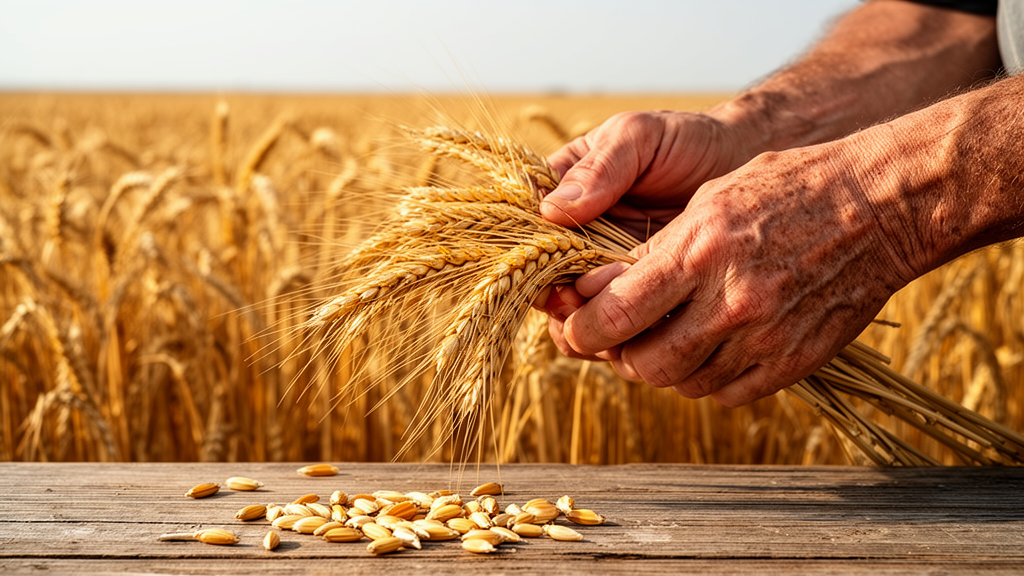
The pasta on your dinner plate begins its life as a seed, and the precise dimensions of that seed — its length, its width, its roundness, its weight — determine far more than most consumers ever realize. In durum wheat, the tetraploid cereal that supplies semolina for pasta, couscous, and a host of other Mediterranean and semi-arid staples, grain morphology sits at the intersection of yield, milling performance, and end-use quality. Yet despite its economic weight, the genetic architecture of seed size and shape in durum wheat has remained far less charted than in its hexaploid cousin, bread wheat. A new genome-wide study published in BMC Plant Biology by a team of Indian researchers led by Thamaraikannan Sivakumar, Divya Sharma, Neeraj Budhlakoti, and Chandra Kant, with corresponding authors V. K. Vikas and Sundeep Kumar, now delivers one of the most detailed looks to date at the genes and markers that shape the durum grain.
The research began with a deceptively simple question: how much natural variation exists in the seeds of durum wheat, and can breeders actually exploit it? To find out, the team assembled a panel of 185 durum wheat accessions and subjected their grains to digital image-based phenotyping, a technique that replaces rulers and calipers with high-resolution imaging and software that extracts precise morphometric measurements from every seed. This approach allowed the researchers to quantify a suite of seed traits — including dimensions related to size, shape, perimeter, and single seed weight — with a level of throughput and repeatability that manual measurement could never match. The panel was grown under a randomized block design, providing the statistical rigor needed to separate genuine genetic differences from environmental noise.
What emerged from the phenotyping was striking. The 185 accessions displayed substantial genetic variation across the measured traits, and perhaps more importantly for any breeding program, the variation proved highly heritable. Single seed weight showed a heritability of 84.1 percent, while grain perimeter reached 78.9 percent. In practical terms, heritability values of this magnitude mean that a large proportion of the observed differences between plants is written into their genes rather than dictated by growing conditions. When traits are this heritable, selection works: breeders can confidently choose parent plants based on their seed characteristics and expect those characteristics to pass predictably into the next generation. The authors note that these high heritability levels indicate a high possibility of selection, a conclusion that transforms the study from a descriptive exercise into a practical roadmap for improvement.
With the phenotypic foundation laid, the team turned to the genome. They genotyped all 185 accessions using the wheat 90K Infinium iSelect SNP array, filtering the data down to 25,019 high-quality single nucleotide polymorphisms — the single-letter DNA differences scattered across the genome that serve as signposts for nearby functional variants. The researchers then deployed not one but eight different genome-wide association study models, a deliberate strategy designed to reduce false positives and ensure that only associations robust across multiple statistical frameworks were retained. This multi-model approach is increasingly regarded as best practice in association mapping, particularly in wheat, where the genome’s sheer size, polyploid structure, and strong population structure can conspire to produce spurious signals.
The GWAS results were rich. Across all traits, the analysis detected 47 significant marker-trait associations, and remarkably, these were distributed across all 14 chromosomes of the durum wheat genome. Durum wheat carries two sub-genomes, designated A and B, inherited from its wild ancestors, and the B sub-genome emerged as the hotspot, harboring the most significant associations. Of the 47 marker-trait associations, five co-located with loci previously reported for grain size, shape, and weight — a reassuring sign that the study’s methods were capturing real biology already known to the field. The remaining 42 associations were putatively novel, meaning they point to genomic regions never before linked to seed morphometry in durum wheat. This trove of new loci represents fresh raw material for marker-assisted selection, the breeding technique that uses DNA markers rather than slow, laborious phenotypic screening to track valuable genes through crossing programs.
Identifying a marker-trait association is only the first step; understanding which genes lie near the associated markers gives the associations biological meaning. The team therefore searched the genomic neighborhoods of their significant loci for plausible candidate genes. Among those they found were genes encoding F-box proteins, transporters, and metabolic enzymes — three functional classes with established credentials in grain development and nutrient allocation. F-box proteins are components of ubiquitin ligase complexes that tag other proteins for degradation, a mechanism central to the hormonal and developmental switches that govern seed growth. Transporters, as their name suggests, move sugars, amino acids, and minerals into the developing grain, directly influencing how large and heavy a seed becomes. Metabolic enzymes, meanwhile, orchestrate the biochemical transformations that convert imported nutrients into starch, protein, and the structural components of the mature grain.
The researchers went further than simple gene listing. They examined the stage-specific regulation of these candidate genes and performed in silico expression profiling — computational analysis of transcriptomic data — during early and mid-grain development. This temporal dimension matters because grain development is a tightly choreographed sequence: cell division and expansion in the early phases establish the seed’s potential size, while the grain-filling period that follows determines how much of that potential is realized as mass. The expression analysis revealed that some of the candidate genes continue to be expressed during seed maturation, hinting at roles that extend into the final stages of seed development and possibly into the determination of mature grain characteristics. Such expression patterns help prioritize which of the 42 novel loci deserve the closest attention in follow-up validation experiments.
To translate all of this genetic information into actionable breeding decisions, the team applied the Multi-trait Genotype-Ideotype Distance Index, or MGIDI, an analytical framework that scores each accession by how closely it approaches an ideal combination of multiple traits simultaneously. Rather than selecting for one trait at a time — which often drags undesirable characteristics along with the desired one — MGIDI identifies genotypes that best balance the full suite of target traits. The analysis singled out four promising accessions, split neatly into two ideotype classes. The slender grain ideotype was represented by accessions IC0535876 and IC0128512, while the bold grain ideotype — seeds that are larger and heavier — was embodied by UAS12 and UAS38. These four lines now stand as ready-made parental candidates for breeding programs pursuing either grain profile, depending on the end-use quality target.
The distinction between slender and bold grains is not cosmetic. Grain shape and size influence the milling yield of durum wheat, the proportion of the grain that emerges as usable semolina, and the uniformity that pasta manufacturers demand. A bold grain may pack more reserves per seed and support higher yield components, while slender grains can suit specific milling and product applications. By identifying both ideotypes within the same germplasm panel and tying each to specific genomic regions, the study effectively hands breeders a menu: choose the ideotype, then use the associated markers to track the underlying alleles through successive generations of crossing.
The broader significance of the work lies in its synthesis. By combining high-throughput digital phenotyping, a large and diverse accession panel, a dense SNP array, eight GWAS models, candidate gene annotation, developmental expression profiling, and ideotype-based selection, the researchers have connected the full chain from observable trait to underlying gene to breeding application. The authors conclude that the substantial genetic variation and polygenic architecture they uncovered — with many loci each contributing modest effects rather than a few genes dominating — confirm that seed morphometry in durum wheat is a classic quantitative trait system. They suggest that the accessions and associated loci identified here may serve as useful resources for future validation and breeding applications, and that the marker-trait associations and candidate genes can support marker-assisted selection for grain size and shape. For a crop that anchors food security across the Mediterranean basin and semi-arid regions worldwide, and one that faces mounting pressure from climate variability, the ability to breed for optimal grain morphology with genomic precision is a quietly consequential advance — one that may eventually be measured in fuller granaries and better pasta.
Subject of Research: Genetic basis of seed morphometric traits and breeding ideotypes in durum wheat
Article Title: Genome-wide insights into seed morphometry and breeding ideotypes in durum wheat
Article References: Sivakumar, T., Sharma, D., Budhlakoti, N., Kant, C., Mohapatra, A., Sathishkumar, R., Yadav, A., Biradar, S., M., S., Bharadwaj, R., Jacob, S. R., Mishra, D. C., Singh, A. K., Singh, G. P., Vikas, V. K., & Kumar, S. (2026). Genome-wide insights into seed morphometry and breeding ideotypes in durum wheat. BMC Plant Biology. https://doi.org/10.1186/s12870-026-10074-y
Image Credits: AI Generated
DOI: 10.1186/s12870-026-10074-y
Keywords: durum wheat, seed morphometry, GWAS, marker-trait association, SNP, grain development, plant breeding, ideotype, heritability, candidate genes, MGIDI, B sub-genome
News Source: Alan Morgan. (October 9, 2026). Genetic Map of Grain Shape Reveals New Targets for Breeding Better Durum Wheat. Scienmag.