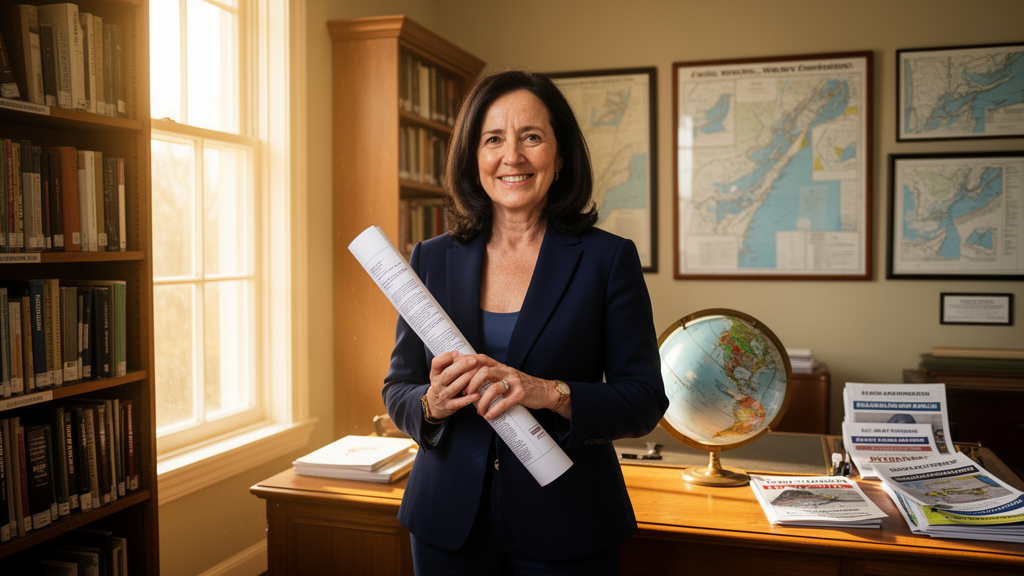
Alka Sapat, a professor and the director of the School of Public Administration at Florida Atlantic University, has been named a 2026 Fellow of the National Academy of Public Administration, one of the highest honors available to scholars and practitioners in the field. The Academy, an independent, nonprofit and nonpartisan organization chartered by Congress, reserves its Fellowship for individuals whose work has made significant and continuing contributions to public administration and public policy. Sapat, who holds her faculty appointment within FAU’s Dorothy F. Schmidt College of Arts and Letters, is among 64 distinguished public service leaders selected for the Academy’s 2026 class, a cohort that spans prominent scholars, educators, executives, nonprofit leaders and practitioners drawn from local, state and federal levels of government. With her election, she becomes the first faculty member at Florida Atlantic University to be elected as a Fellow of the Academy.
The new Fellows will join a membership of more than 1,000 current Fellows, a roster that includes former cabinet officers, members of Congress, governors, mayors and state legislators. Election to the Academy is not a ceremonial appointment. Fellows are chosen by the existing membership on the basis of distinguished and continuing achievements, and the selection process involves a rigorous review by a nominating committee that evaluates hundreds of applicants before making recommendations to the full Fellowship, which then votes on each nominee. That structure is designed to ensure that the Academy’s expertise remains grounded in demonstrated contributions to the effectiveness, efficiency, accountability and transparency of government at every level, from municipal agencies to federal departments.
The organization itself carries a notable institutional history. It was founded in 1967 by James E. Webb, then the administrator of NASA, together with other leading public administration practitioners, and it was subsequently chartered by Congress to provide expert advice to government leaders and agencies. The Academy convenes nationally recognized experts to address critical challenges facing public institutions and public service, functioning as a bridge between academic research and the practical demands of governance. For a scholar of public administration, election as a Fellow represents recognition not only of individual scholarship but of sustained influence on how governments prepare for and manage complex problems.
Sapat’s own research program sits at the intersection of public policy and disaster management, a field that has grown in national importance as hazards intensify and recovery costs climb. Her scholarship focuses on disaster management, community resilience, vulnerability and resilience assessment, housing and population displacement. At its core, her work examines how communities, governments and organizations can better prepare for, respond to and recover from disasters and other complex challenges. That agenda encompasses both the technical dimensions of resilience, such as the performance of infrastructure and building codes under hazard stress, and the social dimensions, including how displaced households find housing and how vulnerable populations navigate the recovery process.
At Florida Atlantic, Sapat has led and contributed to research funded by the National Science Foundation, the U.S. Department of Energy and the U.S. Department of Homeland Security. The projects span critical infrastructure resilience, port resilience, population displacement, energy and water resilience, building code regulations, post-disaster housing, disaster recovery and nonprofit collaboration, and she has secured more than 3.3 million dollars in federally funded grants. The breadth of that portfolio reflects the multidisciplinary character of modern hazards research, which requires engineers, social scientists and policy analysts to work together on questions that no single discipline can answer alone. Her studies have addressed issues ranging from the displacement of populations following disasters and the role of housing in recovery to the resilience of critical infrastructure and ports, and she has examined the role of diaspora communities and nonprofit organizations in disaster recovery as well as disaster readiness among vulnerable populations.
Her professional service extends well beyond her home institution. Sapat was a research fellow with the National Science Foundation’s Next Generation of Hazards Researchers program, an initiative designed to cultivate the leading hazards scholars of the coming decades. She also participated in a National Academies of Sciences report examining lessons learned from the COVID-19 pandemic and their implications for disaster planning, work that connected the experience of a global public health emergency to the established frameworks of emergency management. More recently, she was invited to serve as a subject matter expert and lead author on a chapter focused on disaster recovery for the third national assessment of natural hazards, a large-scale initiative launched in 2024 and 2025 to synthesize more than 25 years of U.S. disaster research, assess evolving risks and establish a research agenda for the next 50 years aimed at reducing the impacts of disasters.
Her engagement with policy has also been practical and regional. Sapat served on the Florida State Disaster Housing Task Force and on the Governor’s Hurricane Conference Scholarship Committee, and she has participated in local initiatives focused on post-disaster housing. In a state where hurricanes routinely test the housing stock, the insurance system and the coordination mechanisms of local government, that combination of scholarly expertise and hands-on policy involvement illustrates precisely the kind of continuing contribution to public administration that the Academy’s election process is intended to recognize. It also reflects the feedback loop at the heart of her discipline, in which research findings inform task force recommendations and field experience in turn shapes new research questions.
Sapat’s scholarship has appeared in leading journals in the field, including the Journal of Public Administration Research and Theory, Public Administration Review, the American Review of Public Administration, Risk Analysis, Natural Hazards Review, Natural Hazards and the International Journal of Mass Emergencies and Disasters. She is co-author of the 2014 book Displaced by Disasters: Recovery and Resilience in a Globalizing World and co-editor of the 2017 book Coming Home after Disaster: Multiple Dimensions of Housing Recovery. Together, those publications have helped define how researchers and practitioners understand population displacement as a global phenomenon and how housing recovery can be assessed across its multiple social, economic and physical dimensions. She also brings more than 15 years of academic leadership experience to the Fellowship, having served as director, Ph.D. program coordinator and undergraduate program coordinator of FAU’s School of Public Administration, and her teaching and mentoring have covered disaster management, homeland security, public policy, research methods and statistical analysis.
Within the university, the election was framed as an institutional milestone as well as a personal one. Michael Horswell, dean of FAU’s Dorothy F. Schmidt College of Arts and Letters, described the honor as an exceptional accomplishment and a powerful recognition of the national significance of Sapat’s scholarship and leadership, noting that her work demonstrates the essential role public administration research plays in addressing some of society’s most consequential challenges, from disasters and displacement to infrastructure resilience and public policy. He added that the distinction reflects well on Sapat and the college, elevates the national profile of FAU’s faculty and underscores the impact and growing reputation of the university’s research enterprise as an R1 institution. Sapat, for her part, described the selection as an extraordinary honor and a meaningful recognition of work shared with colleagues, students and research partners throughout her career, saying she is especially honored because the Academy brings together people who have dedicated their careers to strengthening public service and addressing complex challenges facing communities and governments.
The formal induction of the 2026 class will take place during the Academy’s National Conference, scheduled for Nov. 8 to 10 at the National Academy of Sciences building in Washington, D.C. For the field of public administration, the 2026 cohort arrives at a moment when questions of disaster recovery, infrastructure resilience and institutional trust have moved to the center of policy debate, and the Academy’s convening role gives its Fellows a direct channel through which research can inform governmental practice. For Florida Atlantic University, Sapat’s election signals that scholarship produced in South Florida, in one of the most hazard-exposed regions of the United States, is shaping the national conversation about how communities withstand and recover from catastrophe. As she takes her place among the Academy’s more than 1,000 Fellows, her stated intention is to contribute to that community and to learn from and work alongside Fellows whose scholarship, leadership and public service have had a significant impact, continuing a career devoted to making disaster recovery more equitable, more effective and better informed by evidence.
Subject of Research: Election of disaster resilience and public administration scholar Alka Sapat as a 2026 Fellow of the National Academy of Public Administration
Article Title: FAU’s Alka Sapat named Fellow of the National Academy of Public Administration
Article References: FAU’s Alka Sapat named Fellow of the National Academy of Public Administration. (n.d.). Original publication
Image Credits: AI Generated
DOI: Not provided
Keywords: Alka Sapat, National Academy of Public Administration, Florida Atlantic University, disaster recovery, community resilience, population displacement, public administration, public policy, post-disaster housing, critical infrastructure resilience, fellowship honor, hazards research
News Source: Denise Maddox. (October 9, 2026). Disaster Resilience Scholar Alka Sapat Elected to National Academy of Public Administration. Scienmag.