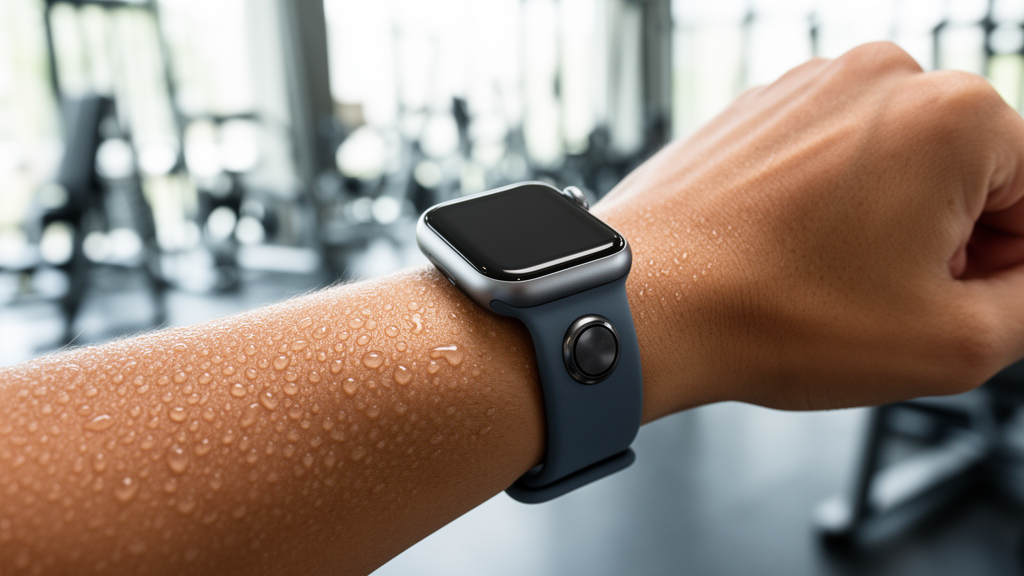
Sweat is far more than a sign of a hard workout. It is a continuously updated chemical readout of what the body is doing, carrying dissolved ions whose concentrations shift with hydration status, exertion, and heat stress. For years, researchers have chased the idea of a wearable device that could tap into this stream of biochemical information as it flows, giving athletes, outdoor laborers, and safety managers a live window into the body’s electrolyte balance. Now, a team at Tokyo University of Science has moved that vision a significant step closer to everyday reality with a wristwatch-type sensor that measures sodium and potassium in sweat in real time and beams the results wirelessly to a computer.
The research, led by Associate Professor Isao Shitanda of the Department of Pure and Applied Chemistry in the Faculty of Science and Technology at Tokyo University of Science, was published online in ACS Omega on September 21, 2026. Co-authored by second-year master’s student Takuma Fujisawa, the study describes a fully integrated system: screen-printed ion-selective electrodes for sodium and potassium, a printed liquid-junction reference electrode, a fabric-based sample transport layer, and custom digital electronics packaged in a wristwatch form factor that can process, store, and transmit data. The work was supported by JSPS KAKENHI Grant-in-Aid for Scientific Research (B), Grant Number 24K02819.
To understand why this integration matters, it helps to look at how wearable ion sensors actually work. Most of them are potentiometric devices, which means they do not measure a concentration directly. Instead, they measure a voltage that changes predictably with the concentration of a specific ion in the sample touching the electrode. An ion-selective electrode is designed to respond preferentially to one ion species, such as sodium or potassium, generating a potential that tracks that ion’s activity in sweat. But a single electrode cannot give a meaningful reading on its own. Every potentiometric measurement is a comparison against a second, unchanging potential, and that is the job of the reference electrode.
The reference electrode is the quiet workhorse of electrochemistry, and it is also the weak link in many printed wearable sensors. Conventional printed reference electrodes can take considerable time to stabilize before they deliver a steady potential, and until they do, the readings from the ion-selective electrodes are unreliable. For a device meant to be strapped on and used immediately, whether on a factory floor or a running trail, a long pre-adjustment period is a serious practical obstacle. Continuous monitoring in dynamic, real-world contexts demands a reference electrode that is ready almost as soon as the sweat arrives.
The Tokyo University of Science team attacked this problem with a liquid-junction reference electrode built by screen printing. The key ingredient is silica gel embedded in the liquid junction, which facilitates water permeation into the electrolyte layer. That permeation allows the reference electrode to reach rapid initial stabilization, dramatically shortening the time between putting on the device and obtaining trustworthy measurements. Because the electrode is printed rather than assembled from bulky conventional components, it fits naturally into a flat, flexible, low-profile sensor that can sit against the skin on the wrist.
Getting sweat to the electrodes is its own engineering challenge, and the researchers addressed it with a dedicated sample transport layer. This layer consists of fabric and superabsorbent fiber placed over the electrodes. Its job is twofold: it helps wet the sensing area as sweat is produced, and it facilitates transport of the sample through the sensing region so that fresh sweat, carrying up-to-date ion information, continuously reaches the electrodes. Without such a layer, a wearable sensor can sit dry against the skin or read stale, pooled fluid, either of which undermines the goal of real-time monitoring.
The sensing elements alone do not make a wearable device, so the team integrated them with digital electronics in a wristwatch-type package. The custom device processes the signals from the sodium- and potassium-selective electrodes, transmits them wirelessly to a host computer, and simultaneously stores them locally on a micro-SD card. That combination of live transmission and onboard storage is important for field use, where wireless links can drop or where data may need to be reviewed after the fact. The wearer gets continuous monitoring without any interruption to their activity, and the researcher or safety officer gets a complete record.
The most striking demonstration came not in the laboratory but at an active construction site. One construction worker wore the wristwatch device through a normal workday, including breaks, hydration, and meals, while carrying out usual tasks around the site. Over approximately two hours and forty-five minutes, the device acquired sodium- and potassium-responsive signals in real time as the worker moved and worked. The measurements were successfully transmitted wirelessly to a host computer and simultaneously stored on the device, showing that the integrated system could acquire and relay ion-responsive signals under the messy, moving, sweaty conditions of genuine fieldwork rather than the controlled stillness of a lab bench.
Dr. Shitanda emphasized that the breakthrough is one of integration rather than novel materials. According to the researchers, the central achievement of the work lies not in proposing a new electrode material, but in combining a printed electrode, a sample transport mechanism, and a wireless measurement circuit, and demonstrating the feasibility of that combination in a real-world environment. This framing matters for anyone following the wearable-sensor field: elegant chemistry in a paper is common, but a printed, wireless, wrist-worn system that survives a full shift on a construction site is rare, and it is exactly the kind of systems-level proof that turns laboratory concepts into practical technology.
The researchers are careful about what has and has not been proven. Quantitative sweat analysis will require controlled sweating experiments and further validation, so the device should be understood today as a demonstration of field feasibility for an integrated wearable electrolyte-sensing system rather than a finished clinical or occupational health product. Even so, the implications are broad. Because the electrodes can be fabricated using printing technology, the approach lends itself to low-cost manufacturing and large-scale production, which is essential if wearable electrolyte monitors are to move from research demonstrations to devices worn by thousands of workers and athletes. Dr. Shitanda noted that the technology could serve as a foundation for acquiring information about ions contained in sweat without interrupting work or exercise in construction sites, manufacturing plants, sports, and outdoor activities, and that in the future, by combining this information with data such as sweat volume and water intake, it could be applied to health management and hydration support in hot environments. As heat stress grows into an ever more pressing occupational and athletic concern, a printed wristwatch that quietly reads the body’s electrolyte story as it unfolds may prove to be one of the more consequential wearables on the horizon.
Subject of Research: Wearable potentiometric sweat sensors for real-time sodium and potassium monitoring
Article Title: Wristwatch-type wearable sensor enables real-time monitoring of sodium and potassium
Article References: Wristwatch-type wearable sensor enables real-time monitoring of sodium and potassium. (n.d.). Original publication
Image Credits: AI Generated
DOI: Not provided
Keywords: wearable sensor, sweat analysis, sodium, potassium, ion-selective electrode, reference electrode, screen printing, potentiometry, real-time monitoring, hydration, occupational health, Tokyo University of Science
News Source: Ophelia Keating. (October 9, 2026). Wristwatch Wearable Tracks Sodium and Potassium in Sweat in Real Time. Scienmag.