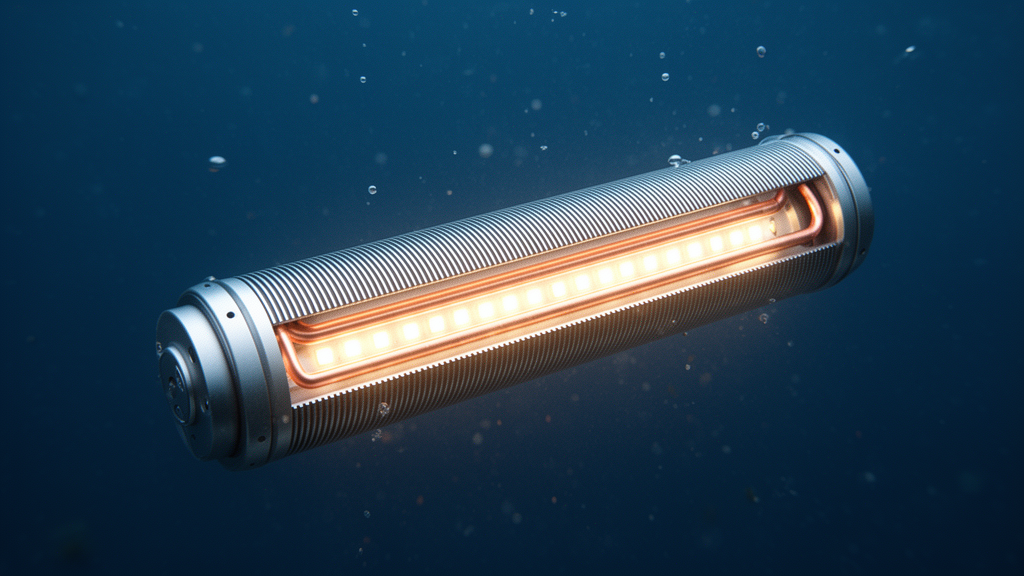
Deep beneath the ocean surface, where hydrostatic pressure crushes ordinary equipment and no fan can spin, a quiet revolution in thermal engineering is taking shape. High-power LED fish-attracting lamps, the glowing beacons that lure schools of fish toward fishing vessels, generate such intense heat that their own light-emitting chips risk cooking themselves to death. Now, a team of researchers in China has unveiled a hybrid cooling architecture that combines topology-optimized lamp housings, chimney-effect airflow, integrated heat pipes, and microscopic surface grooves, cutting the peak operating temperature of these lamps by 6.73 percent compared with conventional designs, all while preserving the hermetic sealing that deep-sea operation demands.
The problem these engineers set out to solve is deceptively simple to state and brutally difficult to fix. Modern high-power LED chips convert roughly 70 to 80 percent of their incoming electrical energy into heat rather than light. In a fish-attracting lamp array, heat flux densities can exceed 100 watts per square centimeter, a figure that rivals the thermal challenges found in advanced computer processors. When junction temperatures climb, luminous efficiency degrades, materials age faster, and the lamp’s operational lifespan shrinks. For fishing fleets, where a single lamp failure can mean a lost night’s catch, that reliability penalty carries real economic weight.
Existing cooling strategies have struggled to square a circle: the lamp must shed heat efficiently while remaining sealed against enormous water pressure. Active cooling with fans adds moving parts that fail under hydrostatic loads. Liquid cooling, while effective in laboratory settings, demands penetrations and plumbing that compromise the pressure envelope. The new approach, published in the journal Mechanical Sciences by Xuehua Chen, Jiafu Ruan, and Xigui Wang, sidesteps this dilemma entirely by relying on passive physics: buoyancy, phase change, and cleverly shaped surfaces do the work that pumps and fans would normally perform.
The first pillar of the design is a reshaped lamp housing produced through topology optimization, a computational technique that lets an algorithm decide where material should and should not exist. The researchers formulated the problem around a quantity called thermal compliance, essentially the thermal analog of potential energy. By minimizing thermal compliance, the algorithm drives heat toward the surrounding medium as efficiently as possible, producing the optimal temperature distribution across the structure. The team used the classical SIMP method on a two-dimensional cross-section of the heat sink, then stretched the result along the lamp’s axis, a pragmatic choice that matches the aluminum extrusion process used for mass production.
That choice was not arbitrary. Because the temperature gradient induced by the chimney effect and the associated airflow remain essentially uniform along the vertical direction, a two-dimensional optimization of a representative cross-section remains physically valid for the full three-dimensional structure. The researchers also had to tame a known weakness of SIMP optimization, which tends to spawn excessively slender, branching structures that fracture under vibration or thermal stress. By imposing a filter radius during iteration, they suppressed fragile micro-branches and achieved nearly uniform wall thickness, balancing cooling performance against mechanical robustness. Their parametric study showed that too large a filter radius smoothed away useful fine features, while too small a radius produced jagged boundaries beyond the limits of conventional machining.
The second pillar exploits the chimney effect, the same buoyancy-driven airflow that ventilates tall buildings. As air inside the lamp housing warms, it becomes less dense than the surrounding cooler air, and the resulting pressure difference drives an upward flow through channels integrated into the housing. The team quantified this behavior using the buoyancy pressure relation and confirmed through the Rayleigh number, calculated at approximately 2.878 times ten to the eighth, that the airflow remains laminar. Simulation slices revealed that air velocity increases monotonically with chimney height, displaying a pronounced bottom-to-top gradient, confirming that buoyancy serves as the dominant driving force for heat removal in the system.
The third pillar brings phase-change heat transfer into the housing itself. The researchers machined grooved heat pipes monolithically from 6063 aluminum alloy using a metal plowing process, in which a tool plows microgrooves into the inner wall of the pipe, inducing plastic deformation that forms a continuous capillary wick structure. Acetone, chemically compatible with the aluminum shell, serves as the working fluid. After evacuation and charging through a sealed T-joint assembly, the finished heat pipes transport heat by evaporating fluid at the hot end and condensing it at the cool end, effectively flattening the temperature gradient between the region near the LED chips and the far end of the heat sink. The simulations showed that this integration significantly homogenizes the temperature distribution and reduces heat accumulation around the phenolic resin substrate that carries the LEDs.
The fourth and most intricate pillar operates at the scale of tenths of a millimeter. At the thermal interface, the team fabricated arrays of micro-element textures and tested five configurations, each with a uniform depth of 0.2 millimeters. The simulations delivered a clear verdict: grooves oriented perpendicular to the direction of gravity outperformed all alternatives. These transverse grooves act as a series of miniature dams along the upward path of the natural-convection airflow, periodically disrupting the thermal boundary layer and enhancing fluid mixing between the near-surface air and the heat-dissipating structure. Grooves aligned parallel to gravity, by contrast, guide air smoothly upward and can actually stabilize or thicken the boundary layer, degrading heat transfer. Dimple-type textures, whether circular or rectangular pits, disturb the boundary layer only locally, trapping recirculating vortices that exchange heat poorly with the mainstream flow.
To move beyond trial and error, the researchers built a second-order response surface model correlating groove width, spacing, and depth with the maximum interface temperature, then validated its statistical assumptions through residual diagnostics. The model revealed a hierarchy of influence, with groove depth mattering most, followed by groove width and then spacing. Depth’s dominance reflects a fundamental tension: deeper grooves stir the boundary layer more vigorously, but they also thin the wall at the groove root, choking the conduction path that carries heat away from the LED. A genetic algorithm searching within practical manufacturing constraints, groove widths between 0.5 and 10 millimeters, spacings between 0.5 and 10 millimeters, and depths between 0.05 and 0.8 millimeters, identified the optimum at a width of 2.48 millimeters, spacing of 3.37 millimeters, and depth of 0.22 millimeters, bringing the predicted peak interface temperature down to 109.868 degrees Celsius. The deviation between this prediction and the full coupled simulation was a mere 0.021 degrees Celsius.
The team then put the numbers to the test on a physical platform, running a prototype lamp at constant 30 degrees Celsius ambient temperature with nine temperature sensors recording every ten seconds for fifty minutes, repeated three times for statistical confidence. Across all measurement points, the relative deviation between experiment and simulation stayed within 10 percent, and the temperature-rise curves tracked each other closely from the base of the chimney to its top. Sensitivity analyses reinforced the result’s robustness: doubling the modeled contact thermal resistance raised the maximum heat sink temperature by only 1.76 percent, emissivity variations shifted temperatures by less than 1.5 degrees, and ambient fluctuations of plus or minus 2 degrees produced only uniform offsets without altering the relative ranking of designs. Taken together, the findings demonstrate that heat pipes and gravity-perpendicular micro-grooves act as independent yet complementary levers, and that a fully passive, pressure-sealed lamp can now match cooling performance once thought to require active systems, offering fishing fleets and underwater lighting engineers a durable blueprint for the next generation of high-power illumination.
Subject of Research: Passive thermal management of high-power deep-sea LED fish-attracting lamps using topology optimization, chimney-effect convection, heat pipes, and micro-textured interfaces
Article Title: Thermal performance regulation of micro-textured interfaces via multi-scale topology optimization and numerical simulation
Article References: Chen, X., Ruan, J., & Wang, X. (2026). Thermal performance regulation of micro-textured interfaces via multi-scale topology optimization and numerical simulation. Mechanical Sciences, 17(2), 883-900. https://doi.org/10.5194/ms-17-883-2026
Image Credits: AI Generated
Keywords: LED thermal management, topology optimization, chimney effect, heat pipes, micro-textured surfaces, natural convection, deep-sea lighting, fish-attracting lamps, response surface methodology, heat transfer, passive cooling, numerical simulation
News Source: Denise Maddox. (October 9, 2026). Micro-Grooves and Heat Pipes Keep Deep-Sea LED Lamps Cool Under Pressure. Scienmag.