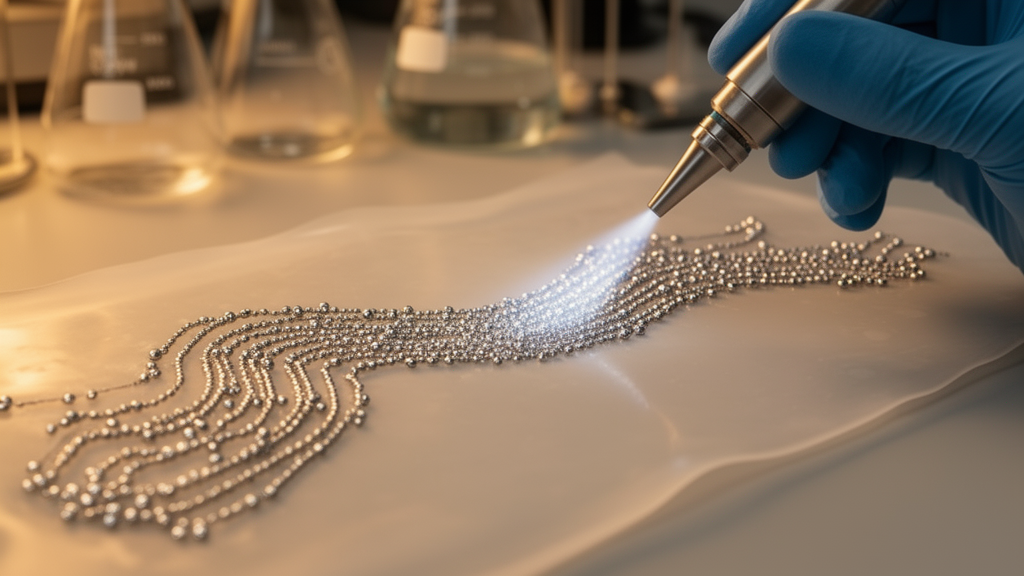
Soft electronics promise a future where health monitors, electronic skins, and human–machine interfaces sit comfortably on the body for days at a time, but the materials behind them have long been caught in an uncomfortable compromise. Human skin and organs are remarkably soft, with stiffness measured in the kilopascal range, while conventional electronic conductors such as copper and aluminum are orders of magnitude stiffer, sitting in the gigapascal regime. That mismatch causes delamination, cracking, and eventual electrical failure whenever a wearable device is stretched or bent. A research team writing in Advanced Science now reports a way to sidestep this trade-off with a spray-printable ink made of poly(vinyl alcohol)-modified liquid metal particles, or PmLMPs, that fuse into fully conductive, highly stretchable circuits the moment they leave the nozzle, with no post-treatment step of any kind.
Gallium-based liquid metals such as eutectic gallium–indium (EGaIn) have long been viewed as the most promising intrinsically deformable conductors. They combine metallic-level conductivity, on the order of a million siemens per meter, with liquid-like flow at room temperature, allowing them to endure extreme strain without fracturing. Yet their practical adoption has been hampered by two stubborn problems. In air, gallium rapidly forms a self-limiting oxide shell roughly three nanometers thick that stabilizes droplet shape but acts as an electrical insulator, blocking electron transport between neighboring particles. At the same time, the metal’s very high surface tension, near 600 millinewtons per meter, makes it difficult to wet and pattern uniformly on soft elastomeric substrates. As a result, most liquid metal inks are electrically dead when deposited and require a separate thermal, mechanical, laser, or chemical activation step to rupture the oxide and establish conductive pathways.
The new work tackles both obstacles at once by wrapping each liquid metal particle in an ultrathin polymer shell and then exploiting the physics of the spray process itself. Bulk EGaIn is fractured into microscale droplets by tip sonication in a 5 weight percent aqueous PVA solution, run at 20 percent amplitude in pulsed mode to prevent overheating. PVA chains hydrogen-bond to the freshly formed gallium oxide surface, lowering particle surface energy and improving wettability. A centrifugation step removes free, unbound polymer, leaving particles with a controlled PVA layer estimated at 7 to 10 nanometers thick atop the 3 to 5 nanometer native oxide. Transmission electron microscopy and energy-dispersive X-ray spectroscopy confirmed this layered structure, with the carbon signal of the polymer conformally wrapping the oxygen-rich oxide shell. The team emphasizes that the PVA is retained after deposition, where it serves as a fusion mediator and adhesive bridge rather than an insulating barrier.
Getting the shell thickness right proved decisive. Particles carrying an excessively thick PVA coating, produced before the centrifuge refinement, showed improved wettability but could not make direct particle-to-particle contact, yielding films roughly eightfold less conductive than the optimized formulation. The refined PmLMP films reached an electrical conductivity of approximately 1.5 × 10^6 siemens per meter immediately after spraying. Zeta potential measurements help explain why: pristine particles carry a strongly negative surface charge of about −70 millivolts, creating an electrostatic barrier that keeps neighbors apart, while PVA modification reduces this to roughly −38 millivolts, allowing hydrodynamic forces during printing to push particles into intimate contact. Density functional theory calculations, using isopropanol as a model for the PVA repeat unit and hydroxylated gallium oxide as a surface model, supported the feasibility of a moderate hydrogen bond at the interface, with a counterpoise-corrected interaction energy of −23.2 kilojoules per mole.
The heart of the innovation is a synergistic mechano-fluidic mechanism that unfolds in a single deposition event. First, high-velocity impact of aerosolized particles delivers enough mechanical stress to rupture the oxide–polymer shell, exposing fresh metallic surfaces that coalesce on contact. Atomic force microscopy nanoindentation measured a yield force of 266.08 nanonewtons per particle, only slightly above the 200 to 250 nanonewtons reported for bare oxide-shelled particles, confirming that the ultrathin PVA layer does not meaningfully suppress rupturability. X-ray photoelectron spectroscopy provided chemical corroboration: screen-printed control films showed only oxidized gallium signals, whereas spray-printed films revealed distinct indium peaks and metallic Ga^0 features, consistent with shell rupture exposing the metallic core. The researchers estimate a critical impact velocity of only about 4 meters per second, well below the particle speeds achieved at the optimized 30 psi spray pressure.
Second and third, the drying process itself consolidates the network. Because the ink uses a binary solvent of deionized water and ethanol in a 3:1 volume ratio, a surface-tension gradient arises within each deposited droplet, driving Marangoni convection. High-speed imaging of fluorescent tracer particles and microparticle image velocimetry showed flow velocities up to 50 times faster, averaging a 22.4-fold increase, compared with a single-solvent system. These vortical flows redistribute particles, counteract gravitational sedimentation, and wedge smaller particles into the voids between larger ones, creating nanoscale point contacts where capillary stress concentrates. The team’s capillary-bridge model predicts a lateral force of roughly 79 nanonewtons at each interparticle meniscus, and under an illustrative contact radius of about 11 nanometers this corresponds to local stresses near 200 megapascals, plausibly sufficient to rupture residual shells. Transmission electron microscopy captured metallic neck formation at particle contacts, and the binary-solvent formulation delivered a threefold conductivity enhancement over the water-only control.
Process optimization revealed how sensitively the mechanism depends on spray parameters. Ultrasonic amplitudes above 50 percent, despite producing smaller particles, introduced enough energy to generate gallium oxide and hydroxide byproducts that interfered with coalescence, so 20 percent amplitude proved optimal. Conductivity saturated at carrier-gas pressures above 30 psi, where kinetic energy reliably exceeds the rupture threshold. Working distance mattered too: at 6 centimeters, air resistance dissipated too much particle energy, while at 3 centimeters the balance of partial solvent evaporation and retained impact energy enabled efficient fusion. The resulting process patterned conductive traces with nominal linewidths down to 50 micrometers and coated areas larger than 20 by 20 square centimeters, and a batch-printed 4 by 4 array showed an average conductivity of 1.55 × 10^6 siemens per meter with limited pixel-to-pixel variation.
Electromechanical testing underscored the practical payoff. Under monotonic tension, PmLMP traces retained electrical continuity beyond 200 percent strain and up to 800 percent, with relative resistance rising only gradually to about 2.8, whereas unmodified particle films lost continuity through droplet beading and over-coated films fractured near 100 percent strain. Cyclic testing at 100 percent strain over 50,000 seconds, roughly 1,400 stretch-release cycles, showed reproducible resistance modulation with limited drift. Integrated light-emitting diodes stayed illuminated through twisting, 100 percent stretching, and bending, and star-shaped LED arrays printed on table-tennis balls, tennis balls, and basketballs remained operational, demonstrating conformability across curvatures. On nonpolar substrates such as PDMS and Ecoflex, an oxygen-plasma pretreatment improved trace uniformity by increasing surface polarity for hydrogen bonding.
The team then pushed the platform toward real devices. Because the printed interconnects are conductive on arrival, standard components, including a microcontroller, resistor, and LEDs, could be pick-and-placed directly onto as-printed flexible circuits that remained functional after folding. A flexible wound-healing patch carrying 640-nanometer red LEDs, driven at 10 hertz and encapsulated in Ecoflex, accelerated macroscopic wound closure relative to untreated controls over seven days in a murine full-thickness excisional wound model. Large-area conductive patterns were printed directly onto textile banners, and the same platform, paired with a LiCl-hydrogel skin interface, served as a wearable electromyography and electrocardiography system. Wireless EMG signals transmitted over Bluetooth Low Energy controlled a remote-controlled vehicle in real time, while custom software visualized ECG waveforms and computed heart rate. Together, these demonstrations sketch a manufacturing route in which liquid metal circuits emerge from an ordinary airbrush already alive with current, opening possibilities for wearable healthcare, bio-integrated electronics, and human-interactive devices that no longer wait for a sintering oven to switch them on.
Subject of Research: Post-treatment-free spray deposition of PVA-modified liquid metal particles for soft and wearable electronics
Article Title: Synergistic Mechano‐Fluidic Self‐Fusion of Poly(Vinyl Alcohol)‐Modified Liquid‐Metal Particles for Post‐Treatment‐Free Soft Electronics
Article References: Yook, K.-Y., Kim, S., Kim, C., Kang, M., Lee, Y., Kim, M., Park, K., Han, S. Y., Cho, S.-W., Lee, G.-H., Son, K., Jang, H., Kim, T. Y., & Seo, J. (2026). Synergistic Mechano‐Fluidic Self‐Fusion of Poly(Vinyl Alcohol)‐Modified Liquid‐Metal Particles for Post‐Treatment‐Free Soft Electronics. Advanced Science, Article e78062. https://doi.org/10.1002/advs.78062
Image Credits: AI Generated
DOI: 10.1002/advs.78062
Keywords: liquid metal, soft electronics, spray printing, EGaIn, poly(vinyl alcohol), self-fusion, wearable sensors, Marangoni convection, capillary forces, stretchable conductors, electromyography, wound healing
News Source: Denise Maddox. (October 9, 2026). Spray-Printed Liquid Metal Particles Fuse Instantly Into Stretchable Circuits. Scienmag.