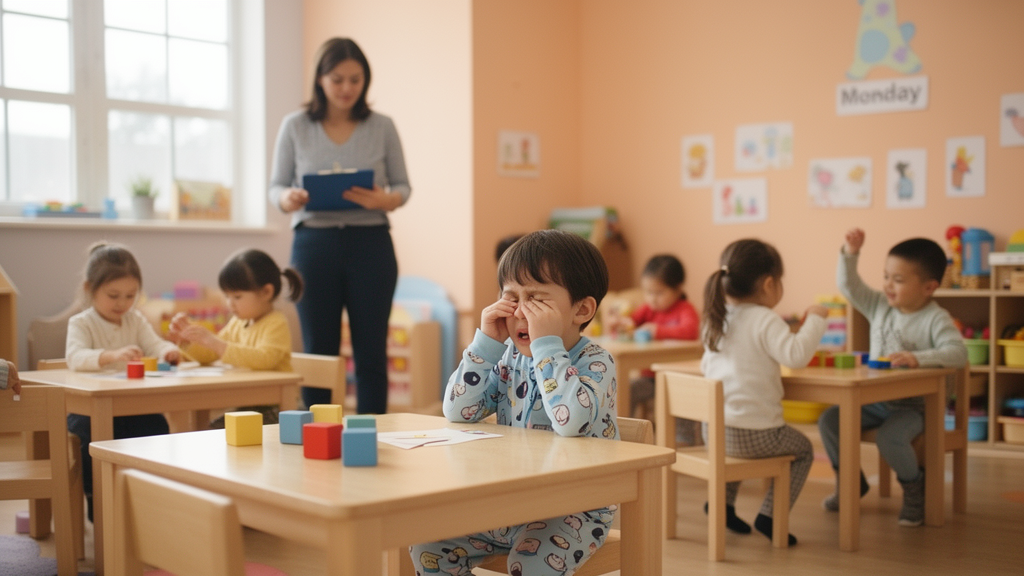
Sleep is one of the most powerful predictors of a young child’s health, shaping everything from body composition to motor development, yet measuring it reliably in preschoolers remains stubbornly difficult. A new cross-sectional study from Heilongjiang, a frigid province in northeastern China, offers a fresh approach: instead of relying solely on sleep diaries or actigraphy, researchers built explainable machine learning models that flag children with insufficient sleep using data that schools and clinics already collect routinely, including physical activity levels, screen time, body size, and fitness test results. The work, published in BMC Public Health, suggests that the behavioral fingerprints of short sleep may be visible in everyday monitoring data, if researchers know how to read them.
The research team, led by Xichao Zhang of Harbin Sport University and corresponding author Hongwei Qiao, analyzed data from 1,258 children aged three to six years collected in 2020 through monitoring programs and caregiver questionnaires. Caregivers reported whether their child met recommended sleep duration, and 344 of the children, or 27.3 percent, were classified as having insufficient sleep. That figure alone is striking: more than one in four preschoolers in this cold-region population falls short of sleep recommendations, a prevalence consistent with growing global concern about young children’s sleep health.
What makes the study methodologically interesting is the discipline of its pipeline. The authors first excluded any variable with more than 15 percent missing data, then split participants into training and internal validation sets in a 7:3 ratio, stratified by outcome so that both sets contained similar proportions of short and adequate sleepers. Missing values were handled with multivariate imputation by chained equations, a technique that fills gaps by modeling each incomplete variable as a function of the others. Crucially, the imputation model was fitted only in the training set and then applied unchanged to the validation set, preventing information from leaking between the two groups, a common and subtle error in machine learning studies.
Feature selection followed a similar logic of restraint. Standardization and least absolute shrinkage and selection operator, or LASSO, regression were used to whittle the candidate variables down to a compact set, with all tuning confined to training data. LASSO retained six predictors: body mass index, weekend moderate-to-vigorous physical activity, weekend outdoor physical activity, weekend screen time, standing long jump performance, and two-leg consecutive jumping time. The prominence of weekend variables is notable, hinting that the structure of family life on non-school days, when routines loosen and outdoor opportunities shift, may be where insufficient sleep leaves its clearest traces.
With features selected, the team trained and compared seven classifiers, evaluating them on discrimination, classification metrics, calibration, and decision curve analysis. Light Gradient Boosting Machine posted the highest area under the receiver operating characteristic curve at 0.849, with a 95 percent confidence interval of 0.806 to 0.889. But the random forest model emerged as the study’s workhorse because of its balanced overall profile: an AUC of 0.827, compared with 0.752 for conventional logistic regression, along with accuracy of 0.798, sensitivity of 0.553, specificity of 0.891, an F1 score of 0.600, and a Brier score of 0.143. The pattern is familiar to anyone who has compared flexible models with classical ones: the random forest traded some sensitivity for strong specificity, meaning it rarely mislabels a well-rested child as sleep-deprived, though it misses roughly half of the true short sleepers.
The interpretability layer is where the study aims to earn its keep. Using Shapley additive explanations, or SHAP, a technique borrowed from cooperative game theory that allocates credit for each prediction to individual features, the researchers ranked weekend outdoor activity, weekend moderate-to-vigorous physical activity, and body mass index as the most influential predictors. SHAP plots also revealed nonlinear relationships between features and model output, meaning the association between, say, physical activity and sleep insufficiency was not a simple straight line but shifted in strength and direction across the observed range. Such patterns are precisely the kind of hypothesis-generating material that linear models tend to smooth over, and they align with the idea that movement behaviors and sleep are intertwined components of a single 24-hour activity cycle.
The cold-region setting is more than geographic color. Heilongjiang’s long, severe winters can sharply curtail outdoor play, altering the seasonal rhythm of physical activity and light exposure that helps anchor children’s circadian systems. The authors are careful, however, not to overclaim a distinct cold-region sleep phenotype. Their stated aim was to test whether routinely collected behavior, body-size, and fitness indicators jointly characterize caregiver-reported insufficient sleep, and their conclusion is that such data do support an interpretable, nonlinear, multivariable framework, one that integrates dimensions of child health that are usually analyzed in isolation.
Equally important is what the authors say the model cannot do. They explicitly position the framework as a tool for multidimensional data integration, status characterization, and hypothesis generation for future prospective studies, not as a replacement for direct sleep assessment. The outcome itself was caregiver-reported, which introduces the possibility of reporting bias, and the cross-sectional design means the models capture associations rather than causes. Low sensitivity further underscores that no screening tool built on indirect indicators should be treated as a diagnostic instrument. External validation across regions, climates, and seasons, the authors write, is required before any broader application.
Still, the study lands at a moment of intense interest in explainable artificial intelligence for child health. Black-box predictors have long faced justified skepticism in medicine, and SHAP-based approaches offer a middle path: models flexible enough to capture nonlinear interactions, yet transparent enough for clinicians and public health practitioners to inspect which factors drive predictions. If weekend outdoor activity and vigorous play emerge repeatedly as the dominant signals, that points toward practical, modifiable targets, such as protecting time and space for active outdoor play on weekends, that could be tested in interventions aimed at improving preschool sleep.
The broader takeaway is a methodological one. Sleep in early childhood is embedded in a web of movement behaviors, body composition, and physical fitness, and the tools used to study it should reflect that entanglement. By showing that ordinary monitoring data, processed through a carefully validated and interpretable pipeline, can characterize insufficient sleep with respectable discrimination, the Heilongjiang team has sketched a template other regions could adapt, and a reminder that sometimes the clues to a child’s sleepless nights are already sitting in the school records, waiting for the right questions to be asked.
Subject of Research: Explainable machine learning prediction of insufficient sleep duration among preschool children in cold-region China
Article Title: Explainable machine learning for identifying insufficient sleep duration among preschool children in cold-region China: a cross-sectional study
Article References: Zhang, X., Diao, Y., Liu, Y., Jin, Z., Gao, W., Wang, L., & Qiao, H. (2026). Explainable machine learning for identifying insufficient sleep duration among preschool children in cold-region China: a cross-sectional study. BMC Public Health. https://doi.org/10.1186/s12889-026-29586-1
Image Credits: AI Generated
DOI: 10.1186/s12889-026-29586-1
Keywords: insufficient sleep, preschool children, machine learning, random forest, SHAP, LASSO, physical activity, BMI, screen time, cold region, BMC Public Health, cross-sectional study
News Source: Ophelia Keating. (October 9, 2026). Weekend Habits and Body Size Reveal Which Preschoolers Are Not Sleeping Enough. Scienmag.