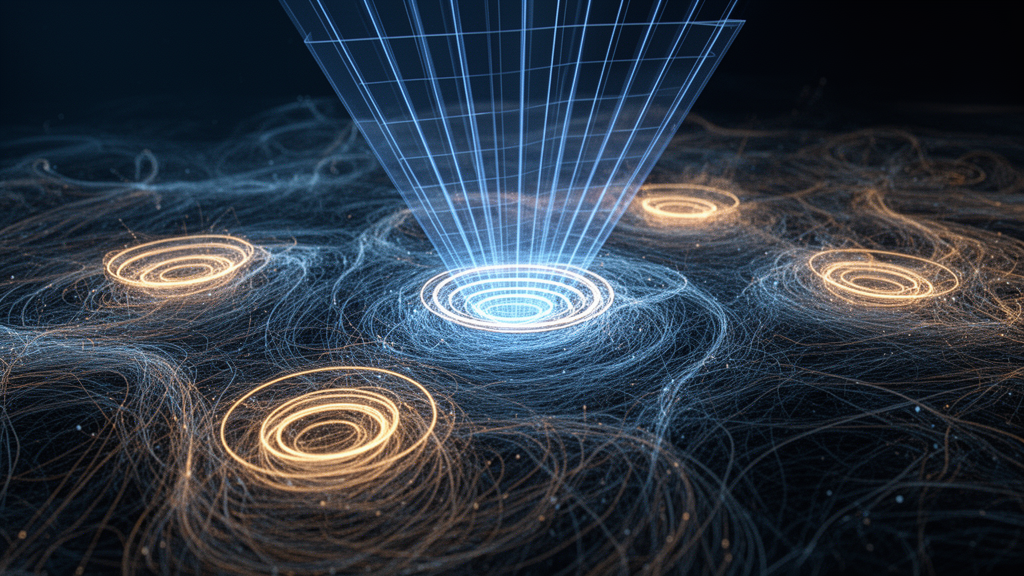
Physicists have long known that classical systems can be neither fully ordered nor fully chaotic. In the phase space of a classical system, regular trajectories and chaotic ones can coexist side by side, a phenomenon formalized by the Kolmogorov–Arnold–Moser theorem, which guarantees that weakly perturbed integrable systems retain islands of regular motion embedded in a sea of chaos. Whether interacting quantum systems can exhibit an analogous mixed structure has been one of the most stubborn open questions in non-equilibrium physics. Now, a team of researchers from Zhejiang University and the University of Leeds reports in Nature Physics that they have not only identified such a quantum many-body mixed phase space but also developed a hybrid quantum–classical feedback protocol that discovers and stabilizes it on a superconducting quantum processor.
The challenge is fundamental. In classical mechanics, one can simply plot trajectories and see where they wander. In quantum mechanics, the state of a many-body system lives in an exponentially large Hilbert space, and the conventional route to a semiclassical picture—taking the classical limit as Planck’s constant goes to zero—does not obviously apply to strongly interacting systems with many entangled degrees of freedom. Generic quantum systems thermalize: according to the eigenstate thermalization hypothesis, highly excited states behave thermally, and any initial condition eventually loses its memory. Yet certain systems weakly violate this rule, hosting special non-thermalizing states such as quantum many-body scars or fragmented Hilbert spaces. The trouble is that such states are exceedingly rare, making them hard to find and even harder to stabilize experimentally.
The new work addresses this by reframing the problem. Rather than searching the full Hilbert space, the researchers project the quantum dynamics onto a low-dimensional variational manifold—a small set of states generated by a shallow quantum circuit. The circuit starts from a Néel-ordered product state and applies two layers of entangling XY gates, parameterized by just three angles. Projecting the exact Schrödinger evolution onto the tangent space of this manifold using the time-dependent variational principle yields effective equations of motion for the three parameters. Crucially, these projected equations are nonlinear, even though the underlying Schrödinger equation is linear. That nonlinearity is the key: it allows the reduced dynamics to display the full repertoire of classical nonlinear systems, including stable periodic orbits, quasi-periodic tori, and chaos.
When the team integrated these equations of motion, they found exactly the structure predicted by classical chaos theory. Some trajectories remained confined to smooth closed curves, the analogues of KAM tori, while others wandered irregularly through the parameter space. By constructing a Poincaré section—a slice through the parameter space recording where trajectories cross it—the researchers revealed a striking coexistence of regular islands and a chaotic sea. This structure emerged from the collective dynamics of entangled degrees of freedom rather than from any conventional classical limit, and it has no direct analogue in few-body quantum systems described by a small number of effective degrees of freedom. The model underlying the dynamics is an interacting Su–Schrieffer–Heeger ladder, whose alternating coupling pattern can be tuned to interpolate smoothly between integrable and chaotic regimes.
Turning this theoretical picture into an experiment required clever observables. The variational parameters are emergent coordinates, not physical quantities that can be read off the qubits directly, and the hardware’s limited coherence time rules out tracking orbits for the long times needed to resolve fine phase-space structure. The researchers’ solution was a subsystem imbalance measured after applying a reverse variational circuit. If the evolved state remains close to the variational manifold, the inverse circuit maps it back toward the Néel state, producing a large imbalance; chaotic states, which leak into high-entanglement directions outside the manifold, lose this memory quickly. The first revival peak of this imbalance, scanned across initial conditions, produces a Poincaré-section-like map built entirely from local measurements.
The experimental platform was a flip-chip superconducting processor with 125 frequency-tunable transmon qubits, of which 24 were configured as the SSH ladder with 34 tunable couplers. The real-time evolution was implemented in analogue mode, with couplings continuously activated rather than decomposed into discrete Trotterized gate sequences, substantially suppressing decomposition errors. Single-qubit gate fidelities exceeded 99.95 percent and two-qubit CZ gate fidelities exceeded 99.5 percent. The measured revival maps on the 24-qubit device closely matched both exact numerical simulations on 16 qubits and the theoretical Poincaré section, with trajectories launched in regular regions showing long-lived coherent oscillations and those launched in chaotic regions decaying rapidly toward thermalization.
The second half of the work is arguably the more remarkable: a feedback protocol that actively finds and stabilizes the regular trajectories. The scheme alternates short bursts of quantum evolution with classical optimization. Each short evolution step slightly drives the state out of the variational manifold, generating entanglement; the projection step, implemented through measurement and feedback, pulls the state back, removing the entanglement-generating component. Repeated application of this evolution–projection cycle acts as a dynamical filter that distills coherence from chaotic motion, converging toward a self-consistent periodic orbit when one exists. The approach builds on the ScarFinder algorithm previously developed by part of the team, but transforms the geometric projection into a practical measurement-based loop suitable for noisy hardware.
In the experiment, the feedback loop was initialized deep inside the chaotic region of the phase space, with parameters chosen far from any regular orbit. After fewer than ten iterations, each involving an 80-nanosecond evolution and an imbalance estimated from 300 measurement shots, the trajectory converged to the stable periodic orbit predicted by numerical simulation. The protocol proved robust against device noise, crosstalk, and calibration imperfections. Importantly, the researchers emphasize that the feedback does not create these trajectories artificially; the regular orbits are dynamical structures already present in the underlying quantum evolution, which the protocol selectively amplifies and renders experimentally accessible. By varying the coupling strengths, the team showed that the stabilized orbits deform smoothly and continuously, confirming the structural stability that defines mixed phase spaces in classical mechanics.
The findings sharpen the connection between this many-body mixed phase space and the better-known phenomenon of quantum many-body scars. Scarring is associated with isolated, unstable periodic orbits, whereas the structure reported here is supported by a finite-measure region of nearby trajectories forming KAM-like islands—a qualitatively richer organization of non-ergodic dynamics. The researchers also note that the regular islands are not dynamically isolated from the thermal sector: rather than exhibiting bounded entanglement, they display slower and more structured entanglement growth than chaotic trajectories, underscoring that this is a genuinely many-body form of semiclassical behavior. The work can be viewed as a quantum generalization of classical chaos control, in which unstable periodic orbits are tamed through continuous feedback.
Beyond its conceptual significance, the protocol offers a practical recipe for preparing long-lived non-thermal states on quantum hardware, requiring no knowledge of the model beyond the definition of the variational manifold. Because each feedback cycle involves only short coherent evolutions and local measurements, it inherently minimizes decoherence and avoids the need to reconstruct full many-body wave functions. The framework is algorithmically general and not tied to superconducting platforms, and it can be extended to deeper variational circuits, higher-dimensional systems, and combinations with tensor-network methods, machine learning, and adiabatic control. As quantum processors grow in size, tools that can navigate the vast Hilbert space and extract coherent structure from chaos may become as essential to quantum simulation as Poincaré sections have been to classical dynamics for over a century.
Subject of Research: Experimental observation of a quantum many-body mixed phase space using hybrid quantum–classical feedback control on a superconducting processor
Article Title: Quantum many-body mixed phase space revealed by hybrid feedback control
Article References: Dong, H., Ren, J., Hallam, A., Wang, H., Cui, Z., Zou, Y., Wang, J., Li, H., Guo, Q., Wang, Z., Ying, L., & Papić, Z. (2026). Quantum many-body mixed phase space revealed by hybrid feedback control. Nature Physics. https://doi.org/10.1038/s41567-026-03431-z
Image Credits: AI Generated
DOI: 10.1038/s41567-026-03431-z
Keywords: quantum many-body physics, mixed phase space, quantum chaos, hybrid feedback control, superconducting qubits, time-dependent variational principle, Poincaré section, quantum many-body scars, eigenstate thermalization hypothesis, Su–Schrieffer–Heeger model, non-equilibrium physics, quantum simulation
News Source: Katie Riggs. (October 9, 2026). Feedback Control Reveals Islands of Order Hidden in Quantum Chaos. Scienmag.