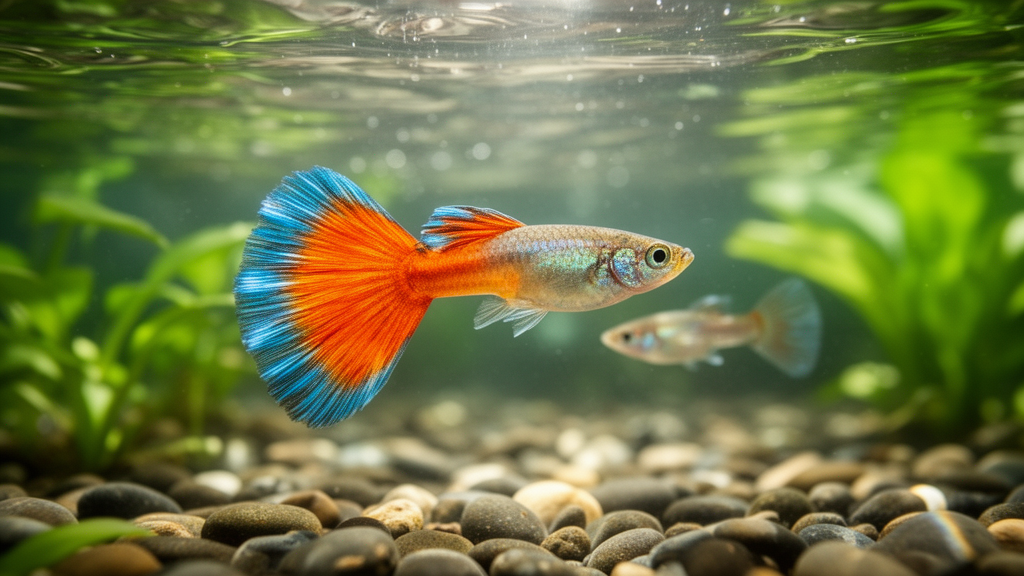
In the streams of Trinidad, a small fish has become one of evolutionary biology’s most productive teaching tools. The guppy, famous for the dazzling colour patterns that males display to prospective mates, now offers a fresh lesson in how genomes hold their secrets over millions of years. A new study published in PLOS Biology by Yuying Lin, Wouter van der Bijl and Judith E. Mank reports that chromosomal inversions, large segments of DNA flipped in reverse relative to the standard arrangement, are far more abundant, more ancient and more consequential in wild guppy populations than standard evolutionary models would predict. The findings point to an unexpected role for sexual selection in keeping genetic variation alive over deep evolutionary time.
Chromosomal inversions have long fascinated evolutionary geneticists because of what they can do structurally. When a stretch of chromosome breaks and reattaches in the opposite orientation, heterozygotes, individuals carrying one inverted copy and one standard copy, produce fewer viable recombinant gametes. The result is that genes trapped inside an inversion tend to be inherited together as a block, shielded from the shuffling effects of recombination. This makes inversions powerful vehicles for adaptation: co-adapted gene combinations that suit a particular environment can be preserved intact rather than broken apart each generation. Yet the same property raises a puzzle. If an inversion carries a combination of genes that is strongly beneficial in one setting, theory suggests it should sweep to fixation, eliminating the standard arrangement. Why, then, do so many inversions persist as polymorphisms, with both arrangements circulating in the same population for long periods?
The Mank lab’s study tackles this question in a system ideally suited to the task. Trinidadian guppies live in rivers where waterfalls create natural barriers, and above and below these barriers, populations experience radically different regimes of predation. Downstream, guppies coexist with predatory fish that exert intense natural selection. Upstream, predators are absent or rare, and the dominant selective force becomes sexual selection, as females choose among males on the basis of their colour ornaments. These paired high-predation and low-predation populations differ across a wide suite of morphological, behavioural and life-history traits, and they have replicated this divergence independently in multiple rivers, a natural experiment repeated by the landscape itself.
Rather than hunting for inversions at known locations, the researchers applied an unbiased method designed to detect them anywhere in the genome. They sampled guppies from three Trinidadian rivers, each containing a high-predation and a low-predation population. The scan revealed 22 inversions scattered across the genome. Using linked-read sequencing technology, which provides long-range information about how genetic variants are physically connected along chromosomes, the team was able to verify the precise breakpoints of all but one of these inversions, a level of validation that lends considerable confidence to the catalogue.
The ages of the inversions proved startling. Population-genetic analysis indicated that they range from roughly 1 to 6 million years old, and that they predate the colonisation of each of the three rivers by the guppies now living there. In other words, these are not recent mutations that arose locally in response to local conditions. They are ancient structural variants that arrived in Trinidad’s waters already established, and have been carried along as guppies founded new river systems. The inversions are also widespread, distributed across the genome rather than clustered on a single chromosome, suggesting that no part of the guppy’s genetic architecture is immune to this kind of structural change.
When the researchers tested whether inversion frequencies differed between high- and low-predation populations, three inversions emerged as significantly associated with the local adaptation syndromes that distinguish the two environments. Guppies from high-predation localities tend to be plainer, leaner and faster; those from low-predation localities are more colourful and carry traits favoured by mate choice. The association between specific inversions and these contrasting life histories suggests that the gene blocks locked inside them contribute to the coordinated shifts that predation pressure produces. Notably, however, none of the three inversions was reciprocally fixed across all three replicate rivers. The same inversion might be common below the waterfalls in one river and far less differentiated in another, a pattern that hints at the contingent, population-specific nature of adaptation even when the underlying selective pressures are similar.
Alongside these three adaptive candidates, the team observed seven additional inversions maintained in all three rivers without any evidence of association with the predation gradient. Their persistence demanded an explanation. Simulations modelling the expected level of inversion polymorphism under a neutral model, in which variants drift by chance alone, revealed that the observed diversity far exceeds what neutrality can accommodate. Something must be actively maintaining both arrangements of these chromosomes, preventing either from drifting to loss or sweeping to fixation.
The most striking clue came from a comparison with earlier work on guppy colouration. The researchers found a significant overlap between the polymorphic inversions and genomic loci previously implicated in variation in male ornament patterns, the pigmented spots and splashes that females scrutinise when choosing mates. This overlap suggests a mechanism long proposed in theory but rarely demonstrated with genomic data in the wild: negative frequency-dependent selection arising from female preference for novelty. If females favour males with rare or unusual colour patterns, then whichever arrangement of an inversion is currently common becomes disadvantageous, and the rarer arrangement gains a mating advantage. The two chromosomal arrangements are thereby trapped in a perpetual seesaw, each rising when the other falls, and neither ever winning outright. Such balancing selection can preserve structural variation for millions of years, exactly the timescales the team inferred for the guppy inversions.
The study’s broader significance lies in how it reframes the interplay between the two great engines of evolution. Natural selection, driven here by predation, clearly acts on some inversions, pushing their frequencies up or down in different environments. But sexual selection, driven by female choice, appears to be the force that keeps other inversions polymorphic over geological time, replenishing the raw material of male ornament variation on which mate choice feeds. The two processes do not simply act in opposition or in parallel; they interact in shaping the frequency dynamics of the same structural variants. For evolutionary biologists, the guppy results provide a vivid demonstration that the maintenance of genetic diversity is not merely a story of heterozygote advantage or environmental heterogeneity, but can hinge on the ever-shifting tastes of choosy females.
There are also practical implications for how researchers read the genome. Because inversions suppress recombination across large genomic neighbourhoods, association studies that ignore them can misattribute the effects of genes inside inversions, and conservation geneticists assessing the adaptive potential of fragmented populations may underestimate the hidden structural diversity those populations carry. The guppy work, conducted with an unbiased detection method and validated breakpoints, offers a template for surveying inversions in other natural systems where ancient polymorphisms may be quietly shaping traits, from plumage in birds to life histories in insects. For now, the humble Trinidadian guppy has added another chapter to its scientific biography: a fish whose colours have long charmed biologists turns out to owe part of that charm to chromosomal architecture laid down millions of years before any guppy swam a Trinidadian river.
Subject of Research: Chromosomal inversion polymorphisms and sexually selected traits in natural guppy populations
Article Title: Ancient inversion polymorphisms associate with sexually selected traits across natural guppy populations
Article References: Lin, Y., van der Bijl, W., & Mank, J. E. (2026). Ancient inversion polymorphisms associate with sexually selected traits across natural guppy populations. PLOS Biology, 24(9), e3004024. https://doi.org/10.1371/journal.pbio.3004024
Image Credits: AI Generated
DOI: 10.1371/journal.pbio.3004024
Keywords: guppies, chromosomal inversions, sexual selection, natural selection, local adaptation, balancing selection, frequency-dependent selection, Trinidad, population genetics, male colouration, PLOS Biology, structural variants
News Source: Juliet Wilcox. (October 9, 2026). Ancient Chromosomal Inversions Shape Sexual Traits in Wild Guppies. Scienmag.