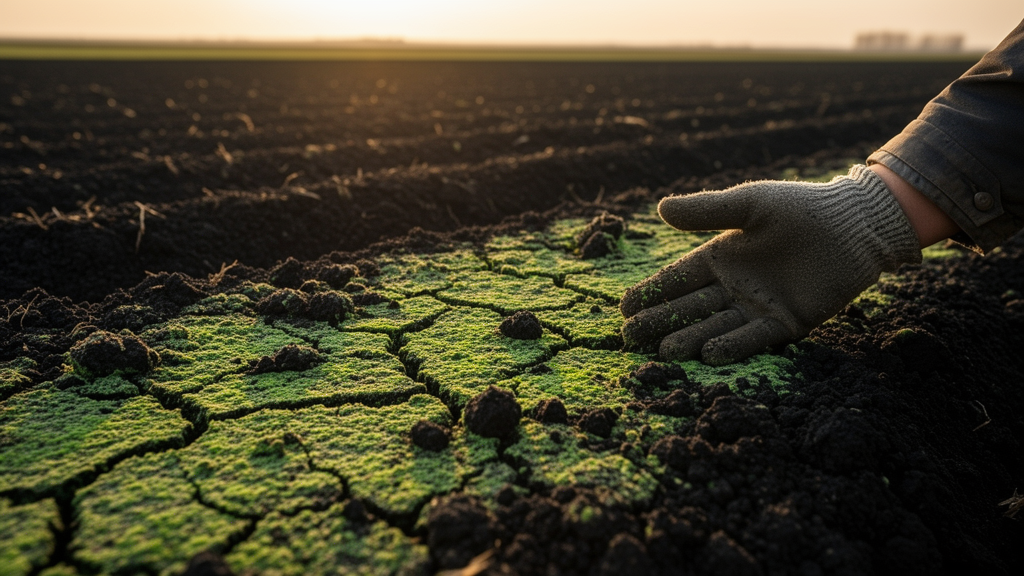
Beneath the surface of China’s northeastern black soil region, one of the world’s most fertile and most threatened agricultural landscapes, a quiet alliance between tiny organisms and a modified plow may be rewriting the rules of carbon storage. A new study published in Plant and Soil reports that biological soil crusts, the thin living skins of cyanobacteria, algae, mosses and fungi that colonize the topmost millimeters of soil, can dramatically boost the accumulation of microbial residue carbon when farmers adopt reduced tillage. The finding matters because microbial residue carbon, the stable organic matter left behind when microbes die, is increasingly recognized as one of the largest and longest-lived reservoirs of carbon in soils worldwide.
The research team, led by Zihan Wu and corresponding author Tianli Bao of Heilongjiang University, worked in farmland near Zhaodong city, an area within the famed black soil belt of Northeast China. These Mollisol soils, rich in organic matter and analogous to the chernozems of the North American prairies, have suffered decades of intensive cultivation, erosion and organic carbon depletion. Restoring their carbon stocks is a national priority, and the new study suggests that the path forward may run through an unexpected partner: the crust-forming microbial communities that most conventional farming practices inadvertently destroy.
To disentangle the effects of crusts and cultivation, the researchers compared three tillage regimes, regular tillage, no tillage and reduced tillage, alongside a control treatment in which biocrusts were absent. They sampled two depth intervals, the top 0 to 2 centimeters where biocrusts exert their strongest influence, and the 2 to 5 centimeter layer just beneath, and quantified microbial residue carbon using amino sugar biomarkers, a well-established technique that traces the cell wall remnants of dead bacteria and fungi. Because these compounds persist in soil long after the organisms die, they serve as a molecular ledger of how much microbial life has been converted into stable soil organic matter.
The results were striking. Reduced tillage produced the highest accumulation of microbial residue carbon of any treatment. Bacterial residue carbon under reduced tillage exceeded that measured under regular tillage by 31.99 percent, under no tillage by 8.37 percent, and under the crust-free control by 22.15 percent. Fungal residue carbon responded even more strongly, rising 17.29 percent above regular tillage, 11.3 percent above no tillage and 12.36 percent above the no-crust control. Taken together, total microbial residue carbon in the biocrust-covered surface soil was 14.89 percent higher under reduced tillage than in the crust-free treatment, and similar patterns extended into the 2 to 5 centimeter layer.
Why would moderate disturbance outperform both aggressive plowing and complete abstention? The authors argue that reduced tillage occupies a sweet spot. Regular tillage physically shreds biocrusts, breaks aggregates and exposes protected organic matter to decomposition, while no tillage, although gentle, may leave the surface so compacted and undisturbed that crust development and the incorporation of organic inputs are limited. Reduced tillage provides what the researchers describe as moderate disturbance, enough to loosen the surface and stimulate microbial activity and organic carbon turnover, yet not so much that the living crust is obliterated. In effect, the practice cultivates the cultivators, allowing biocrust organisms to thrive while still farming the field.
The study also identified the chemical intermediaries of this effect. Redundancy analysis, a statistical method that links communities of measurements to observed outcomes, pointed to four soil organic carbon fractions as the critical drivers of microbial residue carbon accumulation: total soil organic carbon, light fraction organic carbon, easily oxidizable organic carbon and particulate organic carbon. These fractions represent the more labile, plant-derived pools of carbon that feed microbial growth. By elevating these pools, biocrusts under reduced tillage appear to fuel larger and more active microbial communities, whose subsequent death and decomposition deposit a greater mass of residue carbon into the soil’s stable reservoir.
This mechanism aligns with what soil scientists call the microbial carbon pump, a conceptual framework holding that anabolic processes, the building of microbial biomass from simpler substrates, are a dominant route by which carbon becomes sequestered in soils. Microbial residues, rich in nitrogen-bearing compounds and often bound to mineral surfaces, resist decomposition far better than raw plant litter. Estimates suggest that microbial necromass can account for a substantial share of stable soil organic carbon in many ecosystems, which means that management practices capable of enhancing microbial residue accumulation carry outsized significance for the global carbon balance.
The Northeast black soil region is an especially urgent setting for such interventions. Decades of intensive maize and soybean cultivation have eroded topsoil and depleted organic matter, prompting major Chinese conservation programs aimed at protecting what remains. Previous work has shown that conservation tillage can improve soil structure, microbial food webs and organic carbon storage in Chinese Mollisols, and that biocrusts contribute to soil formation, nitrogen cycling and erosion control in drylands such as the Loess Plateau. The new study connects these threads, demonstrating that in humid, cultivated farmland rather than arid rangeland, biocrusts can serve as active agents of carbon sequestration when tillage intensity is calibrated to preserve them.
There are practical implications for farmers and policymakers alike. Reduced tillage is already promoted as a conservation measure, but this research reframes its benefits: the practice does not merely reduce carbon losses, it actively builds a stable form of soil carbon by nurturing the biological crust at the soil surface. Because biocrusts develop quickly relative to slower soil-forming processes, the carbon gains documented here could begin accruing within a few growing seasons, offering a comparatively rapid lever for soil restoration. The findings also suggest that crust preservation deserves explicit attention in conservation agriculture guidelines, which have traditionally focused on residue cover and mechanical disturbance without considering the photosynthetic skin that caps the soil.
Caveats remain. The study was conducted at a single site in Zhaodong and measured carbon fractions and amino sugar biomarkers rather than tracking carbon fluxes over years, so longer-term field trials across the region will be needed to confirm durability and scalability. Nonetheless, the central message is clear and consequential: in one of the world’s great breadbaskets, the humblest of organisms, bacteria and fungi woven into a living crust, can be enlisted as carbon engineers, provided farmers disturb the ground just enough to keep them working. As nations search for nature-based climate solutions, the ground beneath the furrow may prove to be one of the most overlooked allies of all.
Subject of Research: Effects of reduced tillage and biological soil crusts on microbial residue carbon accumulation in the black soils of Northeast China
Article Title: Biocrust mediates microbial residue carbon accumulation by augmenting soil organic carbon fractions under reduced tillage in the Northeast black soil region of China
Article References: Wu, Z., Li, T., Zhan, J., Yu, C., & Bao, T. (2026). Biocrust mediates microbial residue carbon accumulation by augmenting soil organic carbon fractions under reduced tillage in the Northeast black soil region of China. Plant and Soil. https://doi.org/10.1007/s11104-026-09073-7
Image Credits: AI Generated
DOI: 10.1007/s11104-026-09073-7
Keywords: biological soil crusts, microbial residue carbon, reduced tillage, soil organic carbon, black soil, carbon sequestration, soil microbiology, conservation agriculture, Mollisol, fungal residues, bacterial residues, Northeast China
News Source: Alan Morgan. (October 9, 2026). Living Soil Crusts Turn Gentle Tillage Into a Carbon Trap in China’s Fading Black Soils. Scienmag.