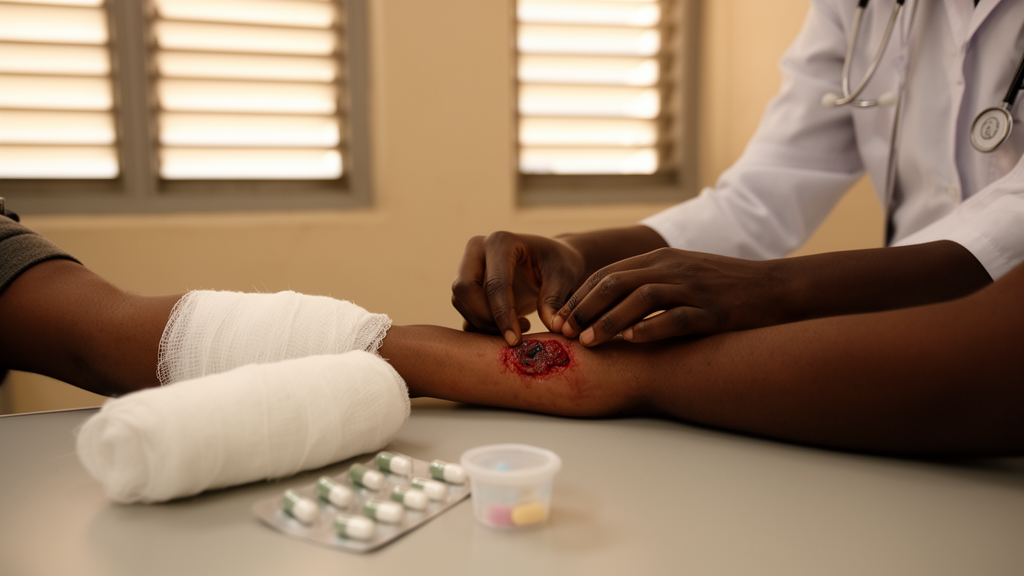
Buruli ulcer, a disfiguring skin disease caused by the environmental pathogen Mycobacterium ulcerans, has long demanded an eight-week course of antibiotics that strains patients, families and fragile health systems in West Africa. Now a randomized controlled trial conducted in Ghana has tested whether a shorter, more intensive regimen could do the job in half the time. The study, published in PLOS Neglected Tropical Diseases, compared four weeks of high-dose rifampicin plus clarithromycin against the standard eight-week course, and its findings offer both encouragement and a sobering reminder of how difficult it is to compress treatment for a slow-growing mycobacterial infection.
The trial, known as SHARP, was an open-label, individually randomized controlled study in which participants with PCR-confirmed Buruli ulcer were assigned in equal proportions to one of two oral regimens. The experimental arm received rifampicin at 20 milligrams per kilogram of body weight together with clarithromycin at 15 milligrams per kilogram for four weeks, while the control arm received the conventional rifampicin dose of 10 milligrams per kilogram with the same clarithromycin dose for eight weeks. All participants, regardless of assignment, had their wounds managed with dressings coated with dialkylcarbamoyl chloride, a synthetic material designed to bind and remove bacteria and debris from the wound bed, ensuring that any differences in outcome could be attributed to the antibiotic regimens rather than wound care.
The primary endpoint was deliberately microbiological rather than purely clinical: the time until viable M. ulcerans could no longer be detected, assessed using quantitative PCR targeting the 16S ribosomal RNA gene, with sampling continuing up to week 20. This choice reflects a key challenge in Buruli ulcer research. Because M. ulcerans grows extremely slowly in culture, conventional culture-based confirmation of clearance can take months, whereas molecular assays provide a faster and more standardized readout of bacterial burden. The researchers reasoned that if a shorter high-dose regimen could sterilize lesions as quickly as, or faster than, the standard course, it would open the door to a fundamentally more practical treatment.
Between late November 2021 and the end of July 2024, the team randomized 42 participants, 23 to the high-dose short-course arm and 19 to the standard arm. That number fell well short of the 112 participants the trial had been designed to enroll, a shortfall that shaped the statistical power of the study and, ultimately, the confidence that can be placed in its conclusions. Recruitment difficulties in trials of neglected tropical diseases are common, driven by factors ranging from seasonal patterns of disease presentation to the logistical burdens of follow-up in rural communities, and the SHARP investigators were transparent about the implications of their smaller-than-planned sample.
On the primary outcome, the mean time to clearance of viable M. ulcerans was 4.9 weeks in the high-dose arm, compared with 7.0 weeks in the standard-dose arm. At first glance, that difference of roughly two weeks appears meaningful, suggesting that the more intensive regimen was pushing the bacteria toward elimination faster. But when the investigators adjusted their analysis, the estimated mean difference shrank to just 0.5 weeks in favor of the short course, with a 95 percent confidence interval stretching from 5.0 weeks faster to 4.1 weeks slower and a p-value of 0.835. In plain terms, the data were entirely compatible with there being no real difference in microbiological clearance time between the two strategies.
Yet the trial was not without signals of potential advantage for the shorter regimen. Paradoxical reactions, a well-recognized phenomenon in Buruli ulcer in which lesions paradoxically enlarge or new inflammatory lesions emerge after treatment begins, even as the bacteria themselves are killed, occurred in none of the 21 participants assessed in the high-dose arm, compared with 5 of 15 in the standard-dose arm. The adjusted odds ratio of 0.19, with a confidence interval that included the null value and a p-value of 0.102, means this difference could plausibly have arisen by chance, particularly given the small numbers involved. Still, the complete absence of paradoxical reactions in the intensive arm is an intriguing observation that deserves scrutiny in larger studies, because such reactions can prolong morbidity, complicate wound management and sometimes require corticosteroid treatment.
Safety and tolerability emerged as reassuring themes. The high-dose rifampicin regimen was well tolerated in this population, with rates of secondary wound infection similar between the two groups. This matters because rifampicin dosing at 20 milligrams per kilogram, double the conventional dose, raises theoretical concerns about hepatotoxicity and other adverse effects, and the trial provides early human evidence that short-course intensive dosing is feasible in a Buruli ulcer population. No recurrences of disease were observed in either arm during follow-up, an important finding given that relapse, though uncommon, is the feared late failure mode of antibiotic therapy for this infection.
The authors’ conclusion was measured: the trial did not find evidence of a significantly shorter time to microbiological clearance or healing with the high-dose short-course approach, and larger trials are needed to determine its efficacy and safety. That caution is scientifically appropriate. With only 42 randomized participants, the study was underpowered to detect the kind of modest differences that could still be clinically important. A two-week reduction in clearance time, if real, could translate into meaningful savings in clinic visits and reduced disruption for patients, but the confidence interval in this trial cannot rule out either a substantial benefit or a modest disadvantage for the shorter regimen.
The broader context makes the question urgent. Buruli ulcer, one of the WHO-listed neglected tropical diseases, predominantly affects children in rural West and Central Africa, where M. ulcerans is thought to be transmitted through contact with contaminated aquatic environments, although the exact mode of transmission remains debated. Since the shift from surgical excision to antibiotic therapy in the mid-2000s, the standard regimen has been eight weeks of daily rifampicin and streptomycin, later adapted in many settings to fully oral combinations such as rifampicin with clarithromycin to avoid the injections and associated complications of aminoglycosides. Eight weeks of daily medication, wound dressings and clinic attendance imposes a heavy burden on families who may travel long distances and sacrifice income and schooling, so every week that can safely be removed from the regimen carries real economic and social value.
The SHARP trial thus functions as an important proof-of-concept step rather than a practice-changing result. It demonstrates that a four-week, high-dose, fully oral regimen can be delivered safely in the field, that molecular monitoring of bacterial clearance is a workable trial endpoint, and that the question of shortening Buruli ulcer therapy can be rigorously tested. It also highlights the persistent challenge of trial recruitment for neglected diseases, which often forces studies to report underpowered comparisons and underscores the need for sustained funding and multi-site collaboration. For now, patients should continue to receive the standard eight-week regimen, which remains supported by the weight of existing evidence. But the complete absence of paradoxical reactions, the absence of recurrences, and the tolerability of double-dose rifampicin give researchers concrete reasons to design the larger, adequately powered trials that will determine whether Buruli ulcer treatment can one day be halved without compromising cure.
Subject of Research: A randomized controlled trial comparing short-course high-dose versus standard-dose antibiotic therapy for Buruli ulcer in Ghana
Article Title: High-dose rifampicin and clarithromycin for 4 weeks versus standard-dose rifampicin and clarithromycin for 8 weeks to treat Buruli ulcer: An open-label, individually randomized, controlled trial in Ghana
Article References: Agbanyo, A., Amoako, Y. A., Opondo, C., Oppong, M. N., Asante-Poku, A., Novignon, J., Tuffour, J., Mintah, I. S., Tuwor, R. D., Ahiatrogah, D. K., Akuffo, R. A., Gborglah, M., Mosweu, I., Pitt, C., Allen, E., Walker, S. L., Yeboah-Manu, D., Marks, M., Phillips, R. O., & SHARP Collaboration (2026). High-dose rifampicin and clarithromycin for 4 weeks versus standard-dose rifampicin and clarithromycin for 8 weeks to treat Buruli ulcer: An open-label, individually randomized, controlled trial in Ghana. PLOS Neglected Tropical Diseases, 20(9), e0014783. https://doi.org/10.1371/journal.pntd.0014783
Image Credits: AI Generated
DOI: 10.1371/journal.pntd.0014783
Keywords: Buruli ulcer, Mycobacterium ulcerans, rifampicin, clarithromycin, randomized controlled trial, Ghana, neglected tropical diseases, antibiotic therapy, paradoxical reactions, microbiological clearance, PLOS Neglected Tropical Diseases, clinical trial
News Source: Ophelia Keating. (October 9, 2026). Shorter High-Dose Antibiotic Course for Buruli Ulcer Shows Promise but Falls Short in Ghana Trial. Scienmag.