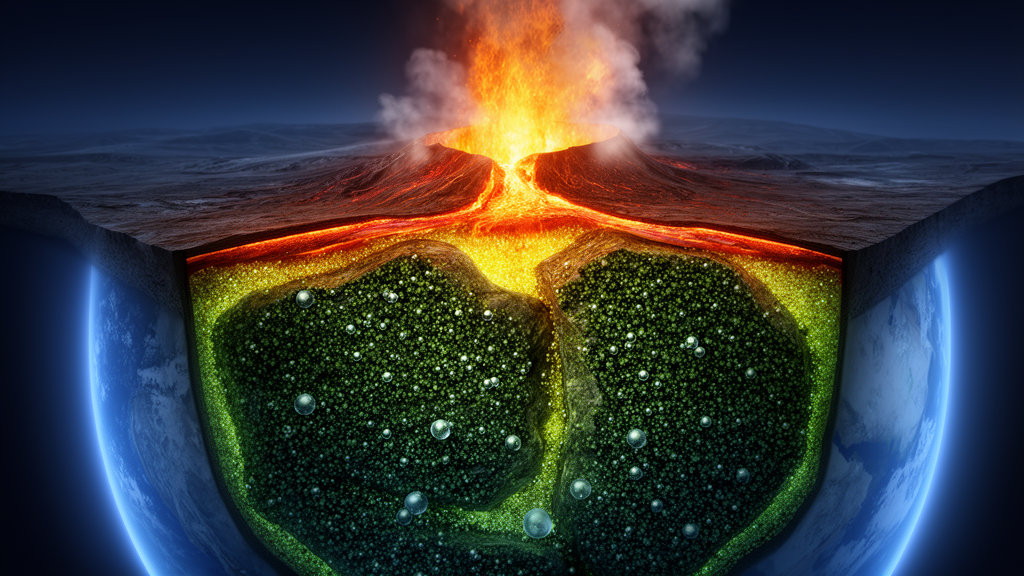
Beneath every volcano lies a messenger from the deep. Mantle xenoliths, fragments of rock ripped from the Earth’s upper mantle and carried to the surface by rising magma, have long been treated as the most direct windows into the hidden water content of our planet’s interior. Water in the mantle, even at concentrations of just tens to hundreds of parts per million, exerts an outsized influence on melting, viscosity, and the long-term evolution of continents. For more than two decades, geoscientists have measured hydrogen locked inside the crystal structures of nominally anhydrous minerals, chiefly pyroxenes, in these xenoliths and used the numbers to map the hydration state of the lithospheric mantle. A new study from the French Massif Central now delivers a sobering correction to that entire enterprise, showing that the water contents recorded by xenoliths can be profoundly reset before they ever reach the outcrop.
The research, led by Konstantinos Thomaidis and Jannick Ingrin of the University of Lille together with colleagues at the Centre de Recherches Pétrographiques et Géochimiques in Nancy and Hohai University in China, was published in the European Journal of Mineralogy. The team analysed seventeen peridotite xenoliths from two volcanoes, Allègre and Ray Pic, using Fourier transform infrared spectroscopy, a technique that detects the characteristic absorption bands of hydroxyl groups bonded into mineral lattices. By measuring point analyses and concentration profiles across olivine, clinopyroxene, and orthopyroxene crystals, the researchers set out to answer a deceptively simple question: how much of the water signature in a xenolith survives the violent journey from mantle to surface?
The two field sites offered a natural experiment of unusual elegance. At Allègre, in the Devès volcanic district, xenoliths are embedded in a thick basaltic body interpreted as a frozen lava lake that filled a maar roughly three million years ago. The Ringue quarry cuts more than thirty metres into this body, exposing spectacular columnar jointing and allowing the team to sample xenoliths from three distinct excavation levels, each of which cooled at a different rate. At Ray Pic, in the Velay Oriental district, the situation was different in kind: xenoliths occur both in pyroclastic density current deposits on the flank of the volcano and along a basaltic lava flow that travelled more than twenty kilometres down the valley of the Bourges River.
The first major result concerns cooling. If the slow solidification of a lava lake, which can take years for a body tens of metres thick, were to strip hydrogen from the entrained mantle rocks, the effect should leave fingerprints. Hydrogen diffuses through pyroxene crystals at rates fast enough, according to laboratory experiments, that complete equilibration with surrounding magma could occur within hours to days at magmatic temperatures. Any partial reset during the progressive cooling of the Allègre lava lake should therefore have produced diffusion profiles at crystal margins. Yet the profiles measured in both clinopyroxene and orthopyroxene were uniformly flat, and the water concentrations were independent of the sampling level within the quarry. Water contents ranged from 126 to 194 parts per million by weight in clinopyroxene, 30 to 55 in orthopyroxene, and fell below one part per million in olivine, values in close agreement with earlier work on the same quarry.
The Ray Pic lava flow told the same story along its twenty-kilometre course. Whether a xenolith was collected near the vent or far downstream, in well-jointed prismatic basalt or in more massive flow interiors, its pyroxene water content showed no systematic trend with distance or cooling history. Orthopyroxene averaged around 43 parts per million and clinopyroxene around 203 parts per million along the flow, with dispersions barely exceeding analytical uncertainty. The conclusion is striking: the emplacement of lava at the surface and its subsequent cooling, however slow, do not significantly alter the water budget of the mantle minerals they carry. The feared overprint from the final stage of the volcanic journey simply does not materialise at these sites.
But the second result upends the conventional wisdom in a different way. When the team compared xenoliths from the Ray Pic lava flow with those from the contemporaneous pyroclastic deposits on the volcano’s eastern flank, the difference was dramatic. Xenoliths from the pyroclastic deposits, which represent explosively erupted, less degassed magma, contained systematically more water: clinopyroxene values reached 371 parts per million, compared with 110 to 371 across the whole dataset, while olivine from the pyroclastic rocks carried measurable hydroxyl bands that were entirely absent, below the detection limit, in olivine from the lava flow. Overall, pyroxene concentrations in the degassed lava-flow xenoliths were lower by a factor of more than ten in olivine and at least two in the pyroxenes relative to their pyroclastic counterparts.
Because the two eruption styles occurred essentially at the same time, the underlying mantle cannot have changed between them. The only viable explanation is that the xenoliths re-equilibrated with their host magma in a shallow crustal chamber before eruption. Xenoliths can reside for days to years in such chambers, ample time for hydrogen to exchange fully with the melt. The effusive lava flow, being the product of a strongly degassed magma, imposed its own low water fugacity on the fragments it carried, while the pyroclastic xenoliths equilibrated with a melt that had retained more of its volatiles. Crucially, neither population shows diffusion profiles, meaning the re-equilibration was complete before the rapid final ascent, erasing the record of the process itself.
The implications ripple far beyond the Massif Central. If even xenoliths from explosive eruptions, long considered the gold standard because of their rapid quenching, may have equilibrated with partially degassed magma, then every published water measurement from mantle pyroxenes must be read as a minimum estimate, not a true value. The finding helps explain a stubborn puzzle that has frustrated the community for years: the absence of any robust correlation between pyroxene water content and major element composition, pressure, or temperature of origin. It also aligns with recent work on xenoliths from southern Patagonia, which reached a similar conclusion that original water contents are modified during ascent. More than two decades of mantle hydration maps may therefore require systematic reinterpretation.
Yet the study is not purely a story of loss. The infrared spectra revealed that different spectral signatures, corresponding to distinct configurations of hydrogen defects in the pyroxene lattice, can coexist in xenoliths collected just a few metres apart within the same lava flow. Two Ray Pic samples displayed a signature dominated by a band near 3525 wavenumbers, unlike the high-frequency signature typical of most mantle xenoliths. Since total water content was demonstrably reset by degassing, the survival of these contrasting signatures suggests they were acquired before the magma degassed, possibly at mantle depths during metasomatic alteration by carbonatitic melts, and that late degassing modifies the amount of hydrogen without erasing the structural memory of where it sits in the crystal.
The team also detected subtle infrared bands attributable to pargasitic amphibole lamellae in some clinopyroxenes, consistent with the hydrous modal metasomatism documented in earlier studies of Ray Pic, though the water content of the nominally anhydrous minerals themselves was apparently unaffected by that metasomatism. Taken together, the results redraw the boundary between what xenoliths can and cannot tell us. Their total water contents record the state of the shallow magma chamber, a lower limit on mantle values, while their spectral fingerprints may preserve genuinely deep information. Disentangling the two promises to become a central task for the next generation of mantle studies, and the volcanoes of the French Massif Central have provided the decisive natural laboratory for that quest.
Subject of Research: Preservation of water concentrations in mantle xenoliths from the French Massif Central
Article Title: Preservation of water concentration in mantle xenoliths: a case study from Allègre and Ray Pic volcanoes (French Massif Central)
Article References: Thomaidis, K., Ingrin, J., Deloule, E., France, L., & Chen, H. (2026). Preservation of water concentration in mantle xenoliths: a case study from Allègre and Ray Pic volcanoes (French Massif Central). European Journal of Mineralogy, 38(4), 477-489. https://doi.org/10.5194/ejm-38-477-2026
Image Credits: AI Generated
Keywords: mantle xenoliths, water content, pyroxene, FTIR spectroscopy, French Massif Central, Allègre, Ray Pic, magma degassing, lithospheric mantle, hydrogen diffusion, peridotite, volcanology
News Source: Bethany Barker. (October 9, 2026). Volcanic Water Trap: Mantle Rocks Rewrite the Story of Earth’s Deep Water. Scienmag.