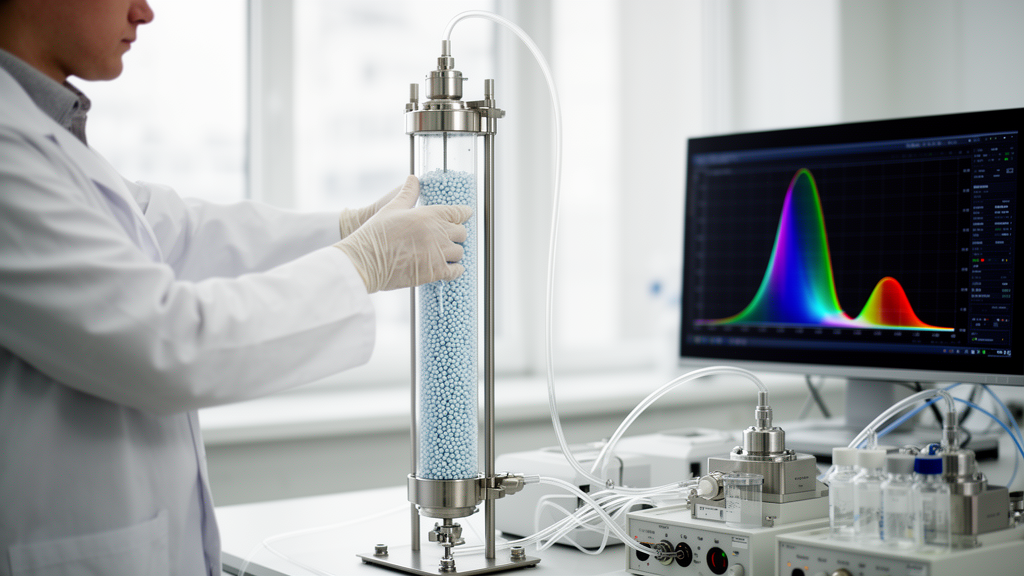
In the world of modern chemistry, one of the most stubborn problems has quietly persisted for four decades: predicting how long a small molecule will take to travel through a liquid chromatography column. Now, a team of researchers led by Fleming Kretschmer and Sebastian Böcker at Friedrich Schiller University Jena, together with Eva-Maria Harrieder and Michael Witting at Helmholtz Zentrum München, has unveiled a deceptively simple solution that could reshape how scientists identify molecules in everything from human feces to plant extracts. Their method, called 2-step, was published in Nature Methods and achieves something previously considered out of reach: accurate retention time prediction for chromatographic setups the model has never seen, without a single measurement from the target system.
To appreciate why this matters, consider what liquid chromatography actually does. It is the workhorse separation technology of the life sciences, used in millions of studies to tease apart the thousands of metabolites, drugs, lipids and toxins hiding inside complex biological samples. When chromatography is coupled to mass spectrometry, the time a compound needs to traverse the column — its retention time — carries precious information about its identity, reflecting properties such as polarity. But that time is not a fixed property of the molecule. It depends on the column, the solvents, the gradient, the temperature, the flow rate and even the plumbing of the instrument. Change any of these, and retention times can shift dramatically, even between instruments that are nominally identical.
This variability has crippled generations of machine-learning models. Hundreds of publications have attacked the problem, yet the standard workflow remains painfully circular: measure a few hundred compounds on one specific platform, train a model on that data, and hope it never encounters a different setup. The current best-performing methods use transfer learning, pretraining a neural network on a large dataset and then fine-tuning it on hundreds of authentic standards measured on the target system. Without that expensive fine-tuning step, these models are useless. As the authors put it in their paper, truly transferable prediction — requiring no training data from the target chromatographic system — has remained an open challenge.
The Jena-led team’s insight is elegant: stop trying to predict the time itself. Retention times may swing wildly between setups, but the order in which compounds elute is far more conserved. A longer capillary between the column and the mass spectrometer will delay every compound equally, scrambling the times while leaving the sequence untouched. The researchers therefore split the problem in two. In the first step, a machine-learning model predicts a retention order index, a real-valued number that respects elution order: if compound A exits the column before compound B, its index must be smaller. In the second step, these indices are mapped to actual retention times using a simple polynomial anchored to a handful of confidently identified compounds in the target dataset.
The technical machinery behind step one is a graph neural network built on a directed message-passing architecture. Each molecule is encoded as a graph, with atoms as nodes and bonds as edges, and the network distills this into a 512-dimensional embedding. Crucially, the chromatographic setup is encoded too, as a 13-dimensional vector combining the mobile phase pH with twelve parameters describing the column’s chemistry — six hydrophobic subtraction model parameters and six Tanaka parameters, which quantify properties like hydrophobicity, steric selectivity and hydrogen bonding capacity. Because the model learns from these continuous descriptors rather than a one-hot column identifier, it can generalize to columns it has never encountered. Training uses a Siamese architecture that feeds in pairs of compounds measured under identical conditions, penalizing the network whenever its predicted indices contradict the observed elution order.
Evaluated on 171 curated reversed-phase datasets from the RepoRT repository, using cross-validation splits that excluded entire chromatographic conditions from training, the condition-aware model achieved an error rate of 4.89 percent in predicting which of two compounds elutes first. That may sound like a modest improvement over the 5.61 percent achieved by an otherwise identical model blind to chromatographic conditions, but the authors show this comparison is misleading. Most compound pairs never change order under any reasonable conditions, so they dominate the statistics. When the analysis focused on setup-characteristic pairs — those that genuinely deviate from the consensus order — accuracy jumped from 40.1 to 60.5 percent, a leap that no setup-agnostic model could achieve, since such models essentially learn the majority vote and would get these tricky pairs wrong almost by definition.
The second step is where the method becomes genuinely practical. For any target dataset, roughly 30 compounds need to be identified with high confidence — for example through spectral library search — to serve as anchors. A polynomial of degree two, fitted robustly with median regression to weed out misidentified anchors, then maps predicted indices to retention times. Astonishingly, as few as 15 anchors suffice, and they do not even need to come from diverse compound classes. In a demonstration on human fecal samples, the team used just 19 N-alkylpyridinium 3-sulfonate standards measured in a separate run, because the structural similarity of these standards and their tiny number made any fine-tuning approach impossible. The method still delivered, resolving ambiguous bile acid matches, distinguishing diastereomers of cholic acid, and elevating nine spectral library hits to ‘almost level 1’ identifications — the gold standard of metabolite annotation, previously reserved for in-house libraries.
Head-to-head against DeepGCN-RT and RT-Transformer, the best pretrain/fine-tune methods available, the 2-step approach held its own under generous evaluation splits and then decisively pulled ahead under a realistic split that prevents models from exploiting near-identical structures in the training data. On five of six benchmark datasets, 2-step outperformed both competitors — despite never having seen the target datasets, while the rivals had been fine-tuned on them. Even more striking, the method improves as more training data accumulate, whereas pretrain/fine-tune methods plateau. Under a ‘maximum challenge’ evaluation that removed both similar datasets and all target compounds from training, performance dropped only slightly, and the method still beat the competition.
Beyond the algorithm itself, the study delivers a systematic map of what actually scrambles elution order. Analyzing thousands of dataset pairs from RepoRT, the researchers found that the column’s stationary phase exerts the largest influence, followed by mobile phase pH and solvent composition, with temperature playing a smaller, compound-dependent role and flow rate largely irrelevant. They conclude that just five parameters — column, mobile phase, gradient, temperature and flow rate — form a sufficient minimum metadata set for preserving the reuse value of retention data. Their plea to the community is concrete: deposit reference LC-MS datasets with this metadata, and column vendors should publish hydrophobic subtraction and Tanaka parameters so that transferable prediction can flourish. Hydrophilic interaction chromatography, with its far more diverse separation mechanisms, remains the next frontier. If the authors are right that huge improvements lie ahead, the humble retention time may finally take its place alongside mass spectra as a first-class citizen in the molecular identification toolkit.
Subject of Research: Transferable machine-learning prediction of small-molecule liquid chromatography retention times
Article Title: Times are changing but order matters: transferable prediction of small-molecule liquid chromatography retention times
Article References: Kretschmer, F., Harrieder, E.-M., Witting, M., & Böcker, S. (2026). Times are changing but order matters: transferable prediction of small-molecule liquid chromatography retention times. Nature Methods. https://doi.org/10.1038/s41592-026-03243-2
Image Credits: AI Generated
DOI: 10.1038/s41592-026-03243-2
Keywords: liquid chromatography, retention time prediction, machine learning, graph neural network, metabolomics, mass spectrometry, retention order, reversed-phase chromatography, small molecules, compound identification, RepoRT, transfer learning
News Source: Blake Davidson. (October 9, 2026). Order Beats Time: AI Cracks Retention Prediction Across Any Chromatography Setup. Scienmag.