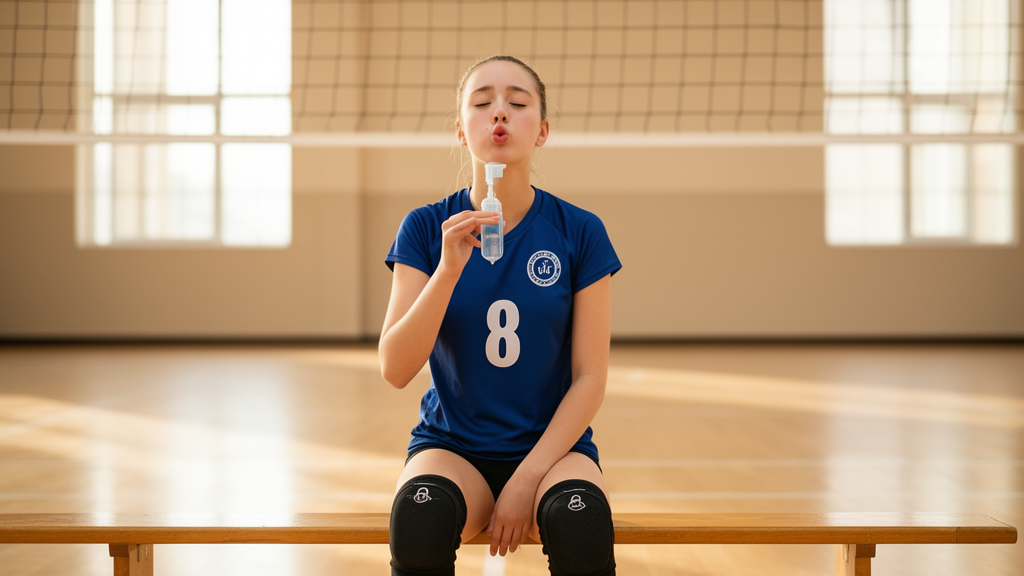
The diaphragm is the engine of human breathing, a dome-shaped sheet of muscle that contracts roughly twenty thousand times a day, and for athletes it carries an additional burden: during intense exercise, the respiratory muscles must work harder while the muscles of the limbs compete with them for blood flow. A new randomized controlled trial from Turkey now offers one of the most detailed looks yet at what happens when adolescent athletes deliberately train this hidden engine, comparing two rival approaches, inspiratory muscle training and expiratory muscle training, head to head. The findings, published in BMC Pediatrics, suggest that both methods produce measurable structural and strength gains in the breathing apparatus within a remarkably short window of just four weeks, and that the specific direction of the training load may matter less than simply challenging the respiratory muscles at all.
The research team, led by Zeliha Celik of Amasya University together with colleagues from Nigde Omer Halisdemir University, Gazi University, and Gazi University’s pulmonary medicine department, recruited 26 adolescent female volleyball players for the trial, which was registered at ClinicalTrials.gov under identifier NCT06759779. The participants were randomly assigned to one of two groups. One group performed inspiratory muscle training, known as IMT, which uses a handheld resistance device that makes it harder to draw air into the lungs, forcing the diaphragm and other inspiratory muscles to work against a load much as a bicep curls a dumbbell. The other group performed expiratory muscle training, or EMST, which instead adds resistance to breathing out, targeting the abdominal muscles and internal intercostals that power forced exhalation.
Both interventions followed an identical schedule: four weeks of training, five days per week, twice daily. That brevity is one of the study’s most striking features. Many training adaptations in skeletal muscle take eight to twelve weeks to become detectable, yet the researchers were able to document changes in respiratory muscle structure and performance after only a month of added work, layered on top of the athletes’ regular volleyball training. This compressed timeline matters for practical coaching, because competitive seasons are short and any supplementary program must deliver results without disrupting the existing schedule.
What sets this trial apart from much of the earlier respiratory training literature is its measurement strategy. Rather than relying solely on performance numbers, the team used ultrasonography to peer directly at the diaphragm, measuring its thickness during both inspiration and expiration as well as its stiffness. Ultrasound has become an increasingly valuable window into respiratory muscle physiology because the diaphragm, sitting deep inside the torso, is otherwise difficult to examine in living people. When the diaphragm contracts, it thickens, and the degree of thickening correlates with the force it generates. Stiffness, assessed with shear wave or elastographic techniques, offers clues about the muscle’s passive and active mechanical properties. Combining these imaging measures with classic pulmonary function tests gave the researchers a two-dimensional picture: what the respiratory system can do and what the muscle driving it actually looks like.
The results were clear on several fronts. The researchers observed significant time effects for diaphragm thickness during both inspiration and expiration, meaning that across the whole study population, the diaphragm became measurably thicker over the four weeks regardless of which training style the athletes had followed. The same pattern held for respiratory muscle strength: maximal inspiratory pressure, or MIP, and maximal expiratory pressure, MEP, both improved significantly over time, with p values below 0.001 indicating a very low probability that these changes arose by chance. MIP and MEP are the standard clinical gauges of respiratory muscle strength, essentially the maximum suction a person can generate breathing in and the maximum pressure they can push out, and gains in both suggest that the training load, whichever direction it came from, strengthened the entire respiratory pump.
Perhaps the most scientifically interesting finding, however, is what did not differ. When the researchers tested for group-by-time interactions, the statistical signature of whether one training modality outperformed the other, they found none for any of the primary outcomes. The inspiratory group and the expiratory group improved to a statistically similar degree on diaphragm thickness, on MIP, and on MEP. Diaphragm stiffness, by contrast, did not change significantly over time in either group, and neither did Tmax, the measure of respiratory muscle endurance used in the study. Pulmonary function parameters likewise showed a significant time effect only for percent-predicted peak expiratory flow, with no group-by-time interaction detected.
This absence of a differential effect invites a deeper physiological interpretation. One possibility is that the diaphragm, as the dominant inspiratory muscle, is recruited even during expiratory training, because forceful exhalation requires precise coordination of the entire respiratory cycle and the diaphragm must eccentrically control the recoil of the system. Another possibility is that four weeks is sufficient to produce general adaptations, such as improved neural drive and coordination of the respiratory muscles, that precede the more modality-specific structural changes that longer programs might reveal. The unchanged stiffness measurement hints that the adaptations observed were primarily hypertrophic and neural rather than involving alterations in the muscle’s elastic properties, though the authors note that respiratory muscle training added to regular sports training may be associated with structural and strength adaptations in adolescent athletes.
The choice of population is also significant. Adolescent female volleyball players occupy a distinctive physiological niche: they are still growing, their rib cages and lungs are developing, and volleyball demands repeated explosive efforts interspersed with short recoveries, a pattern in which respiratory muscle fatigue can subtly degrade performance by triggering the metaboreflex, a protective mechanism that shunts blood away from limb muscles when the breathing muscles struggle. Prior research in adult athletes has suggested that respiratory muscle training can attenuate this reflex and delay fatigue, but evidence in adolescents has been sparse, and studying young athletes raises particular ethical and methodological questions that this team addressed through ethics approval from the Gazi University Ethics Committee, written informed consent from both participants and their parents, and conduct in accordance with the Declaration of Helsinki.
For coaches and sports scientists, the practical takeaway is refreshingly simple. If the goal is to strengthen the respiratory pump of a young athlete, the evidence from this trial suggests that either inspiratory or expiratory resistance training, performed for a modest four weeks at five days per week in two daily sessions, can thicken the diaphragm and boost maximal inspiratory and expiratory pressures on top of a normal sport training load. The devices required are inexpensive handheld resistive trainers, and the time commitment is small compared with the hours devoted to technical and tactical work. What remains open is the question of endurance: neither training modality moved the needle on respiratory muscle endurance in this study, which may require longer programs, higher loads, or different testing protocols to detect.
The study also carries caveats worth weighing. The sample of 26 athletes is small, which limits the statistical power available to detect subtle differences between the two training modalities, and the trial was retrospectively registered, a detail the authors disclose transparently. All participants were adolescent female volleyball players, so generalizing to male athletes, older competitors, or athletes in endurance sports requires further study. Still, as one of the first randomized controlled trials to pair diaphragm ultrasound with comparative respiratory muscle training in adolescents, the work opens a promising line of inquiry: if a month of targeted breathing exercise can visibly remodel the body’s most tireless muscle, the respiratory system may deserve a far more prominent place in the training plans of young athletes than it has traditionally received.
Subject of Research: Comparative effects of inspiratory and expiratory muscle training on diaphragm structure and respiratory function in adolescent athletes
Article Title: Comparative effects of inspiratory and expiratory muscle training on diaphragm adaptations and respiratory function in adolescent athletes: a randomized-controlled study
Article References: Celik, Z., Demirtas, G., Guzel, N. A., Sendur, H. N., Keles, M. N., Karatas, N., & Kokturk, N. (2026). Comparative effects of inspiratory and expiratory muscle training on diaphragm adaptations and respiratory function in adolescent athletes: a randomized-controlled study. BMC Pediatrics. https://doi.org/10.1186/s12887-026-07817-z
Image Credits: AI Generated
DOI: 10.1186/s12887-026-07817-z
Keywords: respiratory muscle training, inspiratory muscle training, expiratory muscle training, diaphragm, ultrasonography, adolescent athletes, volleyball, respiratory function, maximal inspiratory pressure, maximal expiratory pressure, randomized controlled trial, sports physiology
News Source: Ophelia Keating. (October 9, 2026). Breathing Training Thickens the Diaphragm of Young Volleyball Players in Just Four Weeks. Scienmag.