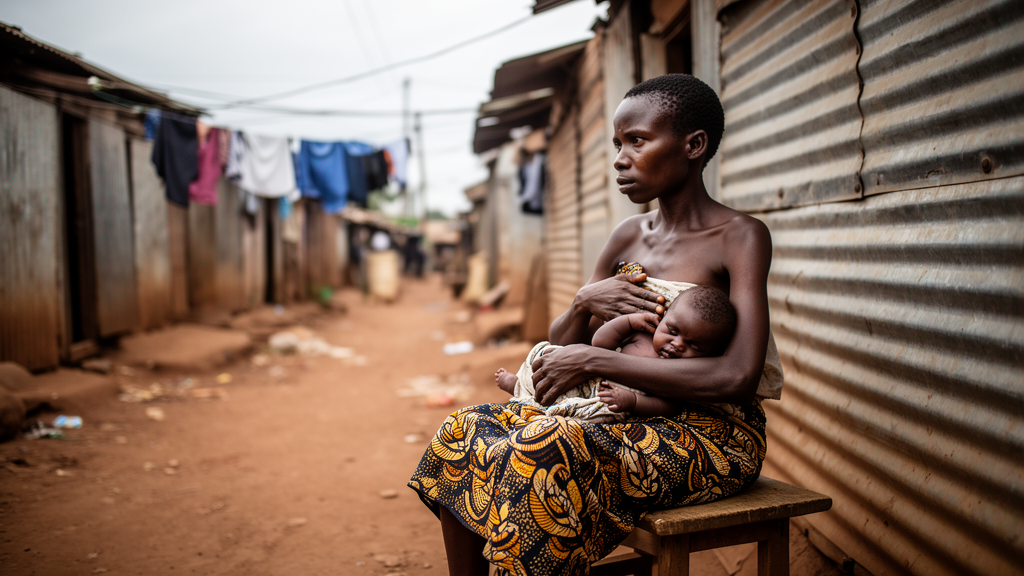
In the crowded informal settlements of Kampala, Uganda’s capital, a quiet nutritional crisis is unfolding among the very women whose bodies must sustain two lives at once. A new study published in PLOS Global Public Health has documented, for the first time with rigorous mixed-methods evidence, how common underweight is among lactating mothers living in the city’s urban slums, and which social and dietary factors push these women toward dangerous thinness. The findings arrive at a moment when urban poverty in East Africa is growing faster than the infrastructure meant to support it, and they suggest that the health of breastfeeding mothers in these settlements hinges on something deceptively simple: whether there is enough food in the house, and whether that food is varied and frequent enough to meet the extraordinary demands of milk production.
The research team, led by Saharu Magona Nerima and colleagues, conducted a convergent mixed-methods cross-sectional study involving 285 lactating mothers aged 20 to 49 years who were living in the slums of Kampala City. Convergent designs of this kind collect quantitative and qualitative data in parallel and then weave the two strands together, allowing researchers to measure not only how widespread a problem is but also why it persists. On the quantitative side, the team used multivariable modified Poisson regression to generate adjusted prevalence ratios, a statistical approach well suited to cross-sectional studies because it estimates how strongly each factor is associated with the outcome while holding the others constant. Statistical significance was set at a probability value below 0.05, and the model’s structure was guided by the UNICEF conceptual framework on maternal and child nutrition, a widely used roadmap that situates individual diets within household, community and societal conditions.
The headline number from the survey is sobering but not shocking to anyone familiar with slum health: 13.7 percent of the lactating mothers studied were underweight. The researchers characterize this as moderately prevalent, and the figure carries particular weight because lactation is one of the most nutritionally demanding periods of a woman’s life. Producing breastmilk requires hundreds of additional calories each day, along with adequate protein, vitamins and minerals. When a nursing mother’s intake falls short, her body may compensate by drawing down its own reserves, and chronic shortfalls translate into weight loss and depletion. The consequences cascade across generations, because suboptimal nutrient intake during lactation is linked not only to maternal underweight but also to reduced quantity and quality of breastmilk, threatening infant growth and development during the most vulnerable window of life.
What makes the study genuinely useful, however, is not the prevalence estimate alone but the identification of specific, measurable correlates. The single strongest risk factor was household food insecurity, which raised the prevalence of underweight by roughly 40 percent, with an adjusted prevalence ratio of 1.4 and a confidence interval of 1.2 to 1.6. In practical terms, mothers who reported that their households could not reliably access sufficient food were substantially more likely to be underweight than those who could. This finding may sound almost self-evident, yet quantifying the effect size in a lactating population matters enormously for policy, because it establishes food access as the dominant lever for intervention rather than, say, maternal education or employment alone.
Just as instructive are the protective factors the study uncovered. Mothers living in households with fewer than five members had a slightly lower prevalence of underweight, with an adjusted prevalence ratio of 0.94, a small but statistically robust effect that likely reflects the way limited food must be stretched across more mouths in larger families. More striking was the effect of eating frequency: mothers who consumed three or more meals per day had a 26 percent lower prevalence of underweight, reflected in an adjusted prevalence ratio of 0.74 with a confidence interval of 0.66 to 0.83. Dietary quality mattered as well. Women who achieved minimum dietary diversity for women, a validated indicator abbreviated as MDD-W that measures whether a person consumed foods from several distinct groups over a reference period, showed a 9 percent lower prevalence of underweight, with a ratio of 0.91. Each of these protective associations survived the researchers’ sensitivity analyses, which refitted the model using three distinct blocks of covariates to confirm that the results were not artifacts of a particular modeling choice.
The qualitative half of the study added texture and explanation to these numbers. The researchers conducted ten key informant interviews with health workers who serve the slum communities, then applied inductive thematic content analysis to identify recurring perceptions. The health workers pointed to household food insecurity and the pressures on working mothers as forces driving underweight prevalence upward. This latter theme deserves attention: in Kampala’s informal settlements, many lactating women must engage in income-generating work, often in jobs that offer no time, privacy or nutrition support for breastfeeding, and the double burden of earning and nursing can leave mothers eating last and least. On the protective side, the informants independently identified higher meal frequency, meeting the minimum dietary diversity threshold, and having fewer household members, a triangulation with the quantitative findings that strengthens confidence in the causal story the data sketch.
Triangulation is the methodological heart of the paper. By comparing what the regression models revealed with what frontline health workers described from daily practice, the researchers arrived at a coherent account of maternal undernutrition in the slums. Food insecurity sits at the center, constraining both how often a mother can eat and how diverse her plate can be. Large households dilute whatever food is available, and the demands of work outside the home compress eating opportunities. The UNICEF conceptual framework that guided the model’s prespecified structure proved a fitting scaffold, because it treats maternal nutrition as the product of immediate dietary factors, underlying household conditions and broader structural forces, all of which the study’s correlates touch in some way.
The policy implications follow directly from the evidence. The authors propose community sensitization on family planning, household food security, meal frequency and dietary diversity, delivered through integrated community outreaches. Family planning enters the list because household size emerged as a correlate, and smaller families appear to buffer mothers against underweight in settings where food is scarce. Integrated outreaches, in which nutrition counseling, family planning services and food security programming reach the same households through a single channel, are an attractive model in slum environments where health facilities are sparse and transportation is costly. The study’s specificity about meal frequency and dietary diversity also gives program designers concrete behavioral targets: encouraging at least three meals per day and varied diets built from multiple food groups, messages that can be communicated cheaply even where food itself remains expensive.
Beyond Kampala, the study fills a gap that has long frustrated urban nutrition planning. Underweight among lactating mothers in slums has been presumed higher than in other areas, but empirical data from Kampala’s settlements were limited, leaving programs to run on assumptions. By generating local prevalence estimates and locally validated correlates, the research gives Ugandan health authorities a baseline against which interventions can be measured. The moderate prevalence figure of 13.7 percent should not breed complacency, because even moderate levels of maternal underweight in a breastfeeding population signal a population under strain, and the study’s confidence intervals indicate the estimate is anchored in enough data to be actionable. As urbanization continues to swell slum populations across sub-Saharan Africa, the Kampala findings offer both a warning and a template: the nutritional status of nursing mothers can be measured precisely, its drivers can be identified statistically, and the resulting evidence can be translated into community-level action before the consequences reach the next generation.
Subject of Research: Prevalence and correlates of underweight among lactating mothers aged 20–49 years living in the Urban Slums of Kampala City, Uganda: A mixed-methods cross-sectional study
Article Title: Prevalence and correlates of underweight among lactating mothers aged 20–49 years living in the Urban Slums of Kampala City, Uganda: A mixed-methods cross-sectional study
Article References: Magona Nerima, S., Kirabo, J., Nsubuga, E. J., Nanyombi, G., Komakech, J. J., Musisi, L., Mbabazi, J., & Ddamulira, J. B. (2026). Prevalence and correlates of underweight among lactating mothers aged 20–49 years living in the Urban Slums of Kampala City, Uganda: A mixed-methods cross-sectional study. PLOS Global Public Health, 6(9), e0007389. https://doi.org/10.1371/journal.pgph.0007389
Image Credits: AI Generated
DOI: 10.1371/journal.pgph.0007389
Keywords: Prevalence, correlates, underweight, lactating, mothers, aged, years, living, Urban, Slums, Kampala, City
News Source: Daisy Hatcher. (October 9, 2026). Hunger in the Slums: Food Insecurity Drives Underweight Among Kampala’s Breastfeeding Mothers. Scienmag.